
Turning Green
The Emerald City: How The Greening Of Houston Is Transforming The Way We Live
Culture
Other
Other
Culture
Houston
More Business Wisdom
Urban Renewal
How do you create more public parks? By bringing in private partners.
By Allyn West
The Emerald City: How The Greening Of Houston Is Transforming The Way We Live
This article by Allyn West originally appeared in Rice Business, Fall 2016.
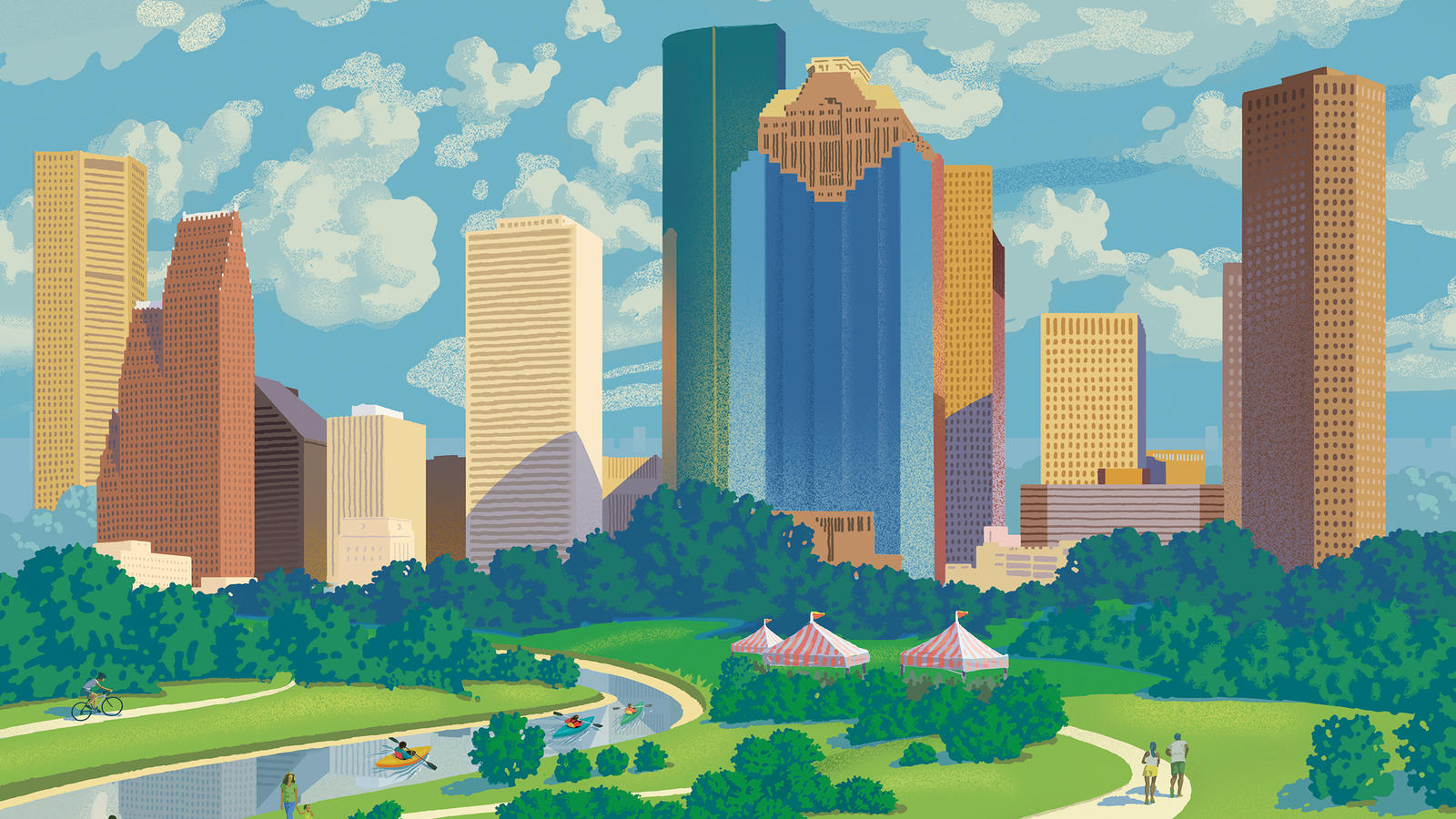
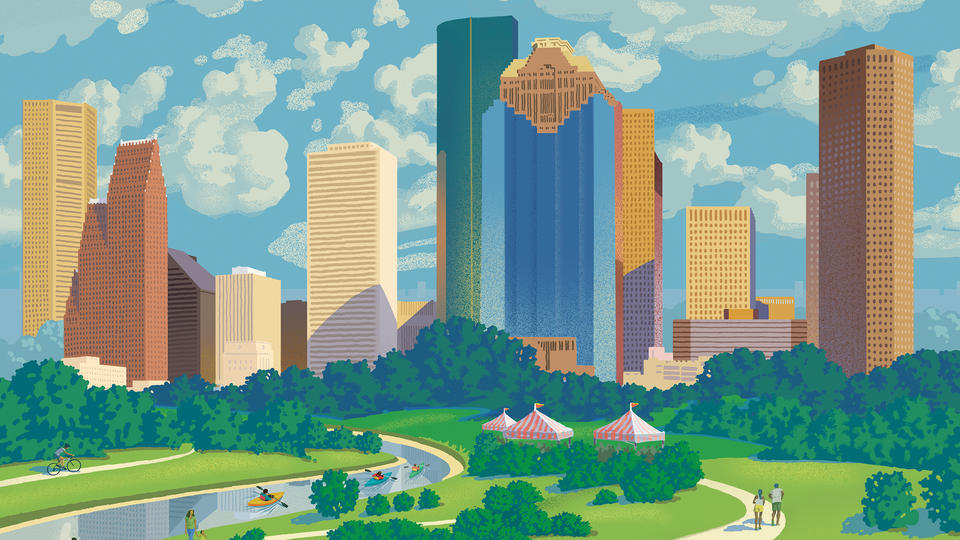
Buffalo Bayou Park feels like a perfect public space. Completed in 2015, the redesign of the park along 2.3 miles of Houston’s primary bayou incorporates 10 miles of hike and bike trails and footpaths, a dog park, public art, gardens, bike and kayak rentals, playgrounds. Visitors can tour an abandoned underground reservoir and eat brunch in a glass-walled restaurant raised on concrete pilings that makes them feel as though they’re up among the trees.
Seeing all the sweating cyclists, the parents drinking coffee and pushing strollers, the pedestrians stopping to take selfies with the skyline as a backdrop, you might not believe that this same park was an afterthought. The bayou had become blocked from view by invasive vegetation and its loved-to-death trails used — especially in the evenings — only by diehards. Large swaths of the park were inaccessible and underutilized.
In 2011, with a comprehensive master plan by SWA Group in hand, Buffalo Bayou Partnership led a $55 million redevelopment, which included a $30 million donation from the Kinder Foundation, that catalyzed its transformation into one of the country’s best urban parks. That’s according to a 2016 USA Today reader poll.
But that same poll ranked another Houston urban park even higher: Discovery Green, designed by Hargreaves Associates, came in fourth. Together, these two parks have helped to change the conversation about the city. As Texas Monthly writer Mimi Swartz quips, “Houston doesn’t look like Houston anymore.”
Once defined primarily by its freeways and parking lots and its “almost sensational lack of convivial public space,” as essayist Philip Lopate griped in the ’80s, Houston is now being celebrated as a national model for its investments in places where people can gather to relax, play and exercise. Charles Birnbaum, president and CEO of Washington, D.C.-based The Cultural Landscape Foundation, which was inspired to hold its annual conference here, writes that Houston is “undergoing a transformation … at a scope and scale unseen in the U.S. in more than a century.”
Consider: The underused Levy Park in Upper Kirby, once come to a few baseball diamonds, is being completely redesigned and reprogrammed with a $15 million investment. On the other side of town, historic Emancipation Park in the Third Ward is getting a $33 million redevelopment, including the construction of community center designed by celebrated African-American architect Phil Freelon. A private group hired landscape architecture firm West 8 to conceive of a master plan for a Houston Botanic Garden. And new master plans have been completed to restore and redesign the 155-acre Houston Arboretum and Nature Center and the 1,500-acre Memorial Park.
“It’s a great time for parks in Houston,” says Anne Olson, president of Buffalo Bayou Partnership. “The appreciation of them has grown over the years, and the business community sees more and more the economic impact that they can have.” Olson points to new residential developments currently under construction that are actively marketing their proximity to Buffalo Bayou Park.
“There’s such intense competition for Millennials,” she says. “Parks and open spaces and trails are just one more amenity that they are attracted to.”
But these parks, open spaces and trails are not cheap. Many cities have parks departments that strain to keep up with the demand, and Houston is no exception. As much as the city has been recognized for its development of these amenities, it has been praised for its innovative ways of paying for them. Adrian Benepe of the Trust for Public Land told the Houston Chronicle: “Houston has become a laboratory of interesting solutions for park building, financing and management.” The predominant solution is the public-private partnership.
The land where Discovery Green is, for example, was purchased by the City of Houston in two transactions in 2002 and 2004 on the recommendations of a pair of private philanthropists. But the park is now managed, programmed and maintained by a separate nonprofit conservancy that raises its own money and has its own staff.
Though some critics have argued that these public-private partnerships can lead to inequity, they do allow certain parks to be chosen, so to speak, so as to be better stewarded by private philanthropy, property tax reinvestment and other focused revenue streams.
There’s no doubt they’re effective: another public- private partnership was formed to lead the way on a project that could be even more transformative for Houston than any single park: Bayou Greenways. Bayou Greenways revisits a plan first developed in Houston in the early 1900s by landscape architect Arthur Comey that called for trails and linear parks along the city’s major bayous. Funded through a $166 million public bond in 2012 and private fundraising — including $50 million more from the Kinder Foundation — work is underway building these trails and transforming more than 3,000 acres of land around Houston’s bayous for use for recreation and mobility.
When the project is completed in 2020, 150 miles of trails will line the bayous, connecting neighborhoods to job and retail centers, parks, transit and more.
Beth White is president of the Houston Parks Board. “Houston is one of the most exciting places in the country right now in terms of investments the city is making in quality of life infrastructure,” she explains. “We’ve been doing all these pieces, and now we have this ability to do all this connective tissue that’s going to take this whole effort to a different level.”
White is excited about the multifaceted social and economic impacts that the Bayou Greenways might have, from improvements in public health to increases in property values to investments in neighborhood parks. She imagines that Bayou Greenways will have an effect on Houston similar to that of other ambitious urban projects like The High Line in New York City or the 606 in Chicago.
Not only will the project spark development, White says, it will transform the way the city “views itself and the way it lives. This will have an impact on people wanting to stay here. The power of visionary systems to make cities livable places cannot be overstated. It’s extraordinary."
Rice Business Wisdom Newsletter
Never Miss A Story
You May Also Like

Real Estate | More Business Wisdom
Why does a horde of housecats have their own tiny house?
After Harvey | More Business Wisdom
Raising the curtain when your artistic vision has been swept away.
Keep Exploring
Contains Video
No
Hide Date
Yes
A Seat At The Table
Rice Business Ranked In The Top Ten Business Schools by Bloomberg Businessweek
Other
Other
Other
More Business Wisdom
Business School Rankings
Rankings, though illusory in many ways, can make a difference for business schools.


By Claudia Feldman
Rice Business Ranked In The Top Ten Business Schools by Bloomberg Businessweek
It’s dusk at the Jones Graduate School of Business at Rice University.
From an outdoor patio, voices, laughter, drift skyward. As darkness falls and the crowd grows, Peter Rodriguez, the school’s new dean, appears. Behind him wait large quantities of champagne, perfect for toasting.
Bloomberg Businessweek has just ranked Rice Business’ full-time MBA program No. 8 in the country, allowing a young Sun Belt business school to shake up a top 10 list that has seen little change for decades.
While all school rankings are somewhat illusory, breaking into the top tier, on this particular list, may be transformative for the small school.
“However flawed these rankings are — and every single one has significant issues associated with them — these lists have a very big impact on a school's reputation and standing,” says John Byrne, who in 1988 created the first regularly published MBA ranking for Businessweek.
Breaking into the magic circle, it turns out, can translate into surprisingly tangible results. A top 10 ranking draws increased and more-qualified applications, heftier donations, and more plentiful corporate recruiters. It encourages minority candidates — underrepresented in business schools nationwide, and courted through recruiting and scholarships — to see the newcomer school as an option.
There’s also a less-tangible aura to such lists. Historically, most of the schools on top 10 lists have simply swapped places in a kind of grad school musical chairs. Rice Business is not only the rare upstart to grab a seat, it’s the youngest. And it has moved into its new spot very fast.
On the Businessweek list, Rice was No. 19 last year, No. 29 in 2010 and not ranked at all in 2006. It topped venerable business programs at Northwestern, the University of Virginia, Columbia and the University of Michigan. Rice even topped Yale, which made its own meteoric jump, from No. 25 in 1990 to No.10 in 2009, on the similar MBA list compiled by U.S. News & World Report.
***
When schools win in this poker game of sorts, they win big. But if they lose, says Byrne, now editor-in-chief of Poets & Quants, the pain can be sharp. Slipping a few percentage points can mean a drop in applications and alumni giving, even threaten the job security of a school’s top leaders.
Before any dean breaks out in hives, though, Byrne offers this advice: “Treat rankings with a big grain of salt. A school's rank on one survey in one year is pretty much meaningless. What's important is a school's rank over time and over multiple rankings. That is how rankings get to the greater truth about where an institution truly stands among its competitors.”
The Rice alumni surveyed this year, accounting for 30 percent of their school’s ranking index score, represented the classes of 2008, 2009 and 2010. The Houston economy seemed recession-proof during those years. Jobs were abundant and salaries stable.
More recently, Houston has been hurt by a struggling energy sector, “which could affect Rice’s scores down the road,” says Lance Lambert, the business school ranking coordinator for Bloomberg Businessweek. “The rankings are really lagging indicators.”
***
Not to worry, says popular culture guru Robert Thompson, who was only mildly surprised when he saw Rice nipping at the heels of the likes of Harvard in the latest Businessweek ranking. .
“It’s not like I spit out my coffee,” says Thompson, trustee professor of television and pop culture at Syracuse University. “On one level, the success of a relatively new university in a Sun Belt city might look like a real cultural shift. But it’s not like Rice is chopped liver.”
Thompson says the mystique associated with iconic universities of the Northeast is fading, “depending on how old you are, where you’ve been and what you know,” while schools such as Rice are on the move and catching up. “I think of Rice as one of the hoity-toity, mystique places now,” says Thompson.
The challenge for Rice, most experts agree, is to keep or improve their seat at the rankings table — while remembering that the strength of the program has everything to do with imagination and hard work and little to do with any list.
Sipping their champagne and pinching themselves this fall evening, Rice Business students and professors perhaps are thinking the same thing. “I’m stunned,” says Rodriguez during a short speech in which he repeats the words “thank you” five times.
Rodriguez arrived on campus in July; he tells students he had little to do with the new ranking. Instead, he gives credit to his predecessor, William Glick, and suggests that they all enjoy the festivities, then get back to work.
“We have to do it again,” Rodriguez says. “We have to prove we’re not a blip.”
Claudia Feldman is a freelance writer living in Houston and editor of the Last Word, a service that helps people tell their own stories.
Rice Business Wisdom Newsletter
Never Miss A Story
You May Also Like
Investing | Finance
A new study finds that “look-ahead bias” makes trading strategies appear highly profitable in published research, even though they fail in the real world.

Sustainability | Marketing
How well-placed reminders help consumers build sustainable habits.
Corporate Responsibility | Organizational Behavior
“Social mandates” can make a company’s response seem more genuine.
Keep Exploring
Contains Video
No
Hide Date
Yes
What Weather Can Teach Us About Market Volatility
In weather-sensitive commodity markets, prices fluctuate even when trading is closed. That gives researchers new evidence that information flow plays a major role in volatility.
Faculty Research
Finance
Finance
Finance and Investing
Finance
Commodities
In weather-sensitive commodity markets, prices fluctuate even when trading is closed. That gives researchers new evidence that information flow plays a major role in volatility.


Based on research Jeff Fleming (Rice Business), Barbara Bennett (Rice Business) and Chris Kirby (Clemson University)
Key takeaways:
- Researchers have long struggled to parse the separate roles of information and human trading activity in causing market price fluctuations.
- Unlike most financial markets, which are affected by a news cycle that follows the flow of the business day, weather-sensitive commodity markets are buffeted by important information flow 24/7.
- Taking advantage of this trait in weather-sensitive markets, researchers have discovered that information plays a big role in price fluctuations.
Market volatility has long perplexed business and economics researchers. According to basic economic principles, prices should reflect available information. Thus, price changes ought to reflect the news. But two complications make it hard to test this idea.
The first difficulty is that much of the news goes unobserved: It doesn’t show up in headlines or even in a tweet. The second is that prices only change when there is trading – and traders trade for many reasons.
In most markets, most news happens during the trading day. As a result, researchers struggle to discern how much price fluctuations are due to the news and how much they’re due to traders over- or under-reacting to the news. And then there’s the question of how much the fluctuations are related to trading activity that’s not linked to the news at all.
Weather-sensitive commodity markets give researchers a chance to make this distinction. In contrast to equities and currencies, weather-sensitive commodities are affected by information that changes randomly over a 24 hour cycle. In addition, the importance of weather news varies across the year. This means researchers can study the changing contribution of information flow throughout the year.
According to groundbreaking research coauthored by Jeff Fleming and Barbara Ostdiek, both finance professors at Rice Business, weather news influences price fluctuations of weather-sensitive commodity markets in ways that can’t be chalked up merely to trading.
Fleming and Ostdiek measured price variations in the corn, soybean, wheat, natural gas and frozen concentrated orange juice markets during the trading day and overnight, when the markets were closed. They then analyzed the overnight share of volatility in comparison to the trading day share of volatility. They found that the share of price fluctuation that took place overnight versus that occurring during the day was much greater than in the U.S. stock market. The finding is consistent with the idea that information about the weather is a substantial factor in moving prices.
The researchers also found that the importance of weather news varies throughout the year. For instance, the weather-sensitive season for wheat runs from March 15, when the crop begins sprouting, to August 31, when 75 percent of the wheat likely has been harvested. Wheat prices are far less sensitive to weather when no crops are in the ground. As a result, the share of volatility occurring overnight falls dramatically in the off-season.
Using traditional equity and currency markets as benchmarks, the researchers found commodity markets depend on weather and their unique news cycles in key ways.
According to past research, stock market returns during the open trading period are more variable than returns from the weekend and overnight. Some researchers have theorized this is because traders are more likely to be informed of, and act on, private information during the day. Other researchers have linked the discrepancy to the large amount of public information that’s at hand when trading is taking place.
In contrast to equity markets, currency markets are open 24/7 and benefit from a never-ending information flow as the news cycle moves around the globe. Compared to stocks, the variability of currency markets during U.S. trading hours is much closer to its variability during non-trading hours. This is consistent with a link between price volatility and information flow.
The takeaway: Irrational trading activity can’t explain these variations, but the unique patterns of the information flow in the different markets can.
Contrary to previous findings, the scholars discovered a strong link between price fluctuations and information flow – a link that can’t be explained by pricing errors or trading activity.
Not only does this information flow affect market volatility, the researchers found it also influences the interactions between different commodities. Returns on corn, wheat and soybean commodities were more strongly connected to each other during the weather-sensitive season – both during the trading day and overnight – which is consistent with the idea that weather information is a primary driver of price fluctuations in weather-sensitive commodity markets.
Fleming, Ostdiek, and Kirby (2006). “Information, Trading and Volatility: Evidence From Weather-Sensitive Markets,” Journal of Finance.
Interim Dean
Fayez Sarofim Vanguard Professor of Finance
Fayez Sarofim Vanguard Professor of Finance
Professor of Finance and Statistics
Director of MBA@Rice
Academic Director of Healthcare Initiatives
Director of MBA@Rice
Academic Director of Healthcare Initiatives
Rice Business Wisdom Newsletter
Never Miss A Story
You May Also Like
Policy | Accounting
A new SEC proposal would let companies report semiannually instead of quarterly. Four scholars make the case for letting companies choose their reporting cadence, and for protecting safeguards.

Innovation | Finance
A new study suggests regions trying to attract venture capital may need to start with commercializable university innovation.

Negotiations | Finance
New research shows how firms use hurdle rates differently in practice than finance theory predicts.
Keep Exploring
Contains Video
No
Hide Date
Yes
Bursting the Bubble
Limited competition may have fanned the flames of the 2008 financial crisis.
Accounting
Faculty Research
Finance
Accounting
Accounting
Finance and Investing
Accounting
Subprime Mortgage
Limited competition may have fanned the flames of the 2008 financial crisis.

Based on research by Brian Akins (Rice Business), Lynn Li (Boston University), Jeff Ng (Singapore Management University), and Tjomme Rusticus (London Business
School)
Key takeaways:
- Low levels of competition in the banking industry make it likelier that banks will engage in riskier activities — and, ultimately, collapse.
- States with lower levels of banking industry competition saw greater housing price inflation during the 2007-2008 financial crisis.
- In states with higher levels of competition, housing price fluctuations were mitigated.
When banks become “too big to fail,” does their size empower them to take risks smaller banks wouldn’t?
It’s easy for Monday-morning quarterbacks to blame the economic collapse of 2007-2008 on bloated financial institutions who lacked rivals to keep them on their toes. But research co-authored by Brian Akins, a professor at Rice Business, applies classic economic measures of competition to determine whether oversized banks and limited competition played a key role in the building — and bursting — of the housing bubble.
Akins’ research does, in fact, link a lack of competition in the banking industry with riskier bank investments, a higher level of regulatory intervention, and, ultimately, bank failure. It also associates low levels of banking industry competition with housing price inflation and steeper housing price declines during the 2007-2008 financial crisis.
While the results may seem intuitive — especially in hindsight — several economic theories actually predict the opposite. For example, the charter value hypothesis presumes that large banks have correspondingly large charter values, and hence have more to lose in case of failure. The theory predicts that larger banks are therefore motivated to counter the potentially massive potential for failure by engaging in lower-risk activities. An increase in competition, the theory holds, would lower the bank’s charter value and free it to engage in riskier investments.
But this theory’s detractors argue that it ignores the effect of bank competition on borrowers’ behavior. According to a counter theory, as the lending market becomes more concentrated, banks use their market power to charge higher loan rates, leading to an increase in their interest margin. Higher loan rates increase the probability of bankruptcy for borrowers — and the increased likelihood that they’ll default on their loans reduces bank stability.
Akins and his colleagues set out to conduct a comprehensive examination of the relationship between banking industry competition and financial stability in the United States — specifically, the impact of competition on individual bank outcomes and on the housing and mortgage market within states.
Their first round of analysis demonstrated that just before the 2008 crisis, more competition was associated with lower interest margins, a less risky portfolio of assets, lower profitability and lower liquidity. During the crisis, more competition was associated with less risk-taking, and, consequently, a lower likelihood of enforcement actions and bank closure.
In a second layer of analysis, the researchers examined the relationship between competition and changes in housing prices before and during the crisis. They found that greater competition led to higher mortgage rejection rates, especially for the highest-risk mortgages. More competition, the authors concluded, seemed to have a disciplinary effect that mitigated the housing price inflation before the crisis and the deflation afterward.
So the Monday-morning quarterbacks are right — and Akins’ study provides the data to prove it. A lack of competition, these results suggest, fueled the hyperinflation of housing prices, their subsequent collapse, and the devastating effects for the U.S. financial system and economy that still linger a decade later.
“Bank Competition and Financial Stability: Evidence From the Financial Crisis,” Journal of Financial and Quantitative Analysis (2014).
Rice Business Wisdom Newsletter
Never Miss A Story
You May Also Like
Policy | Accounting
A new SEC proposal would let companies report semiannually instead of quarterly. Four scholars make the case for letting companies choose their reporting cadence, and for protecting safeguards.
CEO Compensation | Accounting
When companies break loan terms, boards adjust CEO pay to focus on stabilizing finances.
Corporate Disclosures | Accounting
In years with strong performance, corporate disclosures are more helpful for stock price discovery — in bad news years, not so much.
Keep Exploring
Contains Video
No
Hide Date
Yes
Shining A Light
A New Perspective On Energy
Energy
General Management
General Management
More Business Wisdom
Energy Policy
A new perspective on energy and politics.


By William M. Arnold
A New Perspective On Energy
This article by Bill Arnold, the late professor in the practice of energy management at Rice Business, originated as an interview with Pipeline & Gas Journal, November 10, 2016.
Deciphering a political candidate’s policies is never simple. A party’s platform may be used to give voice to supporters (especially the potentially disaffected) rather than reflect a candidate’s real intentions. Candidates can always claim that “circumstances have changed” once they are in office. Of course, it is easier to make a judgment about someone who has held office and built a track record. In the case of Donald Trump it may seem as though we are dealing with a blank sheet.
But maybe not.
In the case of President-elect Trump, his “America First” position and goal of restoring well-paid jobs provide a basis to project his actions in a number of areas. This is not a data-driven approach but is more like the scenario planning that is used widely in the energy industry. What are some plausible energy policies in a Trump administration?
Admittedly, energy was not a prominent point in the presidential debates, because voters are relatively content with low prices for gasoline, natural gas and home heating oil. The producing states may have suffered hundreds of thousands of job losses, but the rest of the country is unsympathetic. Still, energy policy is a crucial part of government, and Trump will bring a new perspective on energy. It will be in sharp contrast to the policies of the Obama administration.
The tools he will have to implement his policies include the Republican majorities in the Senate and House of Representatives. A caveat: This is never as simple as it sounds, given the increasing independence of members of Congress and the bruises inflicted over the past year. At some point there will be pushback.
Presidential appointments will put Trump’s people in senior positions throughout the bureaucracy, and not just at the Cabinet level. Trump’s team will place about 3,500 people across the administration. Several hundred require Senate confirmation, but another 3,000 are discretionary. The latter includes scores of deputy assistant secretaries in every department from defense to agriculture.
Some of Trump’s actions will be part and parcel of broader initiatives. Until being pushed aside recently, Chris Christie quietly led the transition team in consultation with Newt Gingrich and Rudy Giuliani. Undoubtedly they have compiled a long list of Obama executive orders that will be cancelled on day one.
On climate change, Trump’s supporters apparently run from skeptics to deniers. This will have a big impact for the Environmental Protection Agency, the Department of Energy, the Department of the Interior and the new administration’s response to last December’s Paris Agreement (COP-21). The administration will almost certainly:
- Clean house at EPA and energy, replacing advocates of aggressive climate policies with officials who have an agenda friendlier to fossil fuels.
- Declare an end of the Obama administration’s war on coal. Trump owes Pennsylvania and the region that gave him an Electoral College majority.
- Leave the regulation of fracking with the states.
- Open more public land to energy development.
Trump has advocated that Fortune 100 companies “come back to America” (especially bringing back profits held overseas). One fairly easy step in this process would be to encourage energy companies to invest in energy development in the U.S. instead of overseas. They already are doing that, but Trump could take some credit with supportive policies.
Trump’s political philosophy is unclear. But conservatives in his inner circle will insist that market forces, rather than executive orders and regulatory mandates, determine the allocation of coal, natural gas and nuclear for use in power plants. This is already happening. Cheap and abundant natural gas is forcing coal out of power generation, and nuclear plants are shutting in quick succession because of obsolescence and economics.
Trump’s philosophy will also show itself in his response to the Paris Agreement. Through the substitution of natural gas for coal, CO2 emissions from U.S. power plants have reached a 20-year low. Energy efficiency and related measures mean improved energy intensity in this country. By contrast, Germany’s CO2 emissions are increasing despite two decades of focus on renewables. Chancellor Angela Merkel closed about half of her country’s nuclear power plants in response to the disaster at Fukushima, with no ready backup. So Germany resorted to lignite coal.
In a Trump administration U.S. subsidies for wind and solar will be under increased scrutiny, just as costs have come down to sometimes competitive levels. Expect a vibrant debate.
The linkage between Supreme Court nominations and energy policy is most apparent in the Obama administration’s Clean Power Plan. The late Justice Antonin Scalia tipped the 5-4 vote to suspend implementation because costs were not adequately considered. It is in limbo now.
President-elect Trump’s clear position on “America First” will translate into a focus on energy security and affordability. Germans and the British pay about two times what we do for electricity and gasoline.
Low cost natural gas has given rise to tens of billions of dollars of investment in the Houston area’s petrochemical and refining industries even as the upstream industry suffers job losses and capital investment cuts.
Pipelines are the literal backbone of the American economy. They link consumers and industry to abundant North American resources. They also enable exports of natural gas and oil, supporting our balance of payments. But they are often resisted by local communities and national organizations. For safety and environmental reasons pipelines are clearly better than rail and trucking to take oil from North Dakota.
Those who try to block pipelines want to “keep it in the ground.” “It” means hydrocarbons. Advocates of this position believe that limiting infrastructure will minimize production and open more opportunities for renewables.
President-elect Trump may support the Keystone XL Pipeline, but that raises the question of whether TransCanada will want to invest now that oil prices are low and the cost of oil sands is still higher than other available sources. Was the opportunity for thousands of jobs missed or deferred?
A complex issue may be gas exports to Mexico — and not only because of other well-known political issues involving Mexico. Exports are big now and pipeline projects will grow in the medium term. This would seem to be uncontroversial for the new administration — more U.S. oil patch jobs, improved balance of payments, etc. But gas exports to Mexico might be viewed negatively if Mexico uses cheap U.S. natural gas for industrial development that competes with the U.S. heartland. There has even been talk about using this gas for LNG export facilities on Mexico’s west coast or Baja California in competition with Corpus Christi and Sabine Pass, Louisiana. This could result in calls for an export tax on natural gas.
Finally, energy will not be at the top of President Trump’s agenda. Pressing issues of national security, terrorism, restoring good jobs and replacing the Affordable Care Act will have his attention.
William Arnold was a professor in the practice of energy management at the Jones Graduate School of Business at Rice University.
Rice Business Wisdom Newsletter
Never Miss A Story
You May Also Like
Corporate Reputation | Strategy
As corporate value has become more intangible, leaders have less control over how their organizations are perceived. Anastasiya Zavyalova explains what that means for reputation strategy.
Corporate Social Activism | Marketing
Research offers a new framework to help CEOs decide if, when and how to engage in politics.
Safety and Compliance | Strategy
Many companies treat safety training as a compliance requirement. But new research shows that making safety a strategic priority can actually create value for employees, customers and shareholders.
Keep Exploring
Contains Video
No
Hide Date
Yes
Rice MBA ranked among top 10 in US for first time
School Updates
Rankings
School Updates
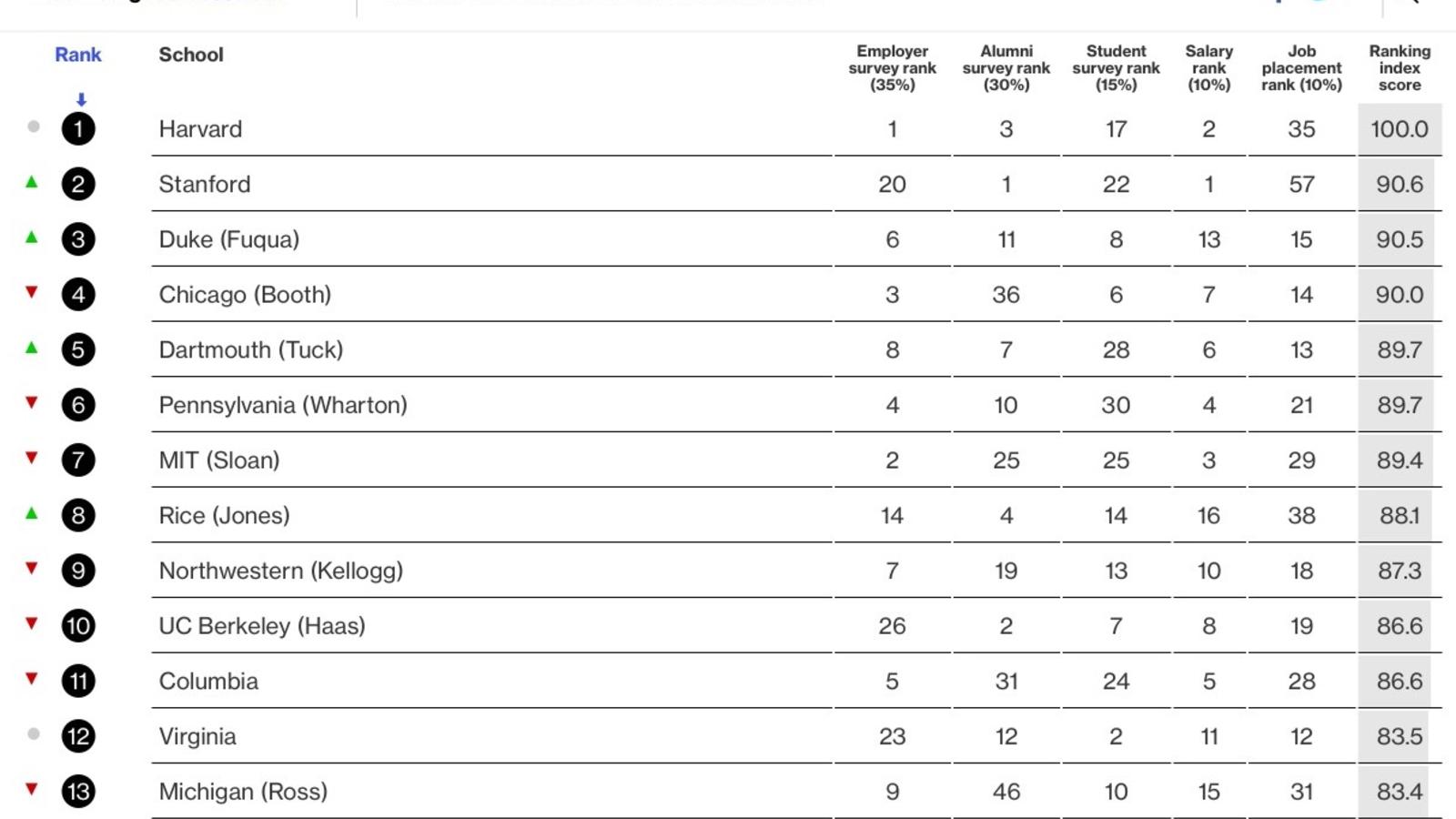
The Master of Business Administration program at Rice University’s Jones Graduate School of Business is ranked No. 8 (up from No. 19 in 2015) in Bloomberg Businessweek’s new analysis of the best full-time MBA programs in the nation. This marks the MBA program’s first top 10 ranking.
Jeff Falk
MBA program moves up 11 in Bloomberg Businessweek’s national ranking
The Master of Business Administration program at Rice University’s Jones Graduate School of Business is ranked No. 8 (up from No. 19 in 2015) in Bloomberg Businessweek’s new analysis of the best full-time MBA programs in the nation. This marks the MBA program’s first top 10 ranking.
The designation places Rice Business among the nation’s most distinguished business schools, including those at Harvard, Stanford, Duke, Chicago, Dartmouth, Pennsylvania and MIT. The rankings include 87 full-time U.S. schools.
To determine which business schools offer the strongest education and best prepare MBAs for their careers, Bloomberg Businessweek ranked the full-time MBA programs on five measures: a survey of employers who hire the school’s graduates (35 percent of the ranking); a survey of program alumni satisfaction (30 percent); a survey of current student satisfaction (15 percent); the Class of 2015 placement rate three months after graduation (10 percent); and the starting compensation for the Class of 2015 (10 percent).
The biggest contributor to Rice Business’s rise in the overall full-time ranking was the positive assessment by employers, current students and alumni; alumni ranked the program No. 4 and employers and students ranked it No. 14.
Rice’s full-time MBA program gives students a comprehensive learning experience that mixes specialized coursework and real-world experience. The program features innovative classes, expert faculty and diverse classmates who become lifetime colleagues.
Rice Business is consistently recognized by several rankings publications for its programs, including the Rice MBA, Rice MBA for Executives and Rice MBA for Professionals. The school is internationally known for the research and thought leadership of its faculty. For more information on Rice MBA programs, visit http://business.rice.edu.
To view the complete Bloomberg Businessweek rankings and methodology information, visit http://Bloomberg.com/bestbschools2016.
For more information about and insights from Rice Business faculty research, visit the school’s Rice Business Wisdom website, http://ricebusinesswisdom.com.
Contains Video
No
Hide Date
No
Optimizing on the Battle Field and in the Field of Finance
Finance
After a stint in the U.S. Army, Patrick Hamel ’16 majored in mathematics/operations research at West Point, graduating in 2004. He stayed in the service for a decade more, completing assignments in Iraq and Afghanistan.
Holly Beretto
After a stint in the U.S. Army, Patrick Hamel '16 majored in mathematics/operations research at West Point, graduating in 2004. He stayed in the service for a decade more, completing assignments in Iraq and Afghanistan.
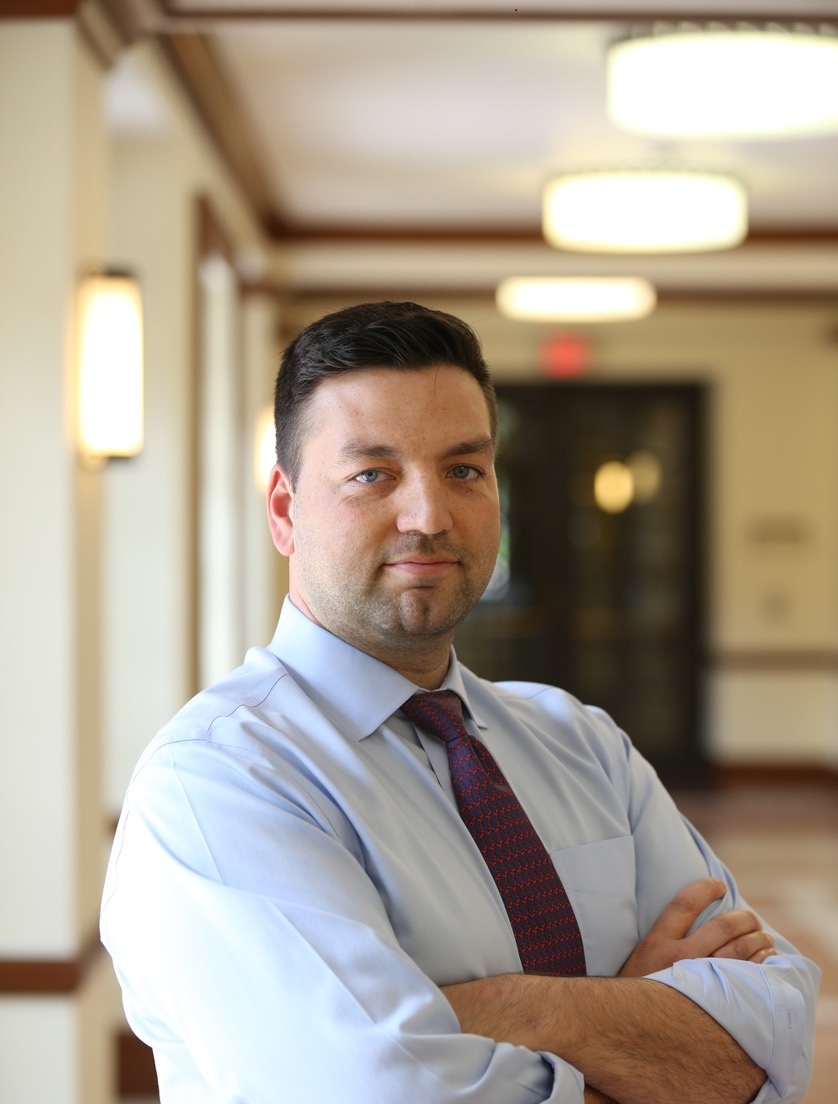 “Operations research is essentially optimization and problem solving of complex systems in a quantitative manner,” he said. “For example, modern portfolio theory is based on a mean-variance optimization problem of selecting the optimal mix of securities to maximize returns with the lowest level of volatility. In other words, how can you maximize return while minimizing portfolio variance?”
The work intrigued him so much, he decided to learn about investing which, to him, seemed similar. He left the Army and decided to earn a coordinated MBA/ME degree.
“I’d applied to the University of Chicago as well,” he said. “I knew I wanted a rigorous program that would give me a great deal of depth into the topic. My wife [Melanie Lunsford ’08] received her Ph.D. in psychology at Rice, so we were familiar with the school.”
The coordinated-degree program allowed Hamel to tackle both theoretical and real-world applications. On the MBA side of the equation, he worked in teams on projects and developed quantitative solutions to projections. And while studying statistics, he was able to achieve more in-depth qualitative analysis to modeling and predictions.
“All of my statistics classes focused on investing in some way,” he said. “And that gave me a tremendous foundational knowledge that I didn’t have before.”
Hamel is now an investment specialist at JPMorgan Chase & Co., a position he started in July. Right from the start, he said he’s seen his coordinated degree pay big dividends. His role with the company is helping clients develop investment strategies, constructing portfolios using equity, fixed income, alternative investments, currencies and derivatives.
“I can’t overstate how much the MBA/ME program prepared me,” he said. “From understanding the mechanics behind derivatives pricing, quantitative portfolio construction, and fundamental, bottom-up equity analysis, I had the opportunity at school to take courses covering all aspects of markets, from economics, business and statistics, to Ph.D.-level finance courses. And I was able to participate in the student-managed investment fund and quantitative portfolio competitions.”
Armed with that experience, Hamel knows he’s ready to take the next steps in his career.
This article by Holly Beretto originally appeared in Rice Engineering, Fall 2016.
Contains Video
No
To Save More, Stop Thinking of Time as a Straight Line
Research suggests that people save more when they see the future as a recurring cycle, rather than a distant destination.
Faculty Research
Finance
Finance
Finance and Investing
Psychology
Marketing
Personal Finance
Research suggests that people save more when they see the future as a recurring cycle, rather than a distant destination.


Based on research Utpal Dholakia and Leona Tam (University of Wollongong)
Key takeaways:
- Americans who based their savings on a cyclical time orientation had a 78% higher savings rate than those who followed a more traditional Western orientation.
- A cyclical world view encourages savings in part because it offers less optimism about the future.
- A cyclical orientation could help financial and retirement planners better advise their clients.
Western culture tends to view life as a line. Plan now, we’re taught, to better control what lies down the road. Other cultures, though, particularly those in Asia, see life as a circle. The change of seasons, the wheeling of planets above, all are echoed in human lives. We start as babies, then grow old and helpless again. We live, die and replaced by our children. It’s a world view expressed by the lunar calendar, in contrast to the Western calendar with its linear march of weeks, and months.
Adopting the cyclical view, it turns out, would change more than just our perspective. According to Utpal M. Dholakia, a marketing professor at Rice Business, it could improve personal finance. In a recent paper, Dholakia and coauthor Leona Tam of the University of Wollongong, propose that Westerners can improve savings by thinking circularly.
Definitely, some new direction is called for: Americans’ personal savings rate has hovered near five percent for much of the past decade, far below the amount needed to retire comfortably. In contrast, savings rates of 20 percent and more are the norm throughout Asia. Maybe, Dholakia and his coauthor proposed, a different concept of time might turn things around.
Most Western savings plans look at time linearly. Advisors urge setting goals, moving on from mistakes and planning systematically for the future. In Asia, however time is not seen as racing down a line toward a future. Instead, life goes round in circles, reliably presenting opportunities, problems and risks, month after month.
To test if these views influenced savings, the researchers randomly assigned American subjects to two groups and instructed them to save based on two sets of advice. The “cyclical” group was told to view life as large and small cycles, and to expect the future eventually to look a lot like the present. If they performed a savings action in right now, they were told, they would be more likely to perform it in the next time cycle.
The “linear” group was told to see time as a road. Its length would be marked by completed goals and benchmarks. If they took action to save now, these subjects were told, they’d be better prepared for the future. On the other hand, if they didn’t act now to save, they would have to catch up.
Metaphysical as it sounds, this varied guidance created tangibly different outcomes. The subjects who saved based on the cyclical model saved a full 78 percent more than did the subjects following the linear model.
A second study gave insight into the savings process. In this research, Dholakia and Tam found, a less optimistic world view actually was preferable: People who were optimistic about the future put off saving until some imagined future time when they expected to have more money and more control of their financial life. Gloomier subjects saved aggressively, because they expected little or no improvement in life as it was.
Needless to say, much in these findings defies U.S. conventional wisdom. Seeing life as a road and the future as the chance for a do-ever, this thinking goes, inspire us to save. Instead, the evidence suggests, that thinking is magical. It still begs the question: How likely is it that Western financial planners, retirement counselors, and families will rethink the concept of time? It’s not impossible, as research increases and Asian immigrants become more part of the American mainstream. There’s nothing like 78% more in the bank to focus the mind.
“Saving in Cycles: How To Get People To Save More Money,” Psychological Science (2014).
George R. Brown Professor of Marketing
Marketing Area Coordinator
Marketing Area Coordinator
Rice Business Wisdom Newsletter
Never Miss A Story
You May Also Like
Policy | Accounting
A new SEC proposal would let companies report semiannually instead of quarterly. Four scholars make the case for letting companies choose their reporting cadence, and for protecting safeguards.
Innovation | Finance
A new study suggests regions trying to attract venture capital may need to start with commercializable university innovation.
Negotiations | Finance
New research shows how firms use hurdle rates differently in practice than finance theory predicts.
Keep Exploring
Contains Video
No
Hide Date
Yes
Slow Going
The Long and Winding Road: Travel Joins the Slow Revolution
Culture
Other
More Business Wisdom
Travel Trends
The long and winding road: Travel joins the slow revolution.


By Sarah Viren
The Long and Winding Road: Travel Joins the Slow Revolution
This article first appeared in Fall 2016 Rice Business magazine. Sarah Viren is a professor at Arizona State University and author of the book MINE.
When Chris Bolding took her family to Panama on a recent vacation, she made sure they stopped by the famous canal. But after that, she, her husband and their three teenage kids did their best to stay off the beaten path. They traveled through the mangroves with local guides, wandered into a bat cave where the water went up to their chests, visited a little-known coffee plantation, and spent a long weekend on a remote island without any cars that they could see or—as they soon learned—ATM machines. At one point, Bolding’s husband embarked on a four-hour boat ride to another island to get cash, but even that inconvenience was worth it, says Bolding, a Rice Business graduate (’98) with more than 18 years of experience working in the travel industry.
Though Bolding probably wouldn’t have classified her vacation as such at that time, her Panama trip is a good example of a relatively new tourist trend known as “slow travel.” Rather than flying in and out of a tourist hot spot for a rushed week of must-see sites, slow travelers try to live by that age-old adage about the journey trumping the destination or experience being more important than acquisition. They advocate taking the scenic train through the Alps, spending a month walking the Appalachian Trail, or renting a house in the French countryside for a week and getting to know the locals and local cuisine.
Or as Bolding, now director of business development at Sabre Travel Network, likes to tell her children, “The fact that you saw the Sistine Chapel or the Panama Canal might get one mention in a conversation, but those stories about the people you met or the food you ate or the experiences you had are the ones you’ll tell again and again.”
As a movement, slow travel has its origins in the slow food revolution, which began in the late-1980s in Italy in response to the first McDonald's opening up in Piazza di Spagna, Rome. Slow foodies believe in local farming, in preserving traditional food preparation customs and cuisines, and in eating communal meals. Their fervor has since ignited a whole host of similarly “slow” movements: slow cities, slow parenting, slow art and even slow sex.
The driving force behind much of this is a sense that, as we’ve become more time-efficient and technology-drive, we’ve also lost track of what makes us happy, healthy and—well—human. In Carl Honoré’s book, In Praise of Slowness: Challenging the Cult of Speed, the self-declared “globetrotting ambassador for the Slow Movement” describes his own awakening as the moment when he found himself almost buying a collection of one-minute bedtime stories to read to his children at night.
“These days, the whole world is time-sick,” Honoré writes in the book’s introduction. “We all belong to the same cult of speed.” His solution, of course, is to slow down. And it’s a message that’s found an audience. Honoré’s book has been translated in to dozens of languages since it was first published in 2004 and was later called the Das Kapital of the Slow Movement by the Financial Times. Though the book didn’t address slow travel when it came out, Honoré later claimed that this branch of the movement was “the most exciting and, certainly for us today I think, the most relevant front in the slow revolution.”
In many ways, though, slow was always the way we traveled—at least until recently. Some of our most famous travel writers and adventurers moved slowly out of necessity. Marco Polo’s trips to China by boat and camel-back later inspired other adventurers including Christopher Columbus. Meriwether Lewis and William Clark spent more than two years, by horse and by foot, exploring the territory west of the Mississippi. In one journal entry from that exploratory trip, Lewis almost sounds like a modern-day slow traveler espousing the joys of taking one’s time while moving through the landscape.
“The buffaloe (sic) Elk and Antelope are so gentle that we pass near them while feeding, without appearing to excite any alarm among them,” he wrote. “And when we attract their attention, they frequently approach us more nearly to discover what we are.”
Things only began to change for travelers as technology advanced: The train came along and then the automobile and finally the plane, and along with these new modes of transportation came the rapid construction of highways and hotel chains and fast food restaurants, all of which has made travel more accessible to more people, and also much quicker.
Ironically, technology is also what is now allowing tourists to return to their slow traveling roots, so to speak. Bolding remembers a family vacation to France when she was in high school and her mom lugging around a big book of bed and breakfasts listings—the only way then to find accommodations with a more local touch.
Now, as Constantine Hallax, another Rice Business graduate (’01) working in the tourist industry, explains, internet upstarts like Airbnb make staying with—or getting a ride or buying a meal from—a local much easier than it was in the past.
“Everyone is seeking uniqueness in travel,” he says. “And the technology that exists today can provide you with that.”
Hallax, who previously worked for Travelocity and is now vice president of business development for TripCase, a travel application developed by Sabre Travel Network, says traveler review sites are a good example of technology aiding slow travel trends. By allowing tourists to read and share opinions about trip itinerary, sites like TripAdvisor and Gogobot can give potential travelers the confidence to go off the beaten path or stay at a nontraditional lodging that they might have avoided—out of fear or lack of knowledge—in the past.
Apps, Hallax says, are also making it easier for travelers to plan more complicated trips without the assistance of a travel agency or local contact. There are apps now to help travelers quickly figure out the exchange rate, learn key phrases in a new language, trace one’s wanderings through an unknown town or city, or coordinate lodging, food and transportation plans.
Hallax’s company recently developed an app feature called SafePoint for TripCase that allows employers to monitor world events, and if anything happens—from a terrorist attack to a flood—to locate and contact employees traveling and working abroad or domestically.
“The world is becoming more dangerous,” Hallax notes. “But technology and these other tools will help mitigate some of these concerns.”
The ecotourism movement, and environmentalism in general, has also had a hand in popularizing slow travel. As Janet Dickinson, professor of tourism at Bournemouth University, explains in her book Slow Travel and Tourism, traditional modes of “mass travel”—via airplane, staying in chain hotels, etc.—tend to leave a larger carbon footprint than embarking on a pilgrimage, say, or staying two weeks in a remote village somewhere off the beaten path. This means that slow travel can often also equal more sustainable travel.
And on this front, the slow traveler has a whole host of resources at her fingertips. Organizations like the International Ecotourism Society help evaluate and publicize legitimately ecological trips and locales while private sector companies such as Expedia are beginning to offer “green” search options for those looking to find sustainable travel or lodgings options.
Money, however, can also be a driving factor for those opting to travel slowly. Though slow travel is not always cheaper, it can be, and those on a budget might find slower forms of tourism more appealing monetarily and philosophically. The great American road trip is said to be making a comeback in recent years for that very reason.
In a recent survey by AAA, road trips were the number one vacation choice for Americans, followed next by trips to national parks. Sarah Schimmer, a spokeswoman for the organization, said the slow pace of a road trip is appealing for nostalgic reasons but added that there is also a practical side to travelers’ decisions to drive instead of fly.
“What we are seeing is that more people are taking road trips and are being inspired to take road trips because gas prices are so low,” Schimmer notes.
Slow travel is still more popular in Europe than the United States in part because the movement began there, but also, as Dickinson explains, because the infrastructure and long holiday traditions in Europe are more accommodating to the slow traveler.
“It’s not uncommon for Europeans to take a one-month holiday which enables people to take time traveling,” Dickinson notes. “It is more difficult to invest in slow travel when your holiday is shorter—it limits how far you can go.”
Still, that doesn’t mean Americans are saddled to fast travel forever. Bolding sees the recent popularity of riverboat tours—especially as an alternative to the cruise ship vacation—as one example of a slow travel trend in the United States. And, she says, the fact that many Americans are now adapting to more overlap between their work and home lives means that lots of potential travelers, herself included, are finding ways to take longer vacations—with the idea that they’ll do a little bit of work here and there while traveling.
“I just took a 16-day trip, and I said, two mornings on the trip, I’ll answer some emails; I’ll do some work.”
The popularity of travel memoirs like Wild by Cheryl Strayed, which chronicles her 1,100-mile trek along the Pacific Crest Trail, and A Walk in the Woods by Bill Bryson, about traveling the Appalachian Trail, also indicate that the old-fashioned pilgrimage—a staple of slow travel—might be finding new life in the United States along America’s trails. According to the Appalachian Trail Conservancy, more than 4,000 people hiked the entire 2,180 miles of that trail in the 2010s, up from about 1,500 hikers in the 1980s. The USDA Forest Service reports that both day hiking and camping are much more popular now than they were in the 1980s, with about a third of all Americans saying they enjoy hiking and a quarter saying they’ve recently camped.
Advocates of slow travel, including the travel writer Nicky Gardener, author of the “Slow Travel Manifesto,” also point out that trips don’t have to be long or even require that much distance to count as “slow.” In her manifesto, published at the travel web site Hidden Europe, Gardener writes that one of the best ways to travel slowly is to start at home. She encourages would-be-slow travelers to walk or take a bus one day rather than driving or to check out a church or cafe they’ve noticed in their neighborhood but never had the time—or perhaps never made the time—to visit in the past.
“The key to slow travel is a state of mind,” she writes.
Rice Business Wisdom Newsletter
Never Miss A Story
You May Also Like
Corporate Social Activism | Marketing
Research offers a new framework to help CEOs decide if, when and how to engage in politics.

Online Polarization | Strategy
New research shows how competition galvanizes identity and emotion to drive supporters and critics apart.

Discrimination | Organizational Behavior
New research shows that people rely on mental prototypes when discerning racial discrimination in the workplace — and Asian Americans are less likely to fit that template.
Keep Exploring
Contains Video
No
Hide Date
Yes
Road Block
Middle Class Consumption Improved A Bit. Life At The Bottom Got Worse
Marketing
Faculty Research
Marketing
Marketing and Media
Marketing
Socioeconomic Status
Since 1982 it has become harder and harder to stay in the middle class.


Based on research by Wagner Kamakura
Middle Class Consumption Improved A Bit. Life At The Bottom Got Worse
- “Middle class” is a vague phrase that needs precise definition.
- The middle class has advanced in income and wealth over three decades, but not nearly as much as the rich.
- While the consumption gap between the upper class and all others has widened, the poor are virtually left behind.
Is the middle class coming to an end? The eulogies come from virtually every political quarter. According to Senator Elizabeth Warren, a middle class American lifestyle is “increasingly out of reach for middle class families.” In the words of Senator Marco Rubio, American workers might “have what was a great job 10 years ago, but now...literally live one unexpected expense away from disaster.”
The reality, research shows, is a bit more nuanced. In a recent working paper, Wagner A. Kamakura, a professor of marketing at Rice Business, shows that there are indeed yawning and growing gaps between America’s socio-economic classes. But while these gaps are real, overall quality of life among the middle class has actually increased, when measured in terms of consumption. Only one group, in fact, has definitively gotten worse off: the poor.
Just who is in the middle class? There’s a remarkable lack of consensus about this, not just among scholars, but also among other Americans. In one survey, for instance, nearly a third of respondents earning more than $150,000 per year identified as middle class. So did 40 percent of respondents earning $20,000 or less. Standard U.S. government definitions, which define middle class in terms of current yearly income, are hardly more illuminating.
The confusion, in part, comes because American class hierarchy can’t really be understood only by income. In the course of one lifetime, an individual’s experiences and expectations can often include chapters of both wealth and adversity. This aggregate lifetime profile – what scholars call “permanent income” – is one way to define economic class.
But it’s not as if lifetime earnings show up on a tax return. So in order to study permanent income, Kamakura looked at a sample of 101,671 U.S. households from a spectrum of incomes between 1982 and 2010.
To estimate their permanent incomes, he included factors such as profession, education and tax payments along with financial and physical assets.
More objective than self-reporting, this method let Kamakura divide America into four economic strata: upper, two middle quartiles, and lower. He defined wealth as financial assets plus the value of an owned home.
The formula revealed stark divides in American fortunes. Over three decades, upper class wealth leaped an average of 3.5 percent per year in real terms. Middle class wealth rose 1.7 percent per year over the same period. But lower class wealth grew a mere 0.3 percent per year.
The annual growth in wealth among the upper quartile, in other words, was more than double that of the middle class. The lower quartile of Americans saw virtually no growth whatsoever.
Kamakura also uncovered generational, gender, and racial chasms. Households headed by men in their 30s to 50s did better than both younger households and households headed by men 61 and older. Households headed by men were more likely to be upper class than households led by women. White households were more likely to be middle class than those headed by African-Americans, which were more likely to be poor.
But to truly understand the middle class, Kamakura argues, you also have to know how people consume.
Even when their incomes go up, for example, many Americans struggle to make the mortgage or pay for health care – not to mention affording a nice vacation, a new car, or jewelry that seems commensurate with their standard of housing. Despite apparently healthy incomes, in other words, many theoretically middle class Americans are dogged with anxiety about their expenses.
To tackle this aspect of class, Kamakura turned to the Bureau of Labor Statistics.
Studying raw data from the bureau’s quarterly Consumer Expenditure Survey, Kamakura found that the United States lurched into a disturbing new state of inequality over three decades. Most strikingly, consumption of medical goods and services grew among the wealthy but declined everywhere else, after adjusting for price changes. The middle and lower class quartiles consumed fewer medical goods and services between 2005 and 2010 than they did between 1982 and 1985.
The gap persisted in recreation, education, family vacations, and charitable donations. Rich people consumed 37 percent more in 2005-10 than they did in 1982-85. Middle class people consumed 28 percent more. And poor people consumed only 20 percent more.
What accounts for the difference? Prices, for one thing. During the time Kamakura studied, inflation lowered the purchasing ability of both the middle class and the poor. Education costs mushroomed 500 percent. Hospital costs increased nearly 600 percent. Even protecting existing assets cost more: both motor vehicle insurance and health insurance ballooned 400 percent during the survey period.
Perhaps the most dramatic shift, though, took place between lower class Americans and everyone else. In contrast to the other groups, lower class Americans’ wealth stagnated. Disposable income for the wealthy quartile was 5.5 times that of the poorest quartile between 2006 and 2010.
That stagnation was reflected in spending. Between 2005 and 2010, the poorest Americans spent 32 percent less annually on medical goods and services than they had between 1982 and 1985. Overall, in fact, they consumed less in real terms than they had three decades earlier.
The figures are stunning, considering that per capita gross domestic product increased by 48 percent during these decades.
Most Americans say they expect to live middle class lives. Kamakura’s findings, however, show that since 1982 it has become harder and harder to stay in the middle lane. It’s cold comfort indeed that the economic class right behind hasn’t moved down the highway at all.
Wagner Kamakura was the Jesse H. Jones Professor of Marketing at the Jones Graduate School of Business at Rice University.
To learn more, please see: Kamakura, Wagner A. (2014). What Happened to the American “Middle” Class? Class and Consumption in America. Class and Consumption in America, Social Science Research Network.
Rice Business Wisdom Newsletter
Never Miss A Story
You May Also Like
Corporate Reputation | Strategy
As corporate value has become more intangible, leaders have less control over how their organizations are perceived. Anastasiya Zavyalova explains what that means for reputation strategy.
Corporate Social Activism | Marketing
Research offers a new framework to help CEOs decide if, when and how to engage in politics.
Safety and Compliance | Strategy
Many companies treat safety training as a compliance requirement. But new research shows that making safety a strategic priority can actually create value for employees, customers and shareholders.
Keep Exploring
Contains Video
No
Hide Date
Yes