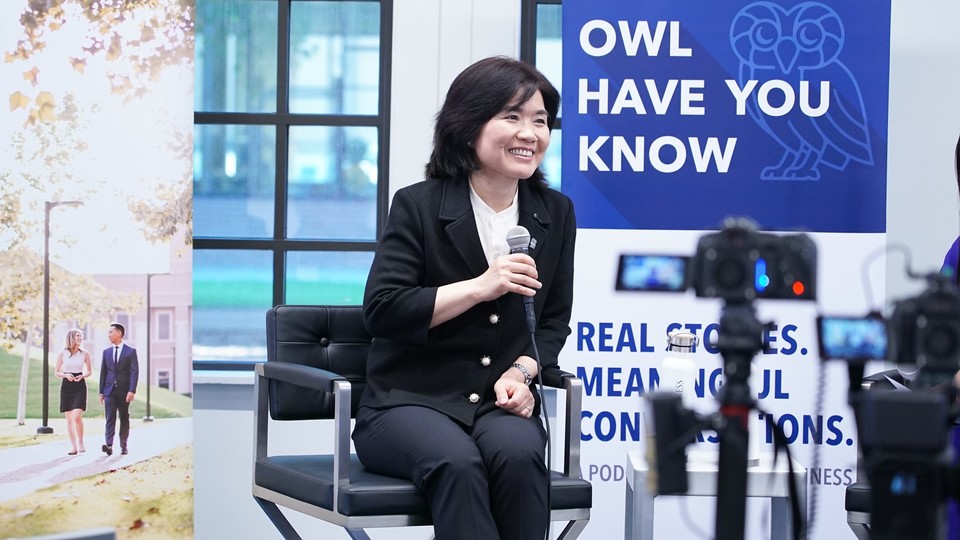
[00:00]Maya: Welcome to Owl Have You Know, a podcast from Rice Business. This episode is part of our Up Next series, where faculty, researchers, and alumni weigh in on the trends currently shaping the world of business.
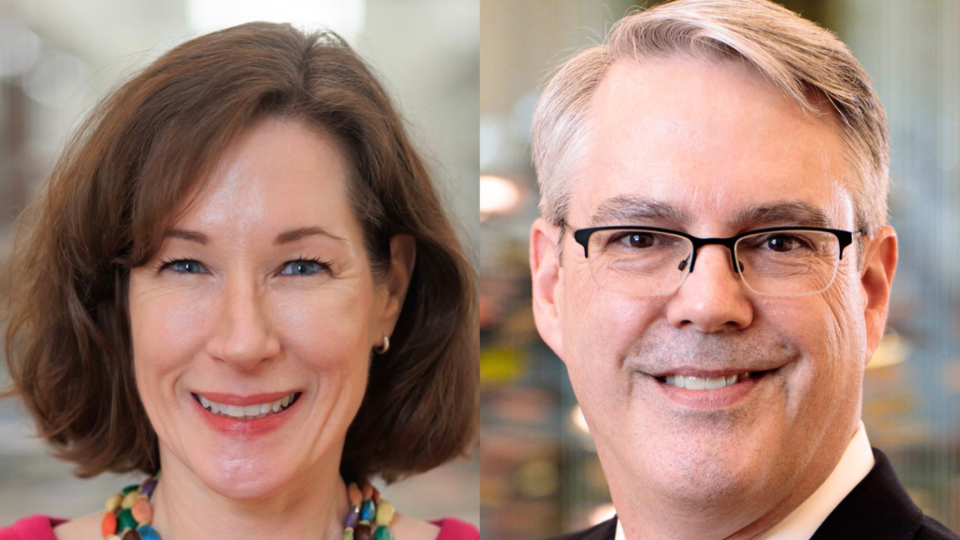
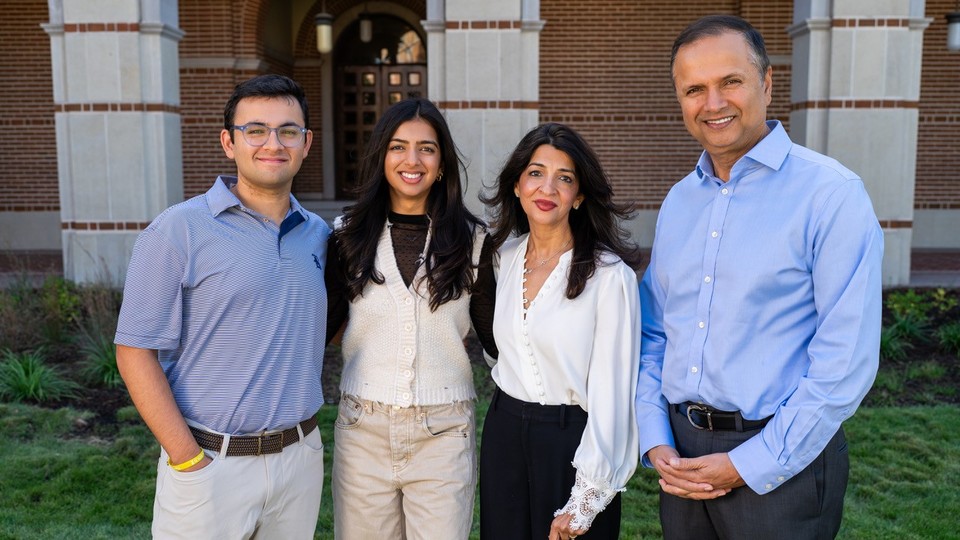
On today's episode of Owl Have You Know, we explore the unique perspective of not one but two faculty members who share not only their deep love of teaching, but of one another. Beloved professors Lee Ann and Alex Butler have dedicated more than a decade to Rice Business. They tell us the story of how they met, fell in love, and why there is no place they would rather be together.
Thank you so much both for being on our podcast. It's a real treat to have professors join me. It's really a phenomenal perspective, because usually, I'm interviewing students, alumni, and now, we get to flip the coin and talk to professors. And not only are you both professors at Rice Business, but you're a husband-and-wife team.
[01:01]Alex: That's right.
[01:02]Maya: Was that planned — to work together?
[01:06]Alex: The working together part, no. The being together part, absolutely.
[01:10]Maya: Okay. Good answer. That's a very good answer. So, let's start from the beginning. How did you two meet?
[01:19]Lee Ann: Well, the short answer is, we met in a bar.
[01:22]Maya: Amazing.
[01:23]Lee Ann: The slightly longer answer is I had a friend who had a romantic interest in another of my friends and asked if I could facilitate a meetup. And I said, sure, “My friend and I will be at a bar this night, this time.” He came with his new friend, Alex. My mutual friends did not end up working out, but we did. So, we've been married for 28 years now.
[01:47]Maya: Wow, congratulations! The whole thing just started with “we met in a bar.” I mean, it can only just get better from here, right? So, Lee Ann, you are a senior lecturer in management, and you are also a former litigator. So, you are an attorney by trade and now teach business law. You were also integral in launching the online program, MBA@Rice. And Alex, your background is finance — corporate finance — and you do a lot of research and you study the financial markets. And both of you were at the same places at the same time. So, I'm assuming this was before 28 years ago and that you've probably worked together before. Is that accurate?
[02:36]Alex: I was faculty at Louisiana State University many years ago, we had a need for someone to come in last minute and teach business law. And that's where Lee Ann came in. And I don't want to put words in her mouth, but I think she found it a pretty daunting prospect, since she had not taught before. But I think she ended up really liking it, and she really has a knack for it. But I don't want to steal your story, Lee Ann.
[03:01]Lee Ann: Well, that's pretty much it. I, really, I think, had no true conception, despite being married to an assistant professor, of how much work goes into prepping a class for the first time when I accepted this adjunct job. But I’m so glad I did because I realized this is really what I want to do. I love talking about the law. I love thinking about the law, discussing the law with other people, and particularly people who are just interested in it prospectively, as opposed to maybe people that are very, very interested in their specific problem at one specific time. So, teaching ends up being, kind of, a perfect fit.
[03:39]Maya: So, tell me what got you really interested in law, to begin with.
[03:43]Lee Ann: So, I was in elementary school. And we had someone talk to us, who was a lawyer, kind of, a Career Day type of thing. And they described practicing the law as sitting around all day doing puzzles but you don't have all the pieces all the time, but you still have to come up with a solution. And I was a super geeky little kid that loved to do puzzles. And I thought, “Oh, my God, this is the life for me. This is what I want to do.” And from that point on, I knew that I wanted to go to law school. So, went to business school first. My undergrad is in business. And then straight on to law school, and then worked in the area of contractual, on the litigation side, but dealing a lot with financial transactional matters, so got to use to the business school part, too.
[04:28]Maya: Financial transactional matter. So, that goes back to you, Alex, since that's something that's in your wheelhouse. So, tell me about your upbringing and what led you to finance.
[04:38]Alex: So,both of my parents were academics. Mom was a poet, dad was an economist. Never even occurred to me to get a real job or that career progression would begin until after the Ph.D. And fortunately, I really enjoy both the teaching and the research sides of things. I enjoy mentoring students.
In terms of, how did I end up in finance? So, when I was an undergraduate student at Rice long, long ago, we didn't have a business major but we had economics major. And so, I was a mathematical economic analysis major. And that was really good training for graduate work in either economics or finance. And I had one finance professor, in particular, who I really enjoyed the class and the professor. And so, that's, sort of, how I got on that path. And that's where I am now.
[05:21]Maya: So, we need to back up and say that, yes, you actually went to Rice as an undergraduate student. Are you from Houston?
[05:27]Alex: No, I grew up in Alabama. So, in fact, when I started looking at colleges, at the time, I had never heard of Rice. But then, my parents, “Have you thought about Rice?” I have not thought about Rice. I'd never even heard of Rice, but then started looking into it. I'm like, “Wow, this is my kind of place.” So, came and visited campus and really enjoyed it and knew then that that was going to be my first-choice school.
[05:49]Maya: And you got in.
[05:51]Alex: And I got in.
[05:51]Maya: So, you went to Rice as an undergraduate and then pursued, you know, a master's and a Ph.D. and all of these phenomenal degrees, and then you decided that you were a researcher before you became a professor, or was that, sort of, hand in hand?
[06:07]Alex: It goes hand in hand. So, Ph.D. is, at least, in most finance programs, is a research degree. Albeit, the first year or two, you take a lot of courses. Really, the point is to learn how to become a researcher, how to become a scholar, how to produce knowledge through research. And I hadn't fully appreciated that when I started on the path. So, it's a good thing that I like it because, you know, both my parents were academics. I wasn't quite ready for just how research-intensive the job really is.
[06:36]Maya: No, for sure. And you've been at Rice for quite some time. What year did you start as a professor?
[06:40]Alex: Yes. I've been back here since 2009.
[06:43]Maya: 2009. And you have actually won a few awards at Rice. You won the Jones School Award for Scholarship Excellence in 2011 and 2012. Congratulations!
[06:56]Alex: Thank you.
[06:56]Maya: And before that, you were at UT Dallas, and so were you, Lee Ann. So, you were both at UT Dallas, you were both at Louisiana State, and found yourself back at Rice together. And how long have you been at Rice, Lee Ann?
[07:07]Lee Ann: Same amount of time.
[07:08]Maya: Well, that would make sense, wouldn't it? Have you been married for 28 years? So, do you have children?
[07:16]Lee Ann: We have two, both off at college. We are beginning our empty-nester era.
[07:20]Maya: Where are they in school?
[07:22]Lee Ann: One is at Austin College and one is here at University of Houston.
[07:25]Maya: Wonderful. Do they want to become academics, lawyers, you know, finance people? Or, are they going to be artists? Or, are they taking a completely different path than their parents?
[07:36]Alex: Well, they started off on the artist track, and I think both are pivoting a little bit — the older one toward medicine, maybe, or maybe chemistry, and the younger one to education, I think.
[07:48]Maya: Nice. Then, close to home. That must be nice to be able to see them. Because I've got one that's 17 and she wants to go to Maine, which I'm like, “That's a really, really, really long flight. And I would really… like, why didn't you consider Rice, right?” So, I'm still working on that a little bit, but as you well know, they want to forge their own path, and if you say one thing, they're going to go in the complete opposite direction.
[08:13]Alex: I am familiar with that, yes.
[08:17]Maya: So, what is it about Rice? Because you've been to other universities and been professors there. So, could you tell me what it is, that magic sauce? Because you've been there for quite some time and you've seen the evolution and the progression, you know, Dean Rodriguez has done so much for the university. And now, we have an undergraduate program, which you have been integral in as well, in terms of launching. Tell me a bit about Rice from your perspective.
[08:43]Lee Ann: For me, it comes down to, A, the students, right? That is, my interaction, most of the time, they are phenomenal. They are here to learn and they have that kind of hunger that's amazing. I really enjoy teaching in the MBA program because they come with so much work experience and I learn something every single class that I teach. Hopefully, they learn a lot from me, but I am absolutely learning a lot from them each time, too. But we also have wonderful support and administration here, which is not always the case at every school. But we, kind of, have the whole package, which is just a joy, a joy to work here.
[09:21]Maya: And tell me about the undergraduate program, because I know that that is something that Rice had been working on for quite some time. And there are lots of institutions that only have graduate school programs, for a reason. If you could just shed a little bit more light on why you feel that that was an important decision to be made and how it really expands the opportunities that Rice provides.
[09:45]Alex: Yeah, the undergraduates, so, really, sort of, underserved population, in my view. Of course, I'm biased. You know, I'm in the business school.
[09:53]Maya: Well, you wanted a business major. That's one of the things that you were looking for.
[09:56]Alex: We all need to learn finance, of course, of course. But there was a lot of demand from the students for a business major, and there was none. After many years, we finally started offering an undergraduate business minor. So, that started in, I think, 2007, so just before I got here. And that was limited to six courses, sort of, the core courses you expect in an MBA program, but taught at the undergrad level, and that was it. Those are the only undergraduate business offerings that we had at all. And almost immediately, that undergraduate business minor became the most popular minor on campus by a factor of about three. The next most popular one was…had maybe 10 people, 20 people per year, and we were graduating 60, 80, 90, 100 people per year with a business minor.
So, obviously the demand was there for something bigger. So, after, sort of, years of getting the pieces in place and laying some groundwork, we were finally able to launch the business major. The rationale behind it is that it's much more like a social sciences degree than, say, an engineering degree, in the sense that most social sciences majors — so, economics, psychology, what have you — have a fairly limited number of course requirements. Whereas, in engineering, a student might have two free electives the entire time that they're an undergraduate. That was not the model we wanted. We wanted something that was, sort of, lean, flexible, and so that the students could double-major if they wanted to. And many of them do, be that in comp sci or one of the engineering majors, or especially, in humanities and economics.
[11:37]Maya: How many are enrolled? There was the first graduating class, right?
[11:42]Alex: Yeah. So, we had our first graduating class this past year. And I think there were 61 students in that class. And so, for some perspective, the total size of the graduating class of undergrads at Rice is on the order of 1,000 students. So, 6% of the entire graduating class was a business major, and those students became business majors, not realizing that we were going to have a business major when they chose to enroll at Rice.
So, they got here, surprise, now we have a business major, and ah, yay! And so, those are the people who not only chose to come over to business, but did so late in the game, and still were able to get everything done. On a going forward basis, I think we're going to have, probably, at least double that many students every year. So, 100 to 120, maybe more. Hard to know, because the students can change their major on a whim, basically, but it looks very promising.
[12:41]Maya: You know, I'll ask you, Lee Ann. So, in terms of teaching, because you teach across the board for students that are in different phases of their career journey, what have been some of the most surprising things that you have learned from your students? Because you mentioned earlier that there's a lot that you learn from your own students. So, what are some of those things?
[12:59]Lee Ann: Weirdly, this is my favorite thing ever that I learned, and that is the term “land skirt.” We know of land men, but I had no idea that there was a feminine version-
[13:09]Maya: I didn't, either.
[13:10]Lee Ann: … of executors and executrix, but yes, the land skirt. I often hear insight as to particular goings on at particular companies that I probably won’t repeat, that I find incredibly interesting, given what I know about the law and the current environment. So, I will not repeat those things here. But they always have fascinating stories.
[13:30]Maya: As educators and as professors, what have been some of the most surprising things that you have learned?
[13:35]Alex: Well, I mean, this is probably not the answer you were expecting, but several years ago, we ran an experimental course where faculty from four different functional areas got together, all of whom were going to teach their discipline, but along the theme of decision-making.
And so, we had someone from one group who's going to think about decision-making in teams, one person decision-making as far as how personal psychological biases affect your decisions, one person doing game theory, and I doing decision-making with data. So, I learned a few things in that. One was what a great place to work where someone can have this bonkers idea of, let's come at decision-making from four different ways, all of us with our own strange perspectives, and deliver that as a course to the students and have the administration be like, “Yeah, man, let's do that. That sounds awesome.” And so, we did. So, that was a neat thing to learn.
The second thing I learned is that you can try it, but if your plan is to teach that content in two consecutive 10-hour days on a weekend, no one's going to be happy with that. And third, to amplify that, is if you try to do that during the second half of the second semester of an MBA student's second year, they would really rather not to hear about statistics and making decisions with data on that beautiful, beautiful Saturday in March.
[15:07]Maya: Yes, I was in those classrooms on those beautiful, beautiful Saturdays in March, and I actually picked seats where I wouldn't see the window on purpose. I understand that. So, I've got quite a few questions about both of you, you know, working together. Do you… you know, a lot of couples working together would be a disaster, right? It's a nightmare to work together. But for some, it’s exactly the right fit. And I want you to, sort of, shed some light on what it's like? Do you come to school together every day and have lunch together? No, completely separate? I can see you shaking your head, Lee Ann, “No, we don’t do that”
[15:49]Lee Ann: Yeah. Most days, I do not… I see him at breakfast. I see him at dinner. I do not see him in between. Faculty meeting days, I'm pretty sure that I will see him and I might even get to sit at the same table as him if I get there early enough. But no, we have offices on different floors. We teach in different areas. We don't even teach the same students.
[16:09]Alex: Oh, that grossly understates how much overlap there is, no.
[16:15]Maya: This is perfect.
[16:15]Alex: So, audience, from here, everything she said is correct and true, except that what she's left out is that, every night at dinner, we're talking about aspects of your job, right? And so, I've been teaching for over 30 years. My main undergrad class I teach, I've been teaching every year since I got here. And yet, through conversations I had at dinner with Lee Ann, I changed up some of the things I'm doing in the classroom this year. And it's worked like a charm. I should have asked her earlier, “How do you deal with this thing?” And she would have told me, I'd be like, “Okay, well, I'll try that.”
And so, this time I did. And sure enough. And, you know, I think that's a two-way street. I think some of the things that I share with her, she can adapt to her classroom. Even though our student populations are very different and the content that we teach is very different, a lot of the pedagogical stuff that you, kind of, pick up along the way, you learn better when you have someone to share it with.
[17:11]Maya: And to bounce ideas off of.
[17:12]Alex: Exactly.
[17:12]Lee Ann: Yeah, and we've each sat through each other's classes. So, I have sat through his BUSI 343. He sat through Business Law and Reg with me. So, that also is nice. I don't know if I would be excited to invite a random professor to just sit in on my class and critique me, but your husband can do it nicely.
[17:32]Maya: Oh, that's amazing. You do that for one another. Do you take notes?
[17:37]Lee Ann: Absolutely.
[17:37]Alex: Yes, absolutely.
[17:39]Lee Ann: I am a big proponent of note-taking with pen and paper. And absolutely, I took notes.
[17:44]Maya: So, what kind of feedback did you give one another?
[17:46]Lee Ann: Some, I think, actual constructive. Some, you know, “Dude three seats away from me was balancing his checkbook instead of listening,” kind of comments. But, you know, little things. He's a great professor, so there's not a whole lot of feedback to give him.
[18:02]Alex: Well, and when we pivoted to online during the pandemic, pretty much none of us knew what we were doing or how we were going to do it. That was a semester where I was not teaching, but Lee Ann was. And so, I logged on to the Zoom, just like all of our students did, and quietly, you know, watched with my camera off, like, I'm guessing many of the students were. But that helped me think about, “All right, so, I know I'm going to be doing this in the fall.
How do I want to do my pivot?”
So, I got to watch her. I knew what her content was because I've been talking with her about what she teaches for years. And I think I was able to help her by saying things like, you know, just logistical things, like, “Oh, you know, the microphone didn't pick that up, or the camera makes you look funny with that light over to the side,” or whatever, right? That was super helpful.
[18:50]Maya: I want to pivot a little bit about some of your research, Alex, that you've done. You most recently did some research which was fascinating, I read the article, about racial disparity amongst people that are applying for auto loans, which is a very relevant topic in this day and age. And I wanted to talk to you a bit about that.
[19:12]Alex: Yeah, it was a very interesting learning experience all the way through. I think of myself as a corporate finance and financial intermediation researcher, but over the past five or 10 years or so, I've, sort of, pivoted toward consumer finance and household finance. And one of the reasons why I've enjoyed that change is because it's us. You know, it's normal people that I'm studying now. And so, to think about how people make their decisions, it's really gratifying. If you can learn something about how that aspect of the world works as opposed to some tiny niche nuance of financial intermediation, banking law, whatever might be important, but if you're sitting next to some random person on an airplane, they say, “What do you do?” Well, let me explain to you how the basal record, like, you know.
[20:01]Maya: “Sorry, I don't speak English,” and then turn around.
[20:05]Alex: Exactly. So,this paper was really interesting. The question of how do lenders price auto loans is a tough one to answer because data are nearly non-existent.
[20:17]Maya: What specifically about this, though? Like, was it about this? Was it something that you read that wanted you to take a deeper dive into this specific category? Or, what was that?
[20:27]Alex: Sure. Well, there's lots of research on how and whether there's racial discrimination in mortgage markets. For decades now, this has been an area of a lot of interest to regulators, to researchers. And we have some really good data on that called HMDA, the Home Mortgage Disclosure Act data, which basically requires any bank, any lender for mortgages to, when someone applies for a mortgage, to take some information down and then report it to this database, such as the person's income and their race, as well as other aspects about the loan itself and the home that they're trying to buy.
But there's nothing like that for auto loans. It is the Wild West. There is very little regulation. There's very little oversight. And there's certainly no government-mandated database of racial characteristics of the applicants and the ultimate borrowers. So, our innovation in this paper is that we have data for individual credit histories, and then there's this publicly available database for mortgages. Well, anybody in the consumer credit database who had a mortgage at some point in time is going to be in both databases.
And so, what we found is that we could match on when you got a mortgage, where that mortgage was, geographically, how much you borrowed, and a few other characteristics that show up in both databases, so that we could match two different completely anonymized databases, and then say, “Oh, we're here for the people who got auto loans. Now, if they also had a mortgage, I can figure out what race they are based on what they reported when they applied for their mortgage loan.”
And so, it allows us a lens into this otherwise really opaque market. And what we found is just absolutely stunning. So, if you look at how minorities and non-minorities are treated in this market, the difference is huge. In terms of approval rates, if you take two people, one minority, one non-minority, and hold everything else equal, including their credit score, including how much debt they have, because we know all that because we have their credit reports, we have their credit histories, and if you compare that, the minorities are denied substantially higher than the non-minority people. The difference is, like, the equivalent of having a 30-point gap in your credit score. That's a hurdle that the minorities are facing when they apply for these loans.
And don't forget, these are the people who, at some point in time, got a mortgage. So, these are not bad credit risk people. This is a selected sample of people who are already pretty good. Of those who make it past the approval stage, minorities pay higher interest rates, too.
[23:23]Maya: Right, by, like, 60% or something? Some ridiculous…
[23:27]Alex: So, 50 basis points, on average. And in areas where racial discrimination is more prevalent, generally speaking, it goes up to one and a quarter percentage points. So, this is on a mean, average auto loan rate of about five and a half percent.
[23:44]Maya: So, where are these places? I'm curious. I’m assuming the South. Am I right?
[23:50]Alex: So, the South in part, but also some places in the Midwest and some places out in the Mountain West as well. The coasts, not so much, but it's an interesting way to figure out what areas may have more racial animus than others. It's based on Google search volume for racial epithets and slurs, basically. It's a method used in economics that we, sort of, ported over for our paper.
So, even the people who get approved, they make it over that hurdle and they end up paying 50 to 125 basis points more than their non-minority counterparts. All that could still be if it's just the case that the minority people in our sample are worse credit risks.
[24:34]Maya: That makes sense.
[24:35]Alex: Yeah, maybe we're just attributing what looks like racial discrimination to just different credit risks, but it's not, because the minorities who get these loans default less than their non-minority counterparts. They're better credit risks.
[24:52]Maya: That’s just really hard to wrap your brain around, you know. It’s just hard.
[24:55]Alex: It really is. And it made it difficult in the peer review process because a lot of our anonymous peers refereeing our paper were unwilling to think that that could possibly be true. And yet, it seems to be, no matter what sort of alternative tests we throw at it, the result still holds.
So, as an example, if, instead of looking at auto loans, which are a fairly human-intensive process, if you look at credit card loans, which are completely automated and algorithmic, there's none of this evidence of racial disparity there in our sample, none.
[25:32]Maya: But in auto loans, there is. That's fascinating.
[25:34]Alex: But in auto loans where there's no oversight, you have humans involved, there's no algorithms that are doing this, the results are there and they're big. And overall, the minority wedge is about 30 to 40 points on their credit score, that they need to have higher than their non-minority counterparts to get the same approval rates, the same APRs, despite the fact that they actually default less.
[25:59]Maya: So, is this part of the major anti-discrimination enforcement policy that was initiated in 2013, but then it was halted in 2018? Could you talk to me a bit about that? Is this why or is it not?
[26:13]Alex: So, it's not why, but there were Obama-era policies that said, “Hey, seems like maybe there's racial discrimination in the auto loan market. Let's stop that, huh?” And so, the CFPB, the Consumer Finance Protection Board, was charged with trying to put minorities and non-minorities on a more even footing. And what we see there is, indeed, the interest rates, which is what they were charged with, sort of, keeping an eye on, the interest rate gap shrunk substantially during that period of oversight. But then, later administrations said, “No, I don't think we need to enforce that as heavily anymore.” And as soon as they rolled that off, the wedge came back.
[26:55]Maya: So, with this information, now that you have it and it's data and it's happening, now what?
[27:04]Alex: Well, I mean, I guess one of the nice things about my position is I can go out, try to ask a question, and try to find the truth, and then share that truth with the world. And then, hopefully, policymakers will see this and take it seriously and start to think about how to affect change. But I don't think that's… that's probably not a thing that I'm going to be actively a part of, unless I get called to, I don't know, discuss it in front of Congress or something.
[27:35]Maya: To testify in front of Congress? Could you tell me the journal that this study is in?
[27:39]Alex: Yeah, this is in the review of financial studies, which is one of our top finance journals. And when it was published, it was published as the lead article and editor's choice, which means that the editor took a particular interest in it and, sort of, put it on a little platform, if you will, so that it would have a little bit more attention.
[27:56]Maya: Thank you for that. That way, people can go and read it for themselves because I read it and it was really a little bit startling and fascinating. And you think that things like this don't happen today, but clearly, they do. And then moving on to the legal aspect of it, so, Lee Ann, when Alex came home and he was doing this study, talked to you about it, from your legal perspective, what were your thoughts?
[28:21]Lee Ann: I was sadly not surprised. I was extremely proud of the innovation that he created in effort to find this data that is so, so very hard to find. And that's one of the problems, what gets measured gets managed, right? And if we can't measure it, we don't really know where there's a problem. We can't convince the people in power to make those changes. But coming from a regulatory background, it absolutely did not surprise me. It's sad, but true.
[28:48]Maya: So, I'm curious, because, you know, you've got a legal mind and you've got a financial mind. And so, if you could teach a class together at Rice, what would it be?
[28:59]Alex: We've talked about this a lot, actually. I think that the best synergies, co-variants that we would get is probably some sort of class on how companies might raise external capital security offers and things like that, because a lot of what Lee Ann teaches is securities regulation, which I find fascinating. A lot of what my research is on is, how does the supply of finance affect how companies and businesses and governments do their thing? And so, a course that, sort of, combined those two seems like a natural fit for us. So, I can talk about the economics behind what happens when firms can and can't raise external capital. And then Lee Ann can come in and explain why my explanation was way too simplistic because the actual rules are far more complex than that. And do you know that if you do that, you're actually issuing an illegal security? And like, oh, yes, I know that. I sat in your class. I just forgot. You didn't say it was on the exam.
[29:53]Maya: Well, yeah, you can't put it on the exam. I'm just saying. That's just opening up a whole can of worms. So, Lee Ann, I was going to ask you, so, what are some of the most critical, legal or ethical challenges that business leaders face today? Because that's something that you're preparing this generation of leaders to tackle.
[30:12]Lee Ann: Well, I think the ethical challenges come every day. And probably, the most difficult bit is when we just don't realize it's an ethical dilemma that's in front of us, right? And we tend to think of ourselves, everyone thinks of themselves as an ethical person, “I don't need to worry about this because I'm a good person and I will do the right thing.” But when we take the time to actually systematically go through it in a logical way, I think not only what does my ethical framework tell me is right and wrong in the situation, but how might others view it? Because not everyone has the same framework as me or anyone else. So, ethically, we are bombarded with dilemmas on a daily, if not hourly, basis.
Legally, right now, the regulatory environment is at a super weird point. We had some major U.S. Supreme Court decisions this summer that created some huge amounts of uncertainty. Typically, those types of big blockbuster cases are in one area, you know. It’s in securities law. It’s in antitrust. It's in criminal law. But the repeal of the Chevron doctrine hits every administrative agency.
[31:26]Maya: Could you explain that doctrine for those of us that don't know?
[31:29]Lee Ann: So, the Chevron doctrine, which had been the law for a very long time, basically said, you know, we've created these administrative agencies because Congress has a lot on its plate. We need experts to guide us in very specialized areas, right? No one in Congress really knows how to fly an airplane or not enough of them. So, we're going to have a group of experts form the FAA and they're going to make the rules and regulations under congressional oversight. And the Chevron doctrine said, “Given that we have these experts, if a question is posed to the court, is this legal? Is this constitutional? We are always going to defer to the agency's interpretation.”
This is a very simplified version. It's many steps to Chevron review, but basically, there's a thumb on the scale for the administrators because they're the experts. And the repeal of that says, “Actually, we're going to let the courts have a much more involved hand,” or that's, at least, what we think might happen. We don't know. The wheels of justice grind slowly. So, we're waiting for the first wave of cases to go through where we don't have Chevron in place. We don't know. And that, coupled with a major election coming up in November, it's going to be really difficult to teach regulation this fall because there's just a lot of balls in the air. We don't know exactly where they're going to land.
[32:51]Maya: And both of you are teaching. You talked about uncertainty. I mean, talk about uncertainty. There's uncertainty in regulation. There's uncertainty in the financial markets. There's uncertainty literally everywhere. And it must be really, really challenging to teach in this day and age, right?
[33:07]Lee Ann: It makes it fun, right? Because we get to think through all the scenarios. But even if you have a bright line rule, there's going to be the incentive to find a way to work around it. And regulators and legislatures, they have to try to balance. We want to give clarity to businesses, to individuals. If we give too much clarity, they're going to find a way around it, right? So, we need a bit of vagueness also. Finding that sweet spot is difficult for them. Dealing with the gray areas is difficult for those of us who want to comply with the laws and the regulations. So, it's great for discussion. As a lawyer, if I were practicing right now, I would be terrified for my clients, but as someone who is just talking about how things might play out, it's fascinating.
[33:50]Maya: Yeah. And what about you, Alex? What do you think about teaching right now in this? I mean, it really is, I mean, an inverted yield curve that's now not as inverted. I'm, kind of, a finance geek. And so, I follow all of those metrics and, yes, the election. And then you've got, you know, the Fed. There's always uncertainty. That's the only thing certain in this world. But it just, sort of, feels like there's more of it right now. Is there more uncertainty? You tell me.
[34:19]Alex: Well, you know, I'm, kind of, framing against when I was teaching a financial institutions course in the fall of 2008.
[34:26]Maya: Ah, financial crisis. Good times.
[34:30]Alex: And the way it worked out, my lectures tended to line up almost exactly with how the financial world was crumbling. So, the week after all the banks went belly up, that's when my lecture on commercial banks was. And the week after the investment banks all went belly up is when my investment banking lecture happened to be. And so, I would watch the news and just realize, “Oh, everything that I was planning on talking about next Tuesday is now obsolete.”
[35:02]Maya: Bear Stearns doesn't exist. Lehman doesn't exist. They're all gone.
[35:06]Alex: I know. You know, and I had this great slide showing how the investment banking industry had evolved through time and all the mergers and the spinoffs. And I just went to that slide and it's like start putting Xs through all the firms because they just didn't exist anymore, or if they did, not as investment banks. So, yeah, the uncertainty makes it a challenge, but that's the game.
[35:29]Maya: That's the game. So, what do you see for the future? I know you don't have a crystal ball about financial markets or about the law and regulation, but let's talk about Rice. What are you the most excited about for the future of this fabulous institution that you're both a part of, that you, obviously, went to as an undergrad? And you have seen how much it has evolved. What are you both most excited about what's up next? I know that the business school is expanding, which is also just exciting to see. I was on campus. I’m actually auditing a financial class, because like I said, finance geek. So, I'm seeing all of, you know, the construction and everything else that's happening. What are you most excited about?
[36:12]Alex: The construction's pretty exciting. To have that big of an extension to our building is going to be really great. And with the expansion of the undergraduate program, we really, really need it. And so, it'll be nice to have that space and to have that, sort of, visible commitment to integrating with the rest of the universities.
For so long, we had no undergraduate presence or barely any at all. And to now have this huge impact on the university is really gratifying. And I look forward to seeing how we can further serve Big Rice as a business school.
[36:46]Maya: We do talk about it as Big Rice. I know, there's some people that don't know that, but yes, there's Big Rice and then there's the other that falls under Big Rice.
[36:55]Alex: That’s right.
[36:56]Maya: That was something that I learned when I was there. I was like, “Wait, I'm sorry, what is that? Big Rice? Is there, like, a medium and small?” I didn't understand. I think that the business school is certainly such a powerhouse at Rice. And, you know, when you were looking for places to go to university and you didn't even know what Rice was, I mean, man, Rice is now one of the new Ivies and it's the place to be. And it's the best investment for your dollar, if you want to talk about finance, and all these things, it's come such a long way. And for me, that's something that's very exciting. And, obviously, I haven't been there nearly as long as the both of you have been there. It's really rewarding to see.
[37:38]Alex: Yeah, it’s really gratifying when we, when the business school does well in the rankings. And, you know, sometimes, when you see these rankings where they break it down by discipline, finance area usually does really, really well, often in the top 10. The undergraduate program, one of the rankings, gave us a ranking last year, even though we hadn't even had any graduates yet, and we ranked in the top 25, just straight out of the gate. So, it's a very exciting time.
[38:05]Maya: So, Lee Ann, what are you the most excited about for the future?
[38:08]Lee Ann: I’m also, even though I don't teach in the undergraduate program, I am just thrilled with that. I am thrilled with that expansion. I think bringing young students in and getting them ready for the topsy turvy world that is business in the U.S. right now is more important than ever. And having such a quality well to draw from, from the Rice undergraduate population, is going to be amazing. And I think it's going to put some young blood in the building. And that's, kind of, exciting, too. I am excited, as always, to continue with our MAcc program. I think we produce…
[38:47]Maya: That's master of accounting, for those that know what MAcc means.
[38:48]Lee Ann: Yes. And it's a one-year program to help students transition to the world of public accounting, certified public accounting. But we have produced more Elijah Watt Sells winners. That is the very tip-top, I think, quarter of a percent of the CPA test-takers. I mean, that's just amazing. So, getting to work with those kinds of really high-quality students that love accounting is a joy. And I hope that we get to continue doing that.
[39:16]Maya: Yeah, that sounds great.
[39:18]Alex: And it's one of the few places where we have overlap in students because a lot of our undergrads end up going into our Master of Accountancy program. Of those who do, many of them are undergraduate business majors or business minors. And so, they have invariably taken my course. And so, when I hear that they're going to the MAcc program, I say, “Oh, that's good. Now, you get to take classes from the better Professor Butler.”
[39:40]Maya: Oh, that's a nice thing to say.
[39:43]Alex: True.
[39:45]Lee Ann: He's a very sweet man.
[39:45]Maya: Aww. Well, 28 years, you know, that's quite a milestone. What are you going to do for your 30th wedding anniversary? Put you on the spot.
[39:53]Lee Ann: Yeah, that's a good question. 25 was during COVID, and we did nothing. We had big plans. That did not work. I don't know. We had talked about going back to where we went on our honeymoon, which was Northern California wine country. But I don't know what we're going to do. Alex is our vacation planner.
[40:07]Alex: Yeah. Well, you know, I think that'll be during the summer. So, why don't we just stay here?
[40:14]Lee Ann: There's nothing better than Houston in the summer.
[40:17]Maya: Right. I mean, exactly. Like, I'm sorry, worst place on earth in the summer time. But the best time because there's no traffic because there's nobody here. Everybody, sort of, scatters, and then it's, like, “Oh, I can get around town. I don't have to worry about sitting on 59 for 45 minutes.” Yeah, no, wine country sounds like a good place to go. And you also have an anniversary of being professors at Rice coming up as well.
[40:43]Lee Ann: 15 years, yeah?
[40:44]Maya: 15 years. What do you… do professors get something special? I'm just curious.
[40:49]Lee Ann: I think not until you've been here as long as Professor Zeff has do you get something special.
[40:55]Alex: I don't think anyone's been here as long as Professor Zeff has.
[40:58]Maya: How many years?
[40:59]Alex: I don't know exactly, but I took accounting from him when I was an undergrad.
[41:05]Maya: Okay.
[41:05]Alex: And he had been around for a while then.
[41:08]Maya: So, I went to McCombs as an undergrad and had a finance professor. And then I went back and got this Executive MBA and had the same professor, but this time, for economics. And it was Professor Brandl. And I was like, “Okay, 20 years.” So, 20 years apart, I mean, what are… and it was during COVID. What are the odds of that? I was, like, you remember me, right? I was sitting in the second row. It was like, “Yeah, I do not remember you at all.” But yeah, it's, kind of, interesting the way that the world works and someone that you had as a professor is still there. And that's a testament to the university, the tight-knit community that it is, and one of the reasons that you both want to be there and you never want to leave.
[41:55]Alex: Exactly.
[41:56]Maya: Well, any words of wisdom? Because we have to ask you about words of wisdom, as we're owls. Give me some words of wisdom. These will be our parting thoughts.
[42:06]Alex: Buy low and then sell high.
[42:12]Lee Ann: That is wise. That is sage, sage advice all.
[42:15]Maya: So, don’t buy anything right now.
[42:19]Lee Ann: Yeah. Well, at least the dock worker's strike is over, so we will have things to buy at their inflated prices, which is good. I would say, never write it when you can say it. Never say it when you can nod, and never nod when you can wink. Sadly, I can't wink, so Alex has to do that for me.
[42:38]Maya: I love that. I'm going to say that. I am not going to write it. Well, this has really been such an honor to have both of you. Thank you for taking the time to talk with us.
[42:48]Alex: Thanks so much.
[42:51]Maya: Thanks for listening. This has been Owl Have You Know, a production of Rice Business. You can find more information about our guests, hosts, and announcements on our website, business.rice.edu. Please subscribe and leave a rating wherever you find your favorite podcasts. We'd love to hear what you think. The hosts of Owl Have You Know are myself, Maya Pomroy, and Scott Gale.