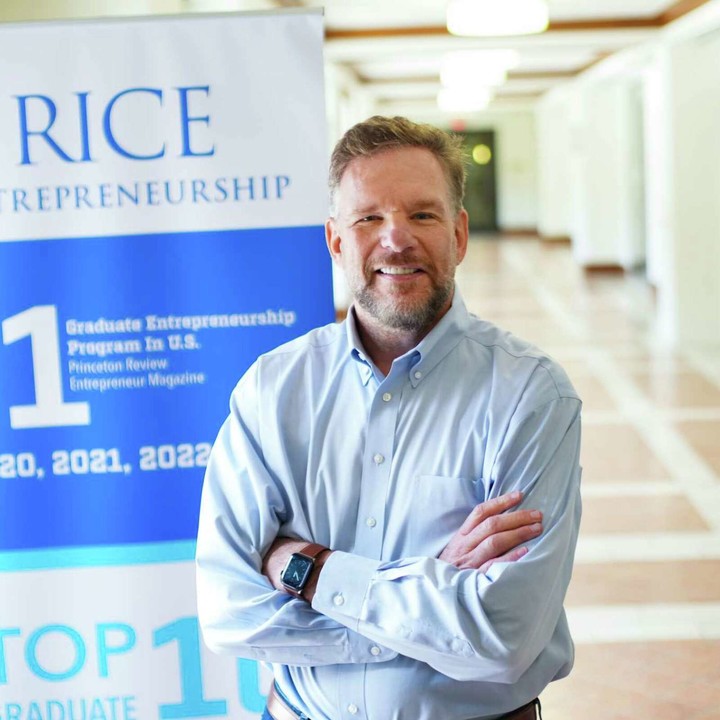
Rice Business has been consistently ranked among the top 10 graduate entrepreneurship programs in the nation, reflective of the depth and breadth of resources for entrepreneurs during their time at Rice and beyond. We are proud to be ranked the #1 Graduate Entrepreneurship Program for the seventh year in a row this year by Princeton Review & Entrepreneur Magazine.
Entrepreneurship classes emphasize a combination of mindset and skillset and focus on multiple stages of the entrepreneurial process. Classes include The New Enterprise, Enterprise Acquisition, The Social Enterprise and more, tailored to a wide range of interests.
In addition, entrepreneurship students have the opportunity to engage with an array of industries in novel ways. In courses such as Healthcare Entrepreneurship and Innovation, Rice Business students join Rice graduate students in bioengineering and physicians from Baylor College of Medicine to work at the intersection of their fields. Classes at Rice Business are accompanied by co-curricular resources for entrepreneurs, including workshops, lectures, mentor office hours and special events to cultivate connections between Rice entrepreneurs locally and nationally.
The Entrepreneurship courses with Professor Al Danto were eye-opening for me. I never seriously considered being an entrepreneur. Well, that mindset was quickly changed during the first class. Entrepreneurship is something definitely in my future.
Evaluating opportunities for a new innovation-based enterprise; conceptualizing and developing a venture plan through an iterative process; articulating venture assumptions; testing venture assumptions through experimentation. Intended for students who want to start their own venture, join an early-stage venture, be entrepreneurial within an existing organization, or want to understand entrepreneurs and how to think entrepreneurially.
The energy transition provides a unique opportunity for entrepreneurs to overcome the challenges of the energy sector’s traditionally slow adoption cycle, short business cycle, and expensive product development cycle. This course provides the entrepreneur with context and learnings from major energy subsectors (renewables, petrochemicals, power, building materials, and oil and gas) needed to build a successful venture.
The goal of this course is to provide students with an overview of financing options for startups. The course covers crowdfunding, angel investors, accelerators, and the venture capital industry; the organization and operation of venture capital funds; investment methodology; monitoring and portfolio liquidation.
The needs approach to buying and selling businesses; enterprise valuation; deal and contract structuring; mergers and acquisitions; leveraged buyouts; consolidating fragmented industries.
This project-based course introduces the user experience concepts needed to lead UX projects including key UX concepts, the UX Lifecycle, user research, and design. Course will include seminal readings about UX, business case studies, and project-based course work.
You’re in charge of a company, whether by founding, buying, inheriting, or promotion within it. You pour your heart and soul into it. Your customers and employees love it. It means something, and you want it to endure. This course is about the enduring enterprise, from startup to long-term sustainability.
Frameworks for making informed decisions about human capital when founding a new venture, including co-founders, early hires, advisors, board members, and investors.
This course introduces an integrated strategy framework for entrepreneurs, focusing on the key strategic challenges facing startup innovators. Students learn how entrepreneurs balance experimentation and learning with strategic decisions that create competitive advantage in dynamic markets. The course also explores financing options for early-stage ventures, including angel investment, accelerators, crowdfunding and venture capital. Topics include term sheets, deal structures, investment methodology and the role of investors as advisors and board members.
Through interactive lectures, guest speakers and case analysis, students apply these concepts across a variety of industries and entrepreneurial contexts.
This course provides a practical, business-oriented overview of three important strategic considerations for a new enterprise: (1) Identifying and monetizing the business's potential intellectual property; (2) identifying and addressing other people's IP-ownership claims, including data-privacy considerations; and (3) long-term planning for a liquidity event.
This is a project based course where students choose a product and practice managing it. Students will learn how to set a vision, empathize with the user, prioritize, create product management artifacts and best practices when working within agile frameworks. This course is intended for students who want to understand the role of a product manager at a technology company, manage their own product offering as an entrepreneur, or learn how to apply agile product management techniques to their own careers.
Students will identify, screen, and evaluate start-ups for investment by the Rice venture capital fund. Through this highly experiential course, students will learn tools for rigorously evaluating startup ventures for investment, valuing early stage companies, and structuring investments. Students will present their investment recommendations to an advisory committee.
Students learn by working with early stage investors including angel and venture capital organizations. Students learn through hands on support and are expected to be at the sponsoring organizations office 8 - 10 hours per week and attend investor pitches. The Venture Capital E-Lab is not a standard class and requires meeting off campus. To apply for this course visit lilie.link/elab-app.
Students follow the processes learned in MGMT 627 to acquire an existing business or start a search fund. Students develop selection criteria, network to connect with sellers, conduct preliminary due diligence, perform a business valuation, develop potential deal structures and have the opportunity to move forward on any potential opportunities on their own after graduation. Students attend a check-in class every other week to present updates and receive feedback from faculty, students and alumni mentors. To apply for this course visit lilie.link/elab-app.
Students working on their own startup have the opportunity to apply the processes learned in the New Enterprise course to their startup. Students attend a check-in class every other week to present updates and receive feedback from faculty, students and alumni mentors. To apply for this course visit lilie.link/elab-app.
This is a survey course of contemporary topics in the new food economy. We pay particular attention to social justice issues surrounding the production, distribution, marketing and sales, and consumption of food. A sample of covered topics may include: access to capital for non-traditional agriculture, organic & GMO, new technologies and production and distribution, food waste, food insecurity, food marketing, food assistance policies, and other public policies.
E-Lab: New Enterprises Accelerate is the second stage partner course to E-Lab New Enterprises and E-Lab Tech Commercialization. Teams will be accepted into E-Lab New Enterprise Accelerate on instructor approval only based on progress accomplished in their preceding E-Lab courses.
Evaluating new opportunities and developing a business concept; de-risking a new venture, attracting stakeholders, the legal forms of business, financing options, deal structure, lean startup versus traditional business planning and exit strategy options.
Image
Image
Rice Business Wisdom features faculty research applied in the classroom.
Startups that lose a founder are much less likely to pivot to new industries — a vulnerability that becomes even more dangerous during economic downturns.
Head of Rice Entrepreneurship Initiative and Liu Idea Lab for Innovation and Entrepreneurship
Ralph S. O’Connor Professor in Entrepreneurship – Finance