Image
News and notes from Rice Business alumni.
News and notes from Rice Business alumni.
Rick Reinhard
Rick Reinhard taught an undergraduate public policy class at the Washington Center at the College of William & Mary (his alma mater) on “spiritual brownfields,” about the need to reuse and redevelop faith properties into community assets. Students heard from national experts via Zoom, toured houses of worship in the D.C. area and met with the administration’s leadership at the U.S. Department of Housing and Urban Development.
Linda Clark
After getting her CPA license, Linda Clark worked in industry specializing in healthcare- related, privately owned businesses. Her last position was as chief operating officer for a Houston-based, employee-owned, niche e-retailer. Linda married her college boyfriend, John, in 2020. Retiring at the end of 2021, they moved to Park City, Utah, where they enjoy an outdoor lifestyle. She and John love to travel and have visited all seven continents. Linda serves as treasurer of two nonprofit boards and continues to provide consulting services to her former employer.
Reggie Greene
Reggie Greene worked in commercial banking for 40 years in Houston, New York, Vermont and New Hampshire at progressively smaller institutions. He finished his career as president and CEO of Claremont Savings Bank. He and Sue raised their four children in Vermont and now have three grandchildren. After his retirement in 2023, they moved to Southampton, Massachusetts, to be closer to Sue’s family. Reggie and Sue recently went on a trek around Mont Blanc in the Alps and, in a wild coincidence, one of the other members of their small group was Linda Clark ’83.
Mark Williamson
Mark Williamson is operations director for Ironwood Capital Partners, an energy service provider delivering combined-cycle gas turbines, as well as all ancillary equipment needed for an operating gas plant, that is attending to the nation’s shift toward off-grid electricity.
Dylan Hedrick
Dylan Hedrick was elected mayor of Garland, Texas, after winning a runoff election June 7. He is excited to be the 38th mayor of Garland and hopes to combine his engineering background with his business expertise to help rebuild city infrastructure, further economic development and promote a better quality of life in Garland.

Sarah Guerrero
This summer, Sarah Guerrero became executive director of Breakthrough Houston, a nonprofit that partners with motivated students (many of whom are first-generation college students) on a 10-year journey from middle school through college graduation. She’s excited to build on this legacy and to continue advancing educational opportunities and cultivating future educators in Houston.
Adrian Trömel
Having helped build the school’s Office of Innovation, Adrian Trömel was appointed interim Chief Innovation Officer at Rice University.
Daniel Barvin
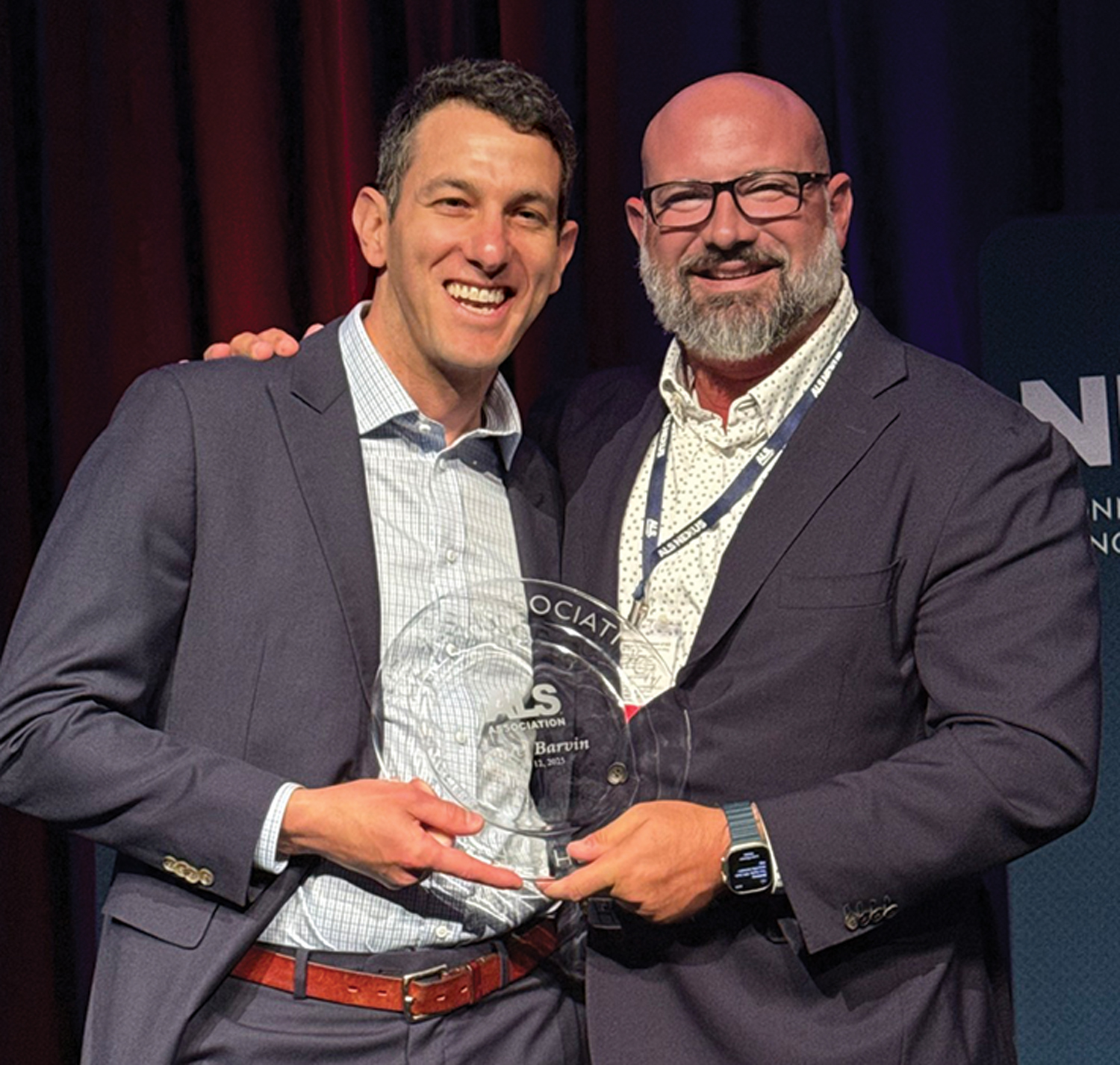
Daniel Barvin was honored with the ALS Heroes Award from the ALS Association in recognition of his long-standing commitment to patient advocacy and community leadership. He also shared that his company, Coya Therapeutics, recently received FDA acceptance of its Investigational New Drug (IND) application for a Phase 2 trial in ALS.
Sean McKenzie
Sean McKenzie was recently promoted to senior manager in Deloitte’s M&A consulting practice.
Arianna Ebers
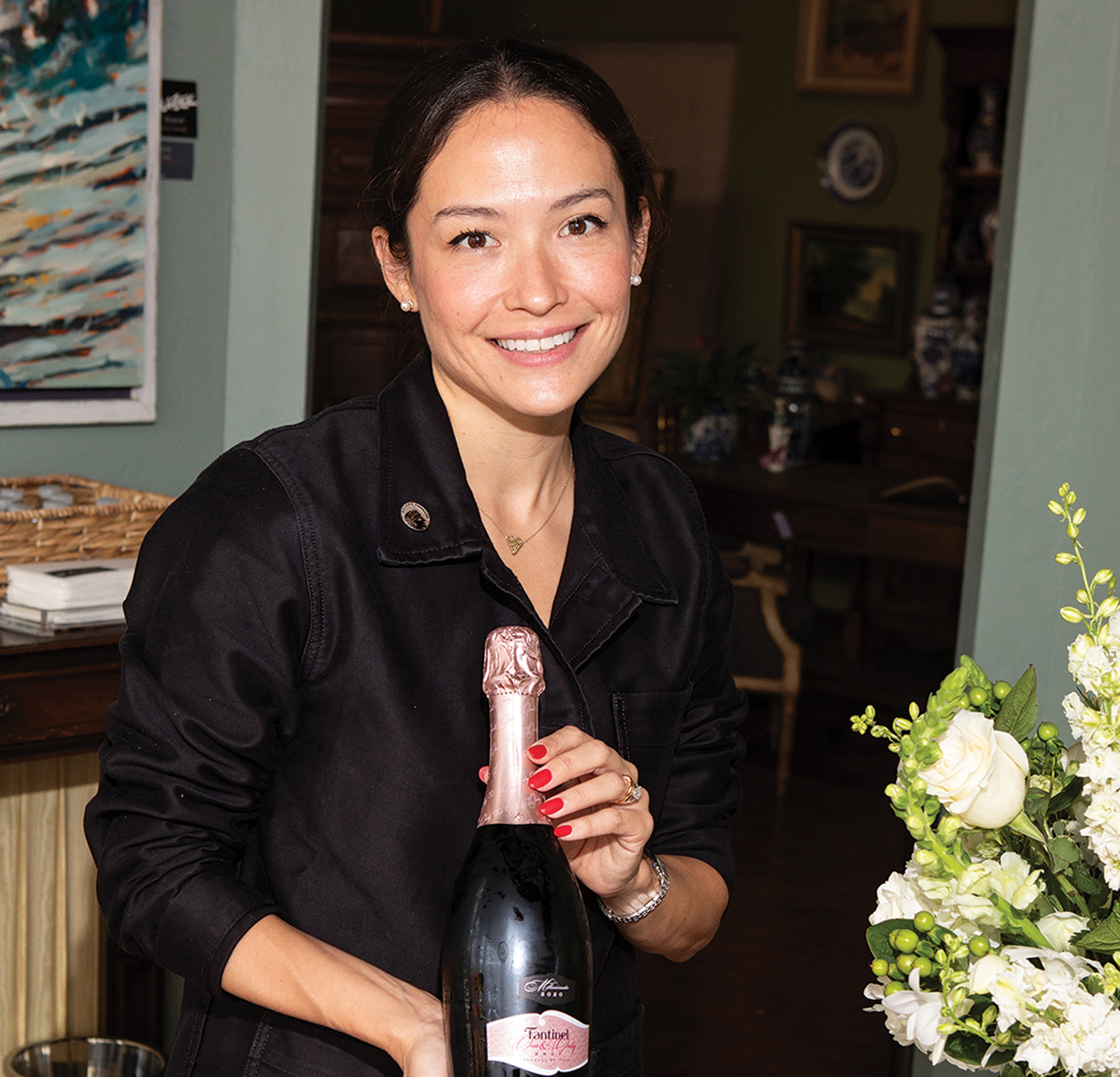
Arianna Ebers earned her sommelier certification from the Court of Master Sommeliers in 2023. She has since focused on food and wine consulting, as well as published writing. In September 2025, she will open her first brick-and-mortar gourmet food/wine market and tasting room in Beaumont, Texas.
Julia Vollmer
Julia Vollmer welcomed a new baby boy, Noah Louis Vollmer, on March 9, 2025.

Zach Neuser
Zach Neuser was promoted to vice president of finance at his company, Arrington Oil and Gas, earlier this year. More recently, he was selected as a recipient of Midland’s inaugural 20 Under 40 Award. Organized by Young Professionals of Midland, this award highlights 20 exceptional individuals under the age of 40 who have demonstrated remarkable leadership, entrepreneurial spirit and community involvement.
Amil Kanji
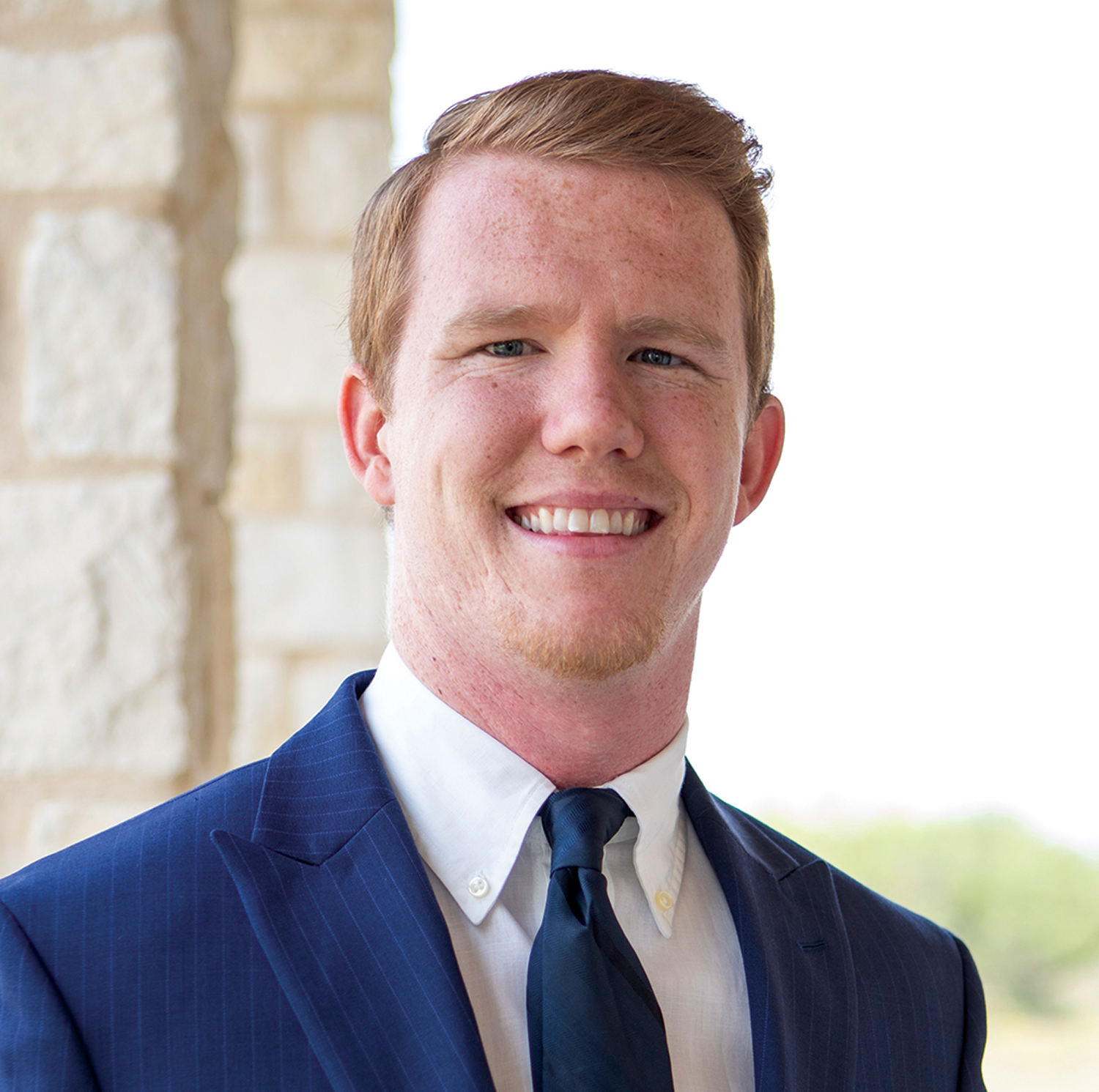
Amil Kanji and his wife, Shabnoor, welcomed their first child. Camila Nia Kanji was born April 29, 2025. She is a happy and loving baby.

Ash Shepherd
Ash Shepherd has been promoted to president of CarbonCycle, a private equity-backed company developing carbon capture, utilization and storage (CCUS) solutions in partnership with natural gas producers, midstream processors and power generators to decarbonize American industry. He previously served as chief commercial officer at CarbonCycle, leading strategy, partnerships and commercial growth.

Humza Saleem
Humza Saleem recently launched Schema 52 (S52), a strategy consultancy and product development partner helping mid-market companies embed AI, streamline processes and build agentic workflows around their biggest ROI opportunities. Founded earlier this year, S52 is already profitable and working with clients across energy, healthcare and financial services. To learn more, visit schema52.com.
Javier Simons
Javier Simons continues to expand his agency, KOQ (Kay-oh-Cue), by building a dynamic DJ roster and bringing on top regional agents to target key market segments. Simons curates full lineups for Pride Festivals in Las Vegas, Austin, Arlington and Denver and is scaling global growth for KOQ, which recently secured SBA funding. Following the successful execution of Danish band Aqua’s U.S. tour, Simons is focused on developing two emerging artists: Houston-based DJ Amarji King and Texas-based rock band Retro Cowgirl. He was recently featured in OutSmart Magazine as a proud Latin member of the LGBTQ+ community and received recognition for his work supporting underrepresented artists and as a social advocate in the nonprofit space.

Mackenzie Ford
Mackenzie Ford has transitioned away from the energy industry to focus full-time on growing her business, Cakery, a platform connecting customers with local bakeries.

"The MBA opened more doors than I could have imagined. I expanded into new businesses, built friendships across the country and even found myself back in the classroom — but this time as the teacher."

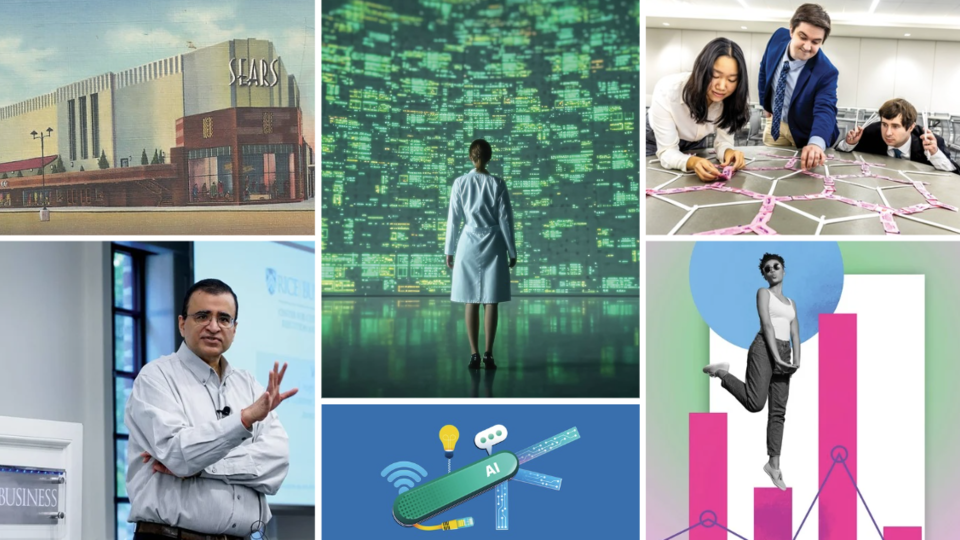
Check out 8 quick takeaways from the latest issue of Rice Business magazine, featuring global MBA experiences, rising undergraduate momentum, faculty highlights, AI insights and much more.
Professor Mijeong Kwon’s research finds that loving your work can be valuable — but treating it as the only “right” reason to pursue a career can cause harm.


New assistant professor Mijeong Kwon discusses her research, which finds that loving your work can be valuable — but treating it as the only “right” reason to pursue a career can cause harm.
The takeaway? Leaders should be mindful to not impose love of work as a standard, and employees should remember that all motives — from money to meaning — are legitimate.
MK: My research focuses on a question we often get in our interviews and work conversations: “Why are you interested in this job?” or “Why do you do this work?” It’s a question of motivation. And we often have a hunch that there is a right answer for that question, but there’s surprisingly little research on this — how people perceive others’ work motivation.
Coming from an international background, especially, I thought that there’s really something interesting about “intrinsic motivation” in this country, about the social pressure to enjoy and love your work. We tend to admire people who love what they do, and we treat that love as a sign of character, not just preference.
So, my research is about what I call the moralization of intrinsic motivation. I study the cultural weight we place on passion and its consequences for careers, organizations and society.
MK: Absolutely. I saw it firsthand early in my teaching at Michigan. Students would come to me worried about their internship interviews. Some would say, “I’m interested in fields outside of consulting or finance, but I feel pressure to choose those paths because of money or prestige.”
They worried that saying “I want financial stability” wasn’t acceptable in an interview context, even if it was honest. I also noticed colleagues reading student applications and dismissing them as “not passionate enough.” That raised a question for me: What counts as passion? Who gets to define it?
Coming from another culture where passion wasn’t emphasized in the same way, I realized this wasn’t a universal problem. In the U.S., loving your work has become a moral expectation. But that can make it difficult for people from different cultural or socioeconomic backgrounds to express their real motives in ways that are accepted.
MK: I do a lot of experimental research. In one of the studies I ran, for example, I asked people to imagine two coworkers, one emphasizing love for work and the other not. When I subsequently asked whether they wanted to help either or both of these coworkers, I found that people were more likely to help out the person who emphasized intrinsic motivation because such a coworker was considered “moral” — closer to an ideal worker prototype. Surprisingly, I found those who love their work themselves were more likely to exhibit this tendency to consider love for work as a moral virtue.
MK: For business leaders, I want them to recognize that while intrinsic motivation (i.e., “love for work”) has real benefits — better performance, persistence, creativity — it shouldn’t be imposed as a moral standard. If leaders overemphasize it, they risk alienating employees who don’t express it in the same way, or who are motivated by family obligations or financial security. These employees may feel excluded or even overlooked for opportunities, even if they’re highly capable and committed.
For students and young professionals, I think it’s equally important to know that this is a social expectation, not an absolute truth. If they feel stressed because they don’t “love” their work, I want them to understand they don’t need to be tortured by that. At 20 years old, you don’t have to have found your lifelong passion. You can experiment, build skills and change direction later.
MK: One current project looks at whether there are positive aspects of extrinsic motivations like money or recognition. These often carry stigma, but they can also reflect admirable goals — supporting your family, building stability, etc.
I’m also developing a broader concept I call “motivational ambidexterity.” Most of us don’t work for a single reason. We juggle passion, meaning, money, identity, security, pride, family. Rather than seeing these as competing motivations, I want to study how people can integrate them in healthier ways.
MK: It’s a little ironic, but studying this downside of intrinsic motivation has been a labor of love for me. I find the topic fascinating because it reshaped my career path. I started my Ph.D. focused on macro-level sociology, but this became my dissertation and shifted me into organizational behavior. So yes — I do love the work. But I also recognize it is just one piece of the story.

Forget guesswork. New research from Rice Business shows the top drivers of customer value across 18 industries — and why CEOs need to rely on customer satisfaction rooted in data, not intuition, to drive strategy.
Forget guesswork. New research from Rice Business shows the top drivers of customer value across 18 industries — and why CEOs need to rely on customer satisfaction rooted in data, not intuition, to drive strategy.
Forget guesswork. New research from Rice Business shows the top drivers of customer value across 18 industries — and why CEOs need to rely on customer satisfaction rooted in data, not intuition, to drive strategy.
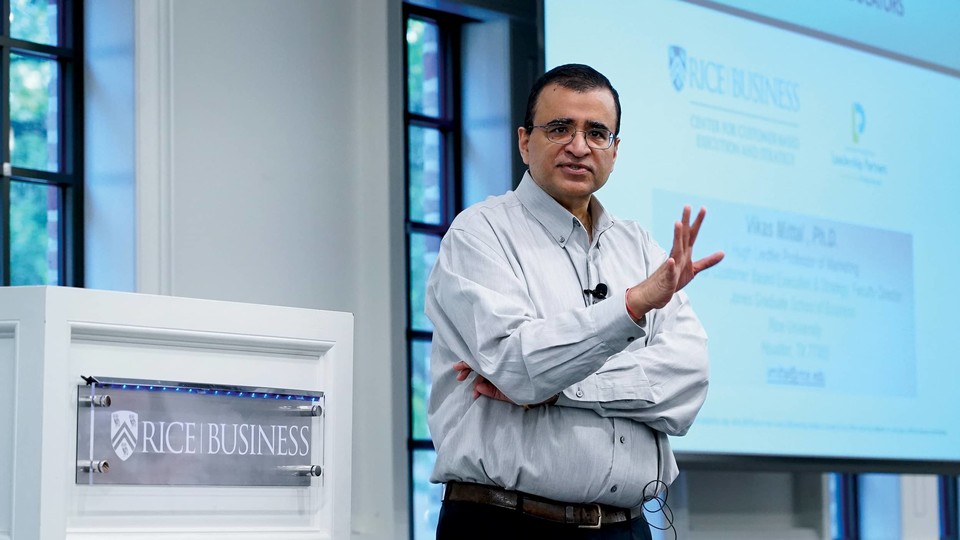
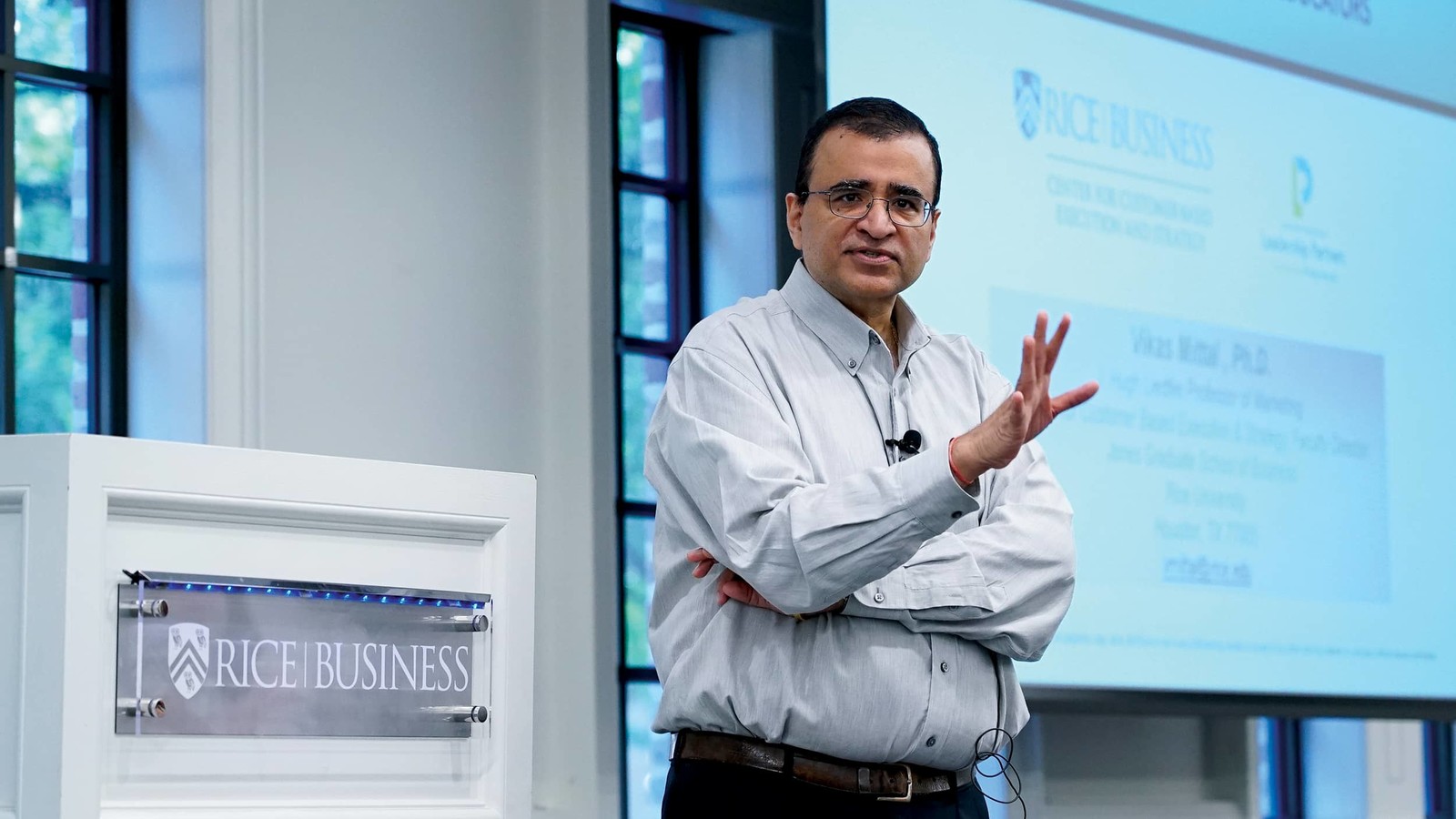
Many CEOs claim their strategy is “customer-focused” or “customer-centric,” but few truly are, says Vikas Mittal, the J. Hugh Liedtke Professor of Marketing at Rice Business. Instead, they struggle to pinpoint — then prioritize — what their customer values most.
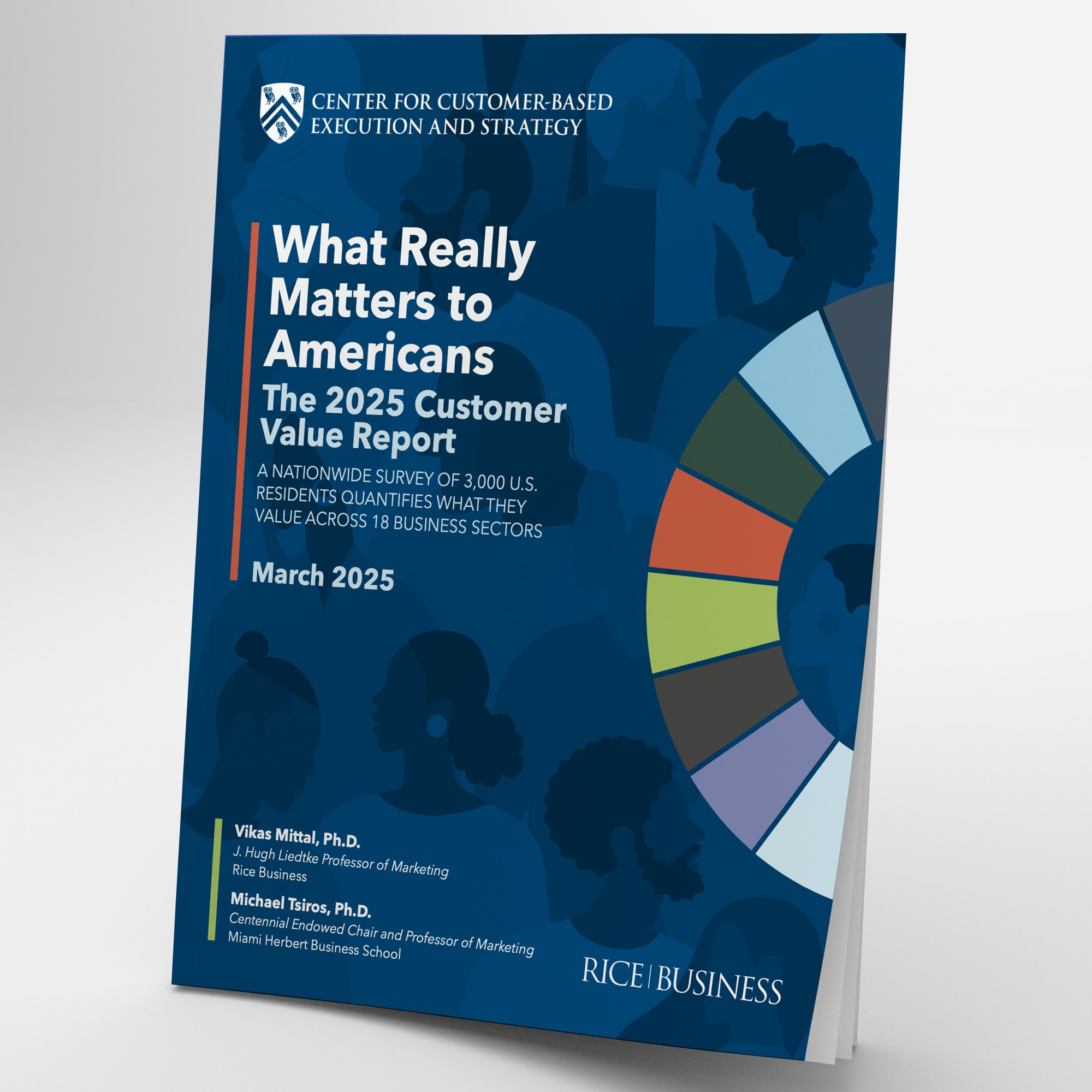
Without rigorous research on what matters most to their customers, executives tend to rely on guesswork or a gut feeling to drive strategy. It’s a costly mistake that can ultimately dent sales and profits, says Mittal, co-author of a first-of-its-kind customer value research study, along with Michael Tsiros from the Miami Herbert Business School. The first research report out of Rice’s new Center for Customer-Based Execution and Strategy (C-CUBES), “What Really Matters to Americans: The 2025 Customer Value Report” measures the relative importance U.S. residents place on key value drivers like cost, ease of use, safety, sustainability, convenience, and diversity, equity and inclusion, across 18 business sectors.
Mittal, C-CUBES’ faculty director, and Tsiros, a faculty affiliate, speak to Rice Business magazine about the findings and how companies and CEOs can use them to create a science-driven strategy that makes for satisfied, loyal customers.
VM: Customer satisfaction drives customer retention and sales and is a leading indicator of a company’s cash flow, revenue and stock price. But often, CEOs rely on legacy strategy planning to try to fulfill all customer wishes and demands. They are simply appeasing customers, without the science to truly get to the core of what their customers really value. They need to prioritize their strategy based on the top two or three drivers of customer value. Our goal was to create research that enables CEOs to do just that, especially for small to medium-sized businesses and nonprofits — a core focus of the center.
MT: We surveyed a representative sample of 3,000 U.S. residents from ages 18 to 75-plus. The sample was pretty balanced across gender, income and political party. For many categories, safety turned out to be a very strong value-driver — that may not have been the case pre-Covid. For example, safety was the top driver of customer value for the K–12 education, financial services, automotive and airline industries. Meanwhile, for all four of these sectors, diversity, equity and inclusion policies are the least consequential driver. Also notable is that sustainability and carbon impact rank among the least important drivers of customer value for the automotive and energy sectors.
VM: Consumers are very practical and wise. They want a reasonably good offering that’s affordable, and they value convenience. The wrong way to read the report is that customers don’t care at all about DEI and sustainability. They do. But they care about affordability, quality and convenience a lot more. These findings are a huge wake-up call for CEOs that likely have not considered — in a rigorous, science-backed way — how to prioritize these benefits in their organizational strategy.
MT: The report can be a conduit for CEOs to change their mindset and choose to follow science, and not gut-feel or intuition. Then, they can figure out which of the industries in the report they fall into and check that their company is at least broadly aligned with the drivers. If not, they’ve got some work to do. First, you have to excel on the top one or two value drivers. Then you can fulfill those additional things customers may care about, but that aren’t the main value drivers. After making science-backed changes to strategy, companies need to measure impact by linking customer value to financial outcomes. We hope these findings inoculate senior decision-makers so they’re not trend-chasing, but instead they’re strengthening their focus on customer value.
VM: Our goal is to run this study every other year. We’re also planning a new study that looks at the drivers of employee value. The center hosts regular events for leaders of nonprofits and for-profits. On Nov. 18, the center will host a customer-based strategy symposium at the Ion in Houston. We have a great lineup of speakers who will detail how they’ve used this customer-centric, science-backed business approach to strengthen their organizations.
Professor Mijeong Kwon’s research finds that loving your work can be valuable — but treating it as the only “right” reason to pursue a career can cause harm.
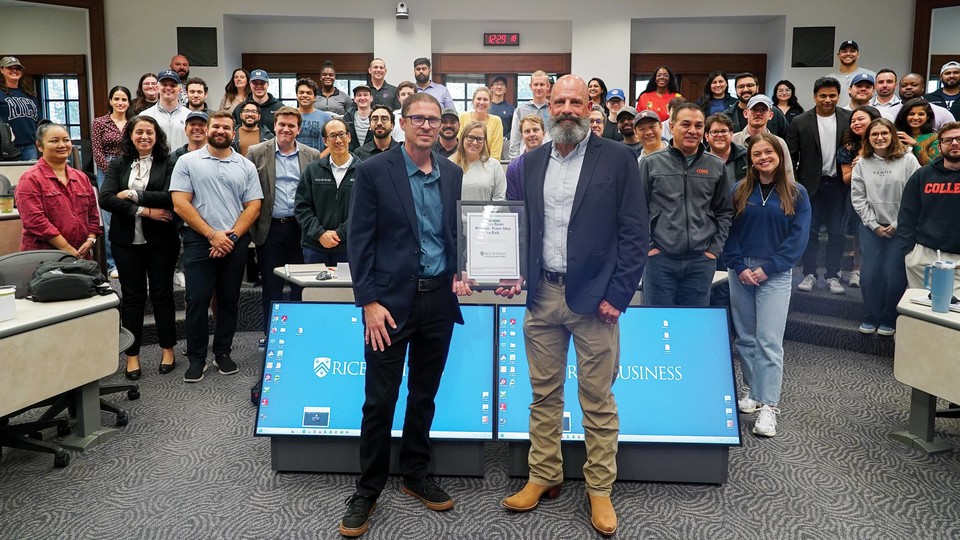

Five MD/MBAs share insights on the future of the nation’s healthcare system, the promises of new tech and how to achieve lasting reform.
Research from Rice Business professor Jing Zhou reveals that tools like ChatGPT can spark creativity at work — but only if employees think strategically.


Tools like ChatGPT can spark creativity at work — but only if employees think strategically.
The rise of generative AI in the workplace has led to a puzzling disconnect. Even as organizations increasingly embrace tools like ChatGPT, there’s been little evidence that they enhance employee creativity. For example, a recent nationally representative Gallup survey found that only 26% of employees who use AI say they’ve seen a creative boost.
This mismatch raises a key question: Can generative AI tools that create text, images and other content truly enhance employee creativity?
A new study from Rice Business suggests they can — but only when paired with the right cognitive approach.
Published in the Journal of Applied Psychology and co-authored by Jing Zhou, the Mary Gibbs Jones Professor of Management, the paper finds that generative AI doesn’t enhance creativity equally for everyone. Instead, its impact depends on how well people manage their own thinking while using it.
To unlock generative AI’s creative potential, employees must pair it with “metacognitive strategies” — mental habits like planning tasks, tracking progress and adjusting tactics.
To test how metacognition affects the creative benefits of generative AI, the authors ran a field experiment with employees at an actual organization — one of the first studies to do so. Using one of the most rigorous methods in organizational research, the study offers rare causal evidence of AI’s impact on workplace creativity.
The field experiment took place at a Chinese technology consulting firm — an industry that puts a premium on innovation. Because employees in this field are expected to develop custom solutions for diverse clients, it made for an ideal research environment.
The team worked with 250 nonmanagerial employees at the firm who were randomly assigned to either a treatment group or a control group.
Treatment group participants received access to ChatGPT accounts, along with usage examples, while those in the control group continued working without help from AI.
“What we found is that AI tools aren’t a creativity machine on their own,” Zhou says. “They can be a powerful partner. But for workers to truly benefit, they need to reflect on their thinking and adjust their approach in real time.”
Both groups completed creative problem-solving tasks during the work week. At the end, participants in the treatment group took a survey measuring their use of metacognitive strategies — including how well they planned, monitored and adapted their methods. For example, they would rate themselves on statements like: “While working toward my goal, I kept track of how effective my approach was.”
Employee supervisors, who were unaware of the study’s design or purpose, later rated the creativity of participant outputs. To supplement these evaluations, external reviewers independently assessed employee responses to a specific written prompt about protecting privacy in the digital workplace. Responses were scored on novelty and usefulness.
So, what were the results?
The experiment showed that employees who worked with generative AI produced more creative ideas than those who did not — but only when they applied metacognitive strategies.
In other words, the value of AI depends less on what it can do and more on how people use it. “Tools like ChatGPT have real potential to expand what we call ‘cognitive job resources,’” Zhou explains. “That is, things like access to relevant information, the ability to switch between tasks and moments of mental rest. But this potential is only unlocked when people use it strategically.”
The study has major implications for both employees and companies who are eager to integrate AI into their workflows. If AI-driven creativity depends on how people think, then companies must invest not just in new tools — but in the mental habits that make those tools work. And for employees: Using AI effectively isn’t just about mastering the technology — it’s about sharpening how you plan, adapt and reflect as you work. The good news is that these strategies are teachable. Firms can boost creativity by investing in metacognitive skills training.
What form that training should take is a fertile avenue for future study. Perhaps it looks like more reflective onboarding, structured support for planning or dedicated time to build and assess problem-solving strategies.
The study raises other important questions, such as the role of employee motivation. Employees who are more motivated to explore and solve problems may be more likely to engage metacognitively with AI. Team dynamics and organizational culture might also play a role in shaping how AI tools are used day to day.
The Rice Business study is promising, but its authors acknowledge limitations. For example, the long-term effects of using generative AI are unclear. Over time, employees who rely heavily on these tools may risk becoming too dependent, potentially weakening the very skills that nourish creativity, like autonomy and learning.
Still, the takeaway is clear: Generative AI isn’t a shortcut to more novel and useful ideas. To successfully use these tools, organizations need to do more than just install new software. They should provide training and support to help employees reflect on their processes and think strategically.
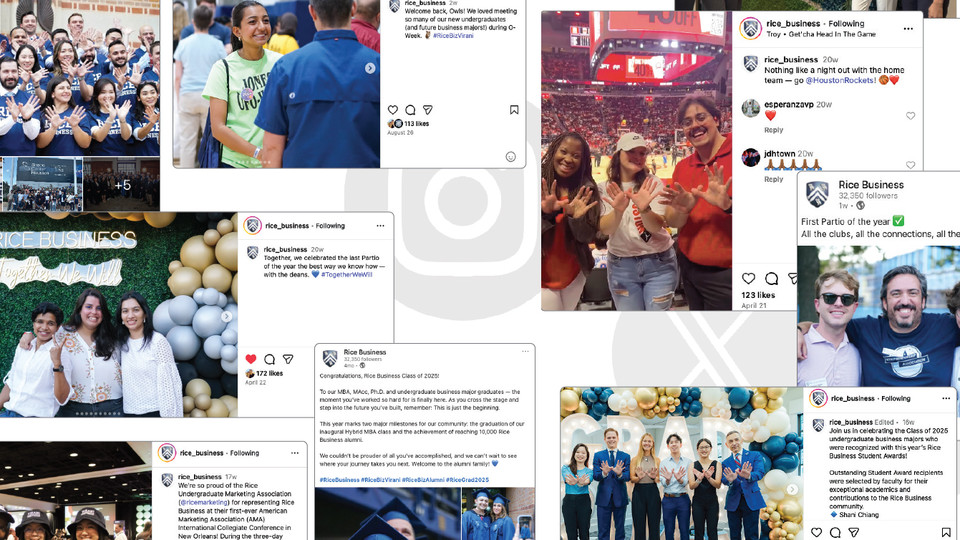
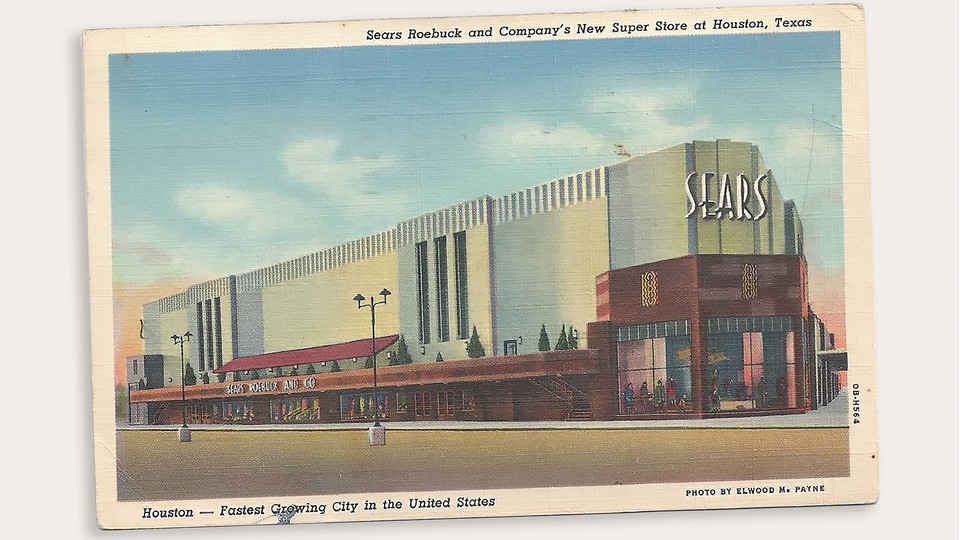
Ramon Marquez ’25 is reinventing iconic retail brands by running them like startups.
"The MBA opened more doors than I could have imagined. I expanded into new businesses, built friendships across the country and even found myself back in the classroom — but this time as the teacher."
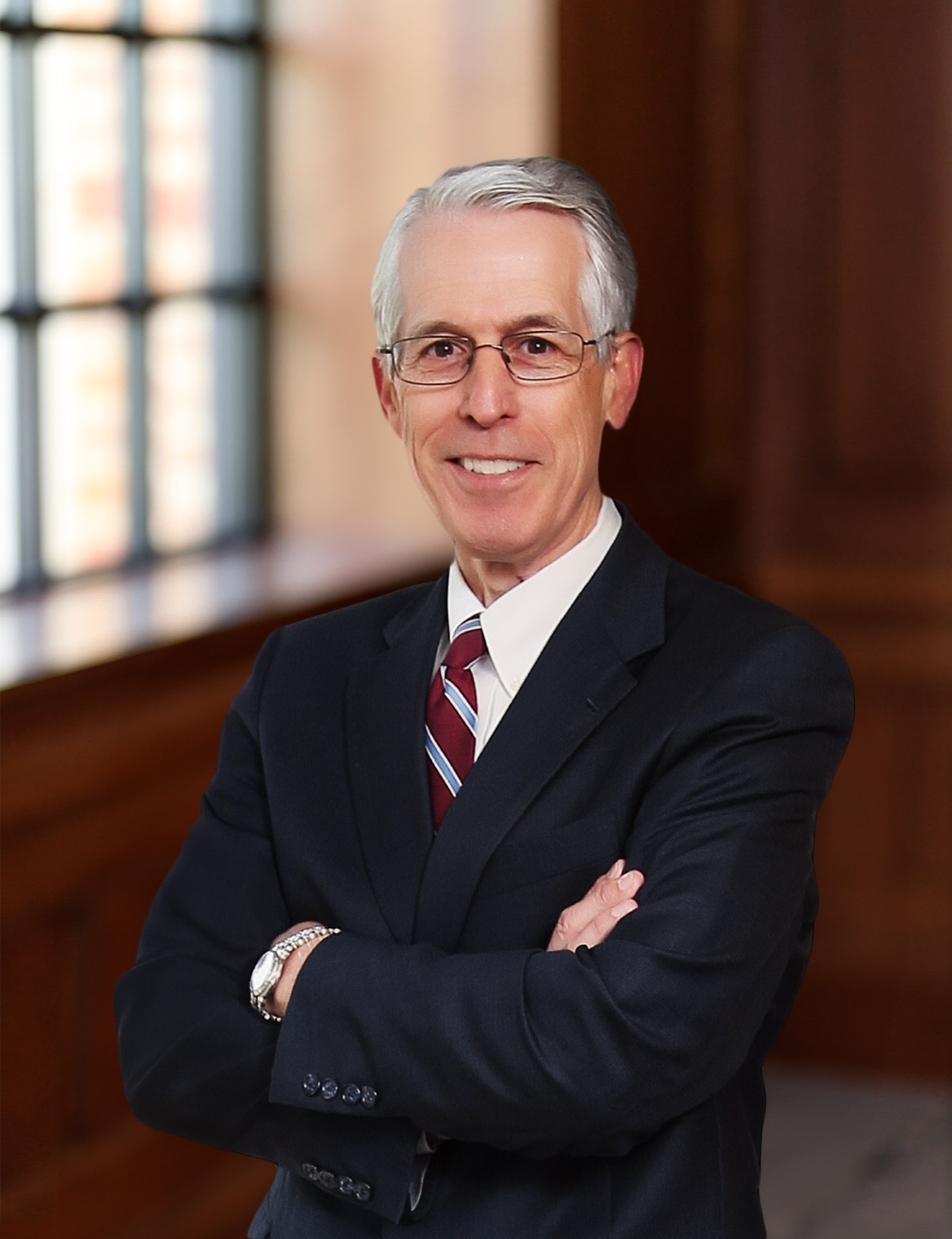
All my life, I’ve joked with my family about how I lived in the shadow of my older brother. He earned a Ph.D. in biology, became renowned in his field, and — at least in my mind — won our mother’s approval in ways I never quite did. I built a very successful career in banking, but I always wondered if she saw me as the son who stopped short, the one who never went on for a master’s degree.
That quiet sense of unfinished business lingered for nearly 50 years.
When I graduated from Baylor University in 1973 with a degree in math, the economy was reeling — Watergate, inflation, oil shocks, hostages in Iran. I had been accepted into a master’s program in mathematics at Texas A&M University, planning to move toward engineering. But graduate school felt like a luxury when jobs were scarce and bills had to be paid. So I set aside my dream of an advanced degree and went to work.
Banking wasn’t what I’d planned, but it turned into a lifelong calling. I spent decades working my way up, eventually buying my own bank and running it successfully for 25 years. By the time I sold it, I had weathered every kind of economic storm. On paper, I had everything — a long career, financial security and the satisfaction of building something from the ground up. But the small ache remained: I had never gone back to school.
The decision to finally pursue an MBA didn’t come from careful planning. It came from a phone call I almost didn’t answer.
I had just sold my bank and was stuck in a three-year non-compete — what I called my “timeout box.” Restless, bored and a little lost, I happened to be home when the phone rang. A recruiter from Rice Business asked if I had ever considered an MBA. My first thought was that it was a scam. My second thought was: at my age?
So I asked him, “Do you have any idea how old I am?”
He paused, then said, “Does it matter?”
That was the moment I was hooked.
Rice’s Online MBA was demanding — accelerated courses, international projects, on-campus residencies — but it was exactly the kind of challenge I needed. I was back in a classroom, decades older than most of my peers, learning alongside professionals who weren’t even born when I started my banking career.
The hardest part wasn’t finance or strategy. It was technology. I had lived much of my career in what I call “life B.C. — Before Computers.” My classmates were miles ahead in tools and shortcuts, while I scrambled to catch up. One day, during a group presentation, I froze when it was my turn to share my screen. I tried to delegate it away, but my professor cut me off: “Mr. Kroll, you’re not going to CEO your way through my class.”
She made me sit there until I figured it out. And I did. That lesson, as humbling as it was, reminded me that growth only happens when you stop hiding behind your experience and allow yourself to be a beginner again.
The MBA opened more doors than I could have imagined. I expanded into new businesses, built friendships across the country and even found myself back in the classroom — but this time as the teacher. Today I’m in my third year teaching banking and financial analysis at Baylor. Standing in front of students, encouraging them to “think big,” I sometimes remember that moment of panic at Rice, learning to share my screen.
At graduation, one of the proudest moments of my life, my family was there — including my wife, Judy, who supported me every step of the way, and my Ph.D. brother. For years I’d carried the feeling that he was the scholar and I was just the businessman. But as I walked across that stage, hooded in my Rice MBA regalia, I realized something had shifted.
It wasn’t about proving myself to him — or even to my mother. It was about finally finishing a dream I had set aside 50 years earlier.
And in that moment, for the first time, I no longer felt like the brother who had fallen short.

From mushroom surfboards to farming with AI, the Rice Business Plan Competition has been putting founders to the test for 25 years.

"At Rice Business, we see AI as a catalyst for innovation in the classroom and the workplace. Our graduates won’t just be proficient in AI — they’ll be leaders in shaping how it is deployed across industries."
Entrepreneurs share advice for startups.
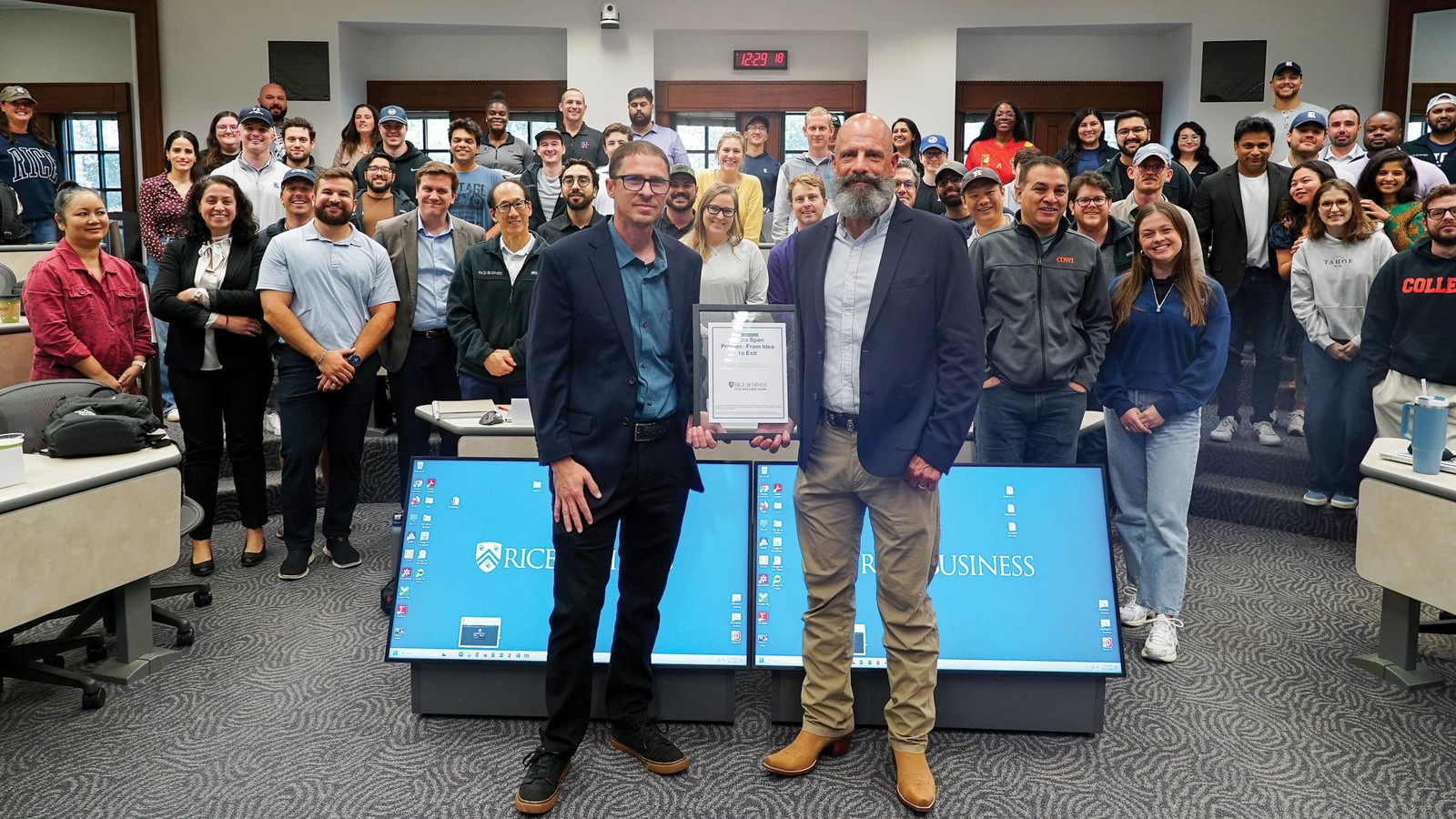
Teaching Forward
Rice Business alumni continue to play an active role in shaping the next generation of entrepreneurs.
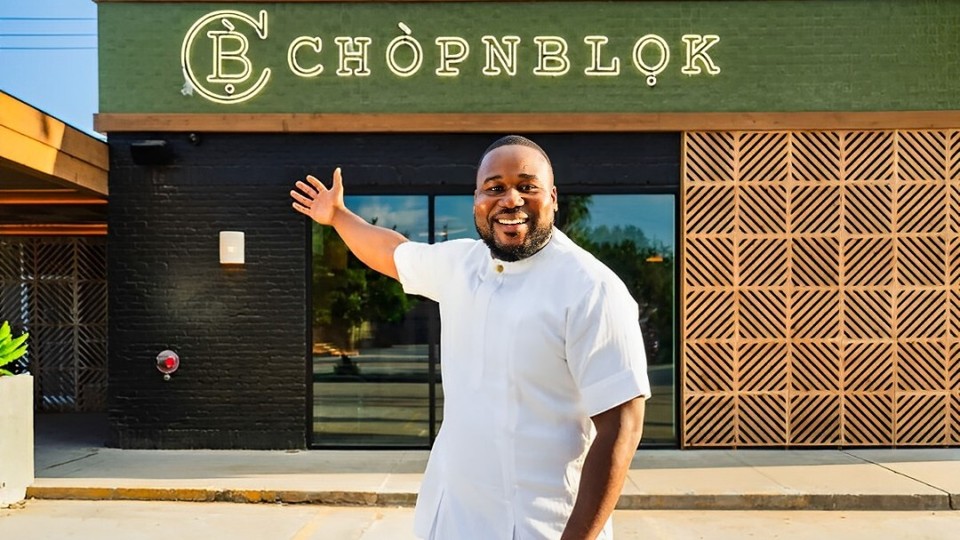
This fall, Executive and Professional MBA students in Al Danto’s Entrepreneurial Pathways class heard directly from graduates who have built and led successful companies: Jacky Fischer ’11 (3 Men Movers); Omair Tariq ’16 (Cart.com); Kelly Ginn ’07 and Mark Daves ’07 (Green Span Profiles); and Ope Amosu ’14 (ChòpnBlok).
Alongside case studies written by Alaina Schuhsler ’25, these alumni described how they launched their ventures and the obstacles they had to overcome — from lawsuits with former employers to the challenges of acquiring and managing family businesses.
At press time, the class was preparing for the visit from Ope Amosu ’14, chef and owner behind the modern West African restaurant concept ChòpnBlok, heralded by The New York Times as one of 2025’s Best Restaurants.
Here are a few of the lessons visiting alumni have left with students.
Jacky Fischer ’11
CEO, 3 Men Movers
When Jacky Fischer’s father experienced a health dilemma in 2002, she acquired his company, 3 Men Movers, at his request. Familiar with the business and its employees, she transformed the small, family-owned operation into a multi-million dollar enterprise as its CEO — prioritizing value creation for both drivers and external clients. “When we were only prioritizing the big numbers, I realized we weren’t being true to ourselves,” Fischer says. “Focus on the individual customer and then you’ll find financial success.” By 2024, 3 Men Movers had become one of the top independent movers in the U.S., with over 100 trucks and 400 employees.
Omair Tariq ’16
Founder and CEO, Cart.com
When Omair Tariq ’16 founded Cart.com in 2020, he left a career spanning strategy, finance and C-suite roles. Seeing an opportunity in the mid-market segment and recalling entrepreneurial inspirations from his younger years, Tariq launched Cart.com — which is now valued at $1.68 billion and works with more than 6,000 brands around the world. “As an entrepreneur, you need to be upfront about what you’re willing to compromise on with your partners and investors,” he says. “Value alignment is crucial from the start.”
Kelly Ginn ’07 and Mark Daves ’07
CEO and CFO, Green Span Profiles
For Kelly Ginn and Mark Daves, building Green Span Profiles into a leader in insulated metal panels has been as much about trust and timing as it has about strategy. Launching during a recession, they leaned on faith, family and a people-first philosophy — putting employees before customers — to navigate crises and grow in a highly competitive niche. “The biggest word for us is ‘trust.’ We built that at Rice and carried it every step of the way. The other word is ‘timing.’ You can’t force things. When the right opportunity comes, you have to take it.” By 2024, the company had surpassed $98 million in revenue and $21 million in EBITDA, establishing itself as one of the country’s leading IMP manufacturers.
Forget guesswork. New research from Rice Business shows the top drivers of customer value across 18 industries — and why CEOs need to rely on customer satisfaction rooted in data, not intuition, to drive strategy.
Meet some of our current students in the fall of 2025.
How do Rice MBAs balance long nights of course prep and the pressures of recruitment?
With greatest hits from artists like Al Green, Metallica, Drake and SZA. Follow along to hear aspirations, recommendations and inspiration from current students in our Full-Time, Executive and Professional MBA programs. You can also check out our spring 2025 issue to hear from students in the undergraduate, MAcc, Hybrid MBA, MBA@Rice and Ph.D. programs.

Hometown: Houston, Texas
Latest role: Operations manager, oil and gas
Favorite class so far: Corporate Financial Management
What books/podcasts are you currently obsessed with? The podcast “Against the Rules” with Michael Lewis and Vikas Mittal’s book “Focus: How to Plan Strategy and Improve Execution to Achieve Growth”
If you could instantly master one skill, what would it be? Creating optimal ChatGPT prompts
Is there anyone in the Rice Business community whom you’d like to shout-out? The APSE team has been hugely supportive.
Favorite album of all time? “Ride the Lightning” by Metallica (1984)

Hometown: Houston, Texas
Latest role: Commercial energy manager, chemical manufacturing
Go-to study spot: Brass Tacks in EaDo
What podcast are you currently obsessed with? “Death, Sex, and Money” with Anna Sale
What Rice tradition or event has meant the most to you, and why? The professional MBAs have PCFs (Post-Class Fun), which is a great opportunity to bond in a relaxed setting.
Best advice you’ve received during your time at Rice? “Leadership depends on the situation; there is no common set of attributes that determine leadership.” –Professor Brent Smith
Favorite album of all time? “What a Time to Be Alive” by Drake and Future (2015)

Hometown: Houston, Texas
Latest role: Marketing, energy/tech
Favorite class so far: All my strategy classes, plus Organizational Behavior with Bernie Banks, and Managerial Operations with Amit Pazgal
Go-to study spot: Coffee House at West End
What podcasts are you currently obsessed with? I’m loving “Friends That Invest,” which was recommended to me by a classmate.
If you could instantly master one skill, what would it be? I would love to instantly master negotiating skills. Either that, or how to dance bachata.
Favorite album of all time? “CTRL” by SZA (2017)
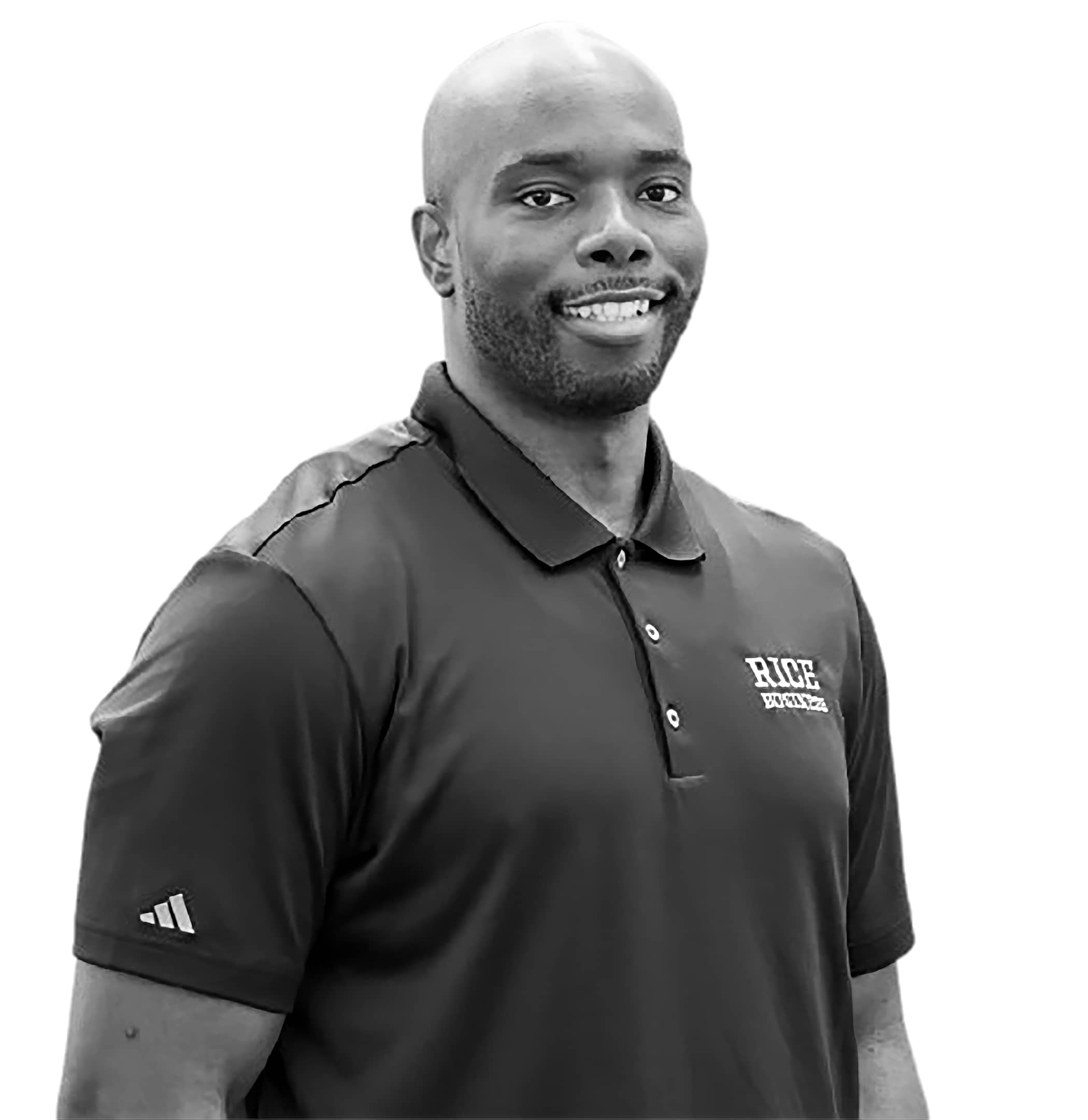
Hometown: Bronx, New York
Latest role: Neuroscientist
Go-to study spot: Breakout room 407
What book are you currently obsessed with? “Say It Well: Find Your Voice, Speak Your Mind, Inspire Any Audience” by Terry Szuplat
What Rice tradition or event has meant the most to you, and why? Rice Follies is such a fun way to unwind with friends and look back on the ridiculous and meaningful moments we’ve had.
Is there anyone in the community whom you’d like to shout-out? My mentor, friend and twin: Pelumi Sikuade ’25. He was my guiding light during my first year.
Favorite album of all time? “I’m Still in Love with You” by Al Green (1972)
Ramon Marquez ’25 is reinventing iconic retail brands by running them like startups.
Inside the office of Professor James Weston.
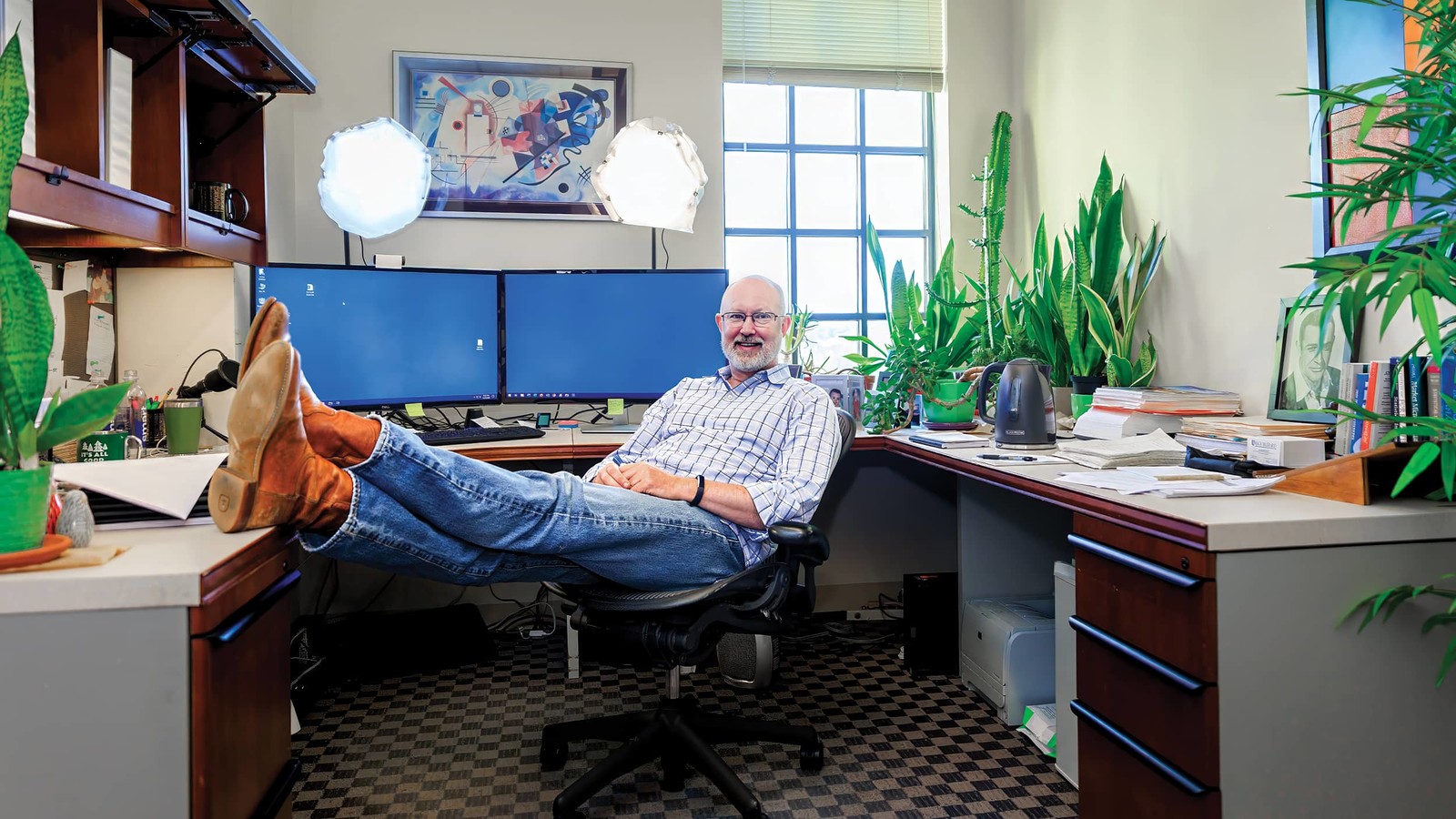
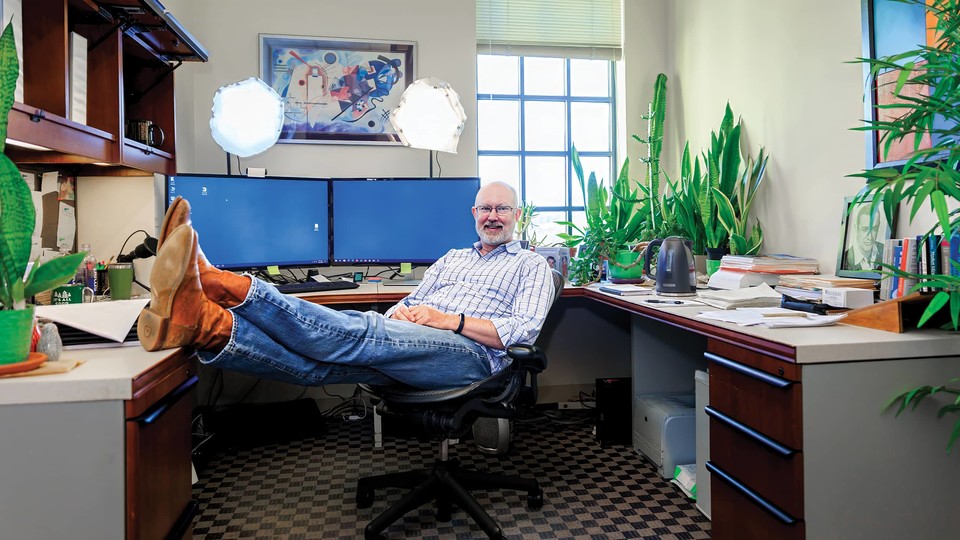
Professor James Weston has worked from the same office since McNair Hall opened in 2002. And after all this time, he has no plans to give it up. “They’re going to have to drag me out,” he says, only half joking.

Weston’s office reflects an energetic and wide-ranging life shaped by conversation, curiosity and community. It has a kind of studio apartment vibe: a tea kettle within arm’s reach of a ring light and microphone setup. Original paintings on the walls, made by his wife, an artist. Lots of greenery, some given to him by colleagues who are traveling or have moved on. A framed photo of Sean Connery — a leftover from a “shrine” at the Kelvin Arms, a Scottish-style bar Weston once co-owned. And in the ceiling above his desk, three #2 pencils stuck in a tile. (“Each pencil took about 100 attempts,” he says.)
There are a few traces of Weston’s academic pedigree — a framed image of the University of Virginia’s iconic academic quad, where he earned his Ph.D. — but the bookshelves are notably bare. “I was an early adopter of e-books,” he says. “I read everything on my Kindle or iPad now.”
Weston has taught finance for years, but his lessons extend far beyond textbook theory. In addition to his bar, he’s led real estate ventures with Rice alumni. And more recently, he finds himself in business pressing limited-edition vinyl for Snoop Dogg, Wu-Tang Clan and Stevie Wonder.
Now serving as senior associate dean for degree programs, Weston finds himself managing less vinyl and more email. But his office reflects an accessible and grounded approach to this new position. Faculty drop in regularly. Students know they can linger.
“It’s like a dinner party,” he says. “At a party, everybody winds up in the kitchen. In McNair, they wind up in my office.”
This is the office where Weston works. But also, it’s where he talks, plans, jokes and reflects. Put simply: “I live here,” he says.
"At Rice Business, we see AI as a catalyst for innovation in the classroom and the workplace. Our graduates won’t just be proficient in AI — they’ll be leaders in shaping how it is deployed across industries."
Research from Rice Business professor Jing Zhou reveals that tools like ChatGPT can spark creativity at work — but only if employees think strategically.
Check out 8 quick takeaways from the latest issue of Rice Business magazine, featuring global MBA experiences, rising undergraduate momentum, faculty highlights, AI insights and much more.
Welcome to Rice Business magazine — here are 8 quick takeaways from this issue:
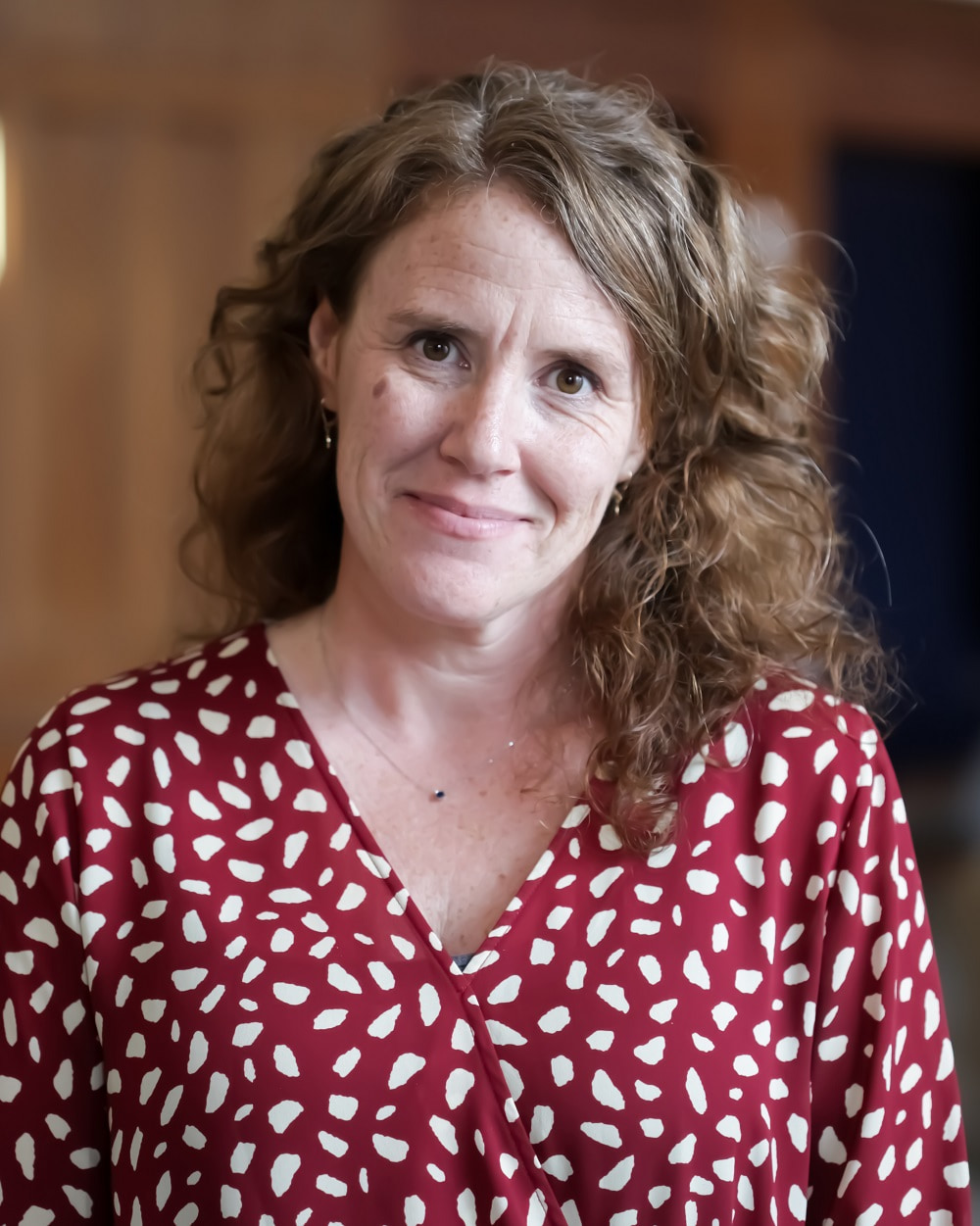
Have a story idea to share? Write to me at maureen.harmon@rice.edu.
Happy reading!
— Maureen
We asked, “What do you do when you're not working?”

I coach my two children’s youth sports teams and play fundamentally sound — though not aesthetically pleasing — pick-up basketball.

In between assignments, I‘m getting my hands dirty in the garden, tackling house renovation projects and training two puppies.
Outside of work, I love to bake (everything but cookies, which are my nemeses), spend time outdoors and act as mediator between our two cats and the houseplants.
Dean
Peter Rodriguez
Chief Marketing Officer and Assistant Dean of Marketing and Communication
Kathleen Harrington Clark
Editor-in-Chief
Maureen Harmon
Magazine Contributors
Helen Huneycutt
Annie McDonald
Scott Pett
Design Director
Bill Carson Design
Marketing
Kateri Benoit
Tessa Conrad
Tricia Delone
Helen Huneycutt
Dawn Kinsey
Michael Okullu
Kevin Palmer
Ananya Zachariah
Contributing Writers
Maureen Harmon
Helen Huneycutt
Weezie Mackey
Dan Morrell
Scott Pett
Proofreader
Jenny West Rozelle
Contributing Photographers
Tommy LaVergne
An Le
Annie McDonald
Printing
RRD Houston
Online Magazine Developer
Tricia Delone
Ramon Marquez ’25 is reinventing iconic retail brands by running them like startups.
Five MD/MBAs share insights on the future of the nation’s healthcare system, the promises of new tech and how to achieve lasting reform.
"At Rice Business, we see AI as a catalyst for innovation in the classroom and the workplace. Our graduates won’t just be proficient in AI — they’ll be leaders in shaping how it is deployed across industries."

The Future is Here: AI in Business Education
When I talk with our students today about preparing for the future of business, one topic rises to the top again and again: artificial intelligence. AI is no longer a futuristic tool waiting on the horizon — it is here, transforming industries, reshaping job functions and changing the way leaders make decisions. As a business school, it’s our responsibility to not only keep pace with these changes but to help lead them.
I recently served on a panel of deans discussing the future of AI. I was able to talk a bit about what we can offer students at Rice Business. For our students, AI is more than a skill set to list on a resume; it is fast becoming a foundational competency. AI certainly has ethical concerns, but our goal is to show students how to use it as a supplementary tool, one that can enhance the way they think about an issue or one that can serve as a tireless tutor for their work, continually making them better thinkers, doers and leaders.
Our undergraduates have BUSI 233 (“GenAI For Business: Tools and Implementation”) to help students on an introductory level, but we are also offering graduate-level elective courses like “AI Tools for Business Decision Making,” with Piyush Anand, assistant professor of marketing, or “Introduction to Generative AI for Business Applications,” with Kathleen Perley, an instructor in management who is also serving as an adviser on AI initiatives at Rice Business. Whether you’re an aspiring marketer using machine learning to understand customer behavior, a finance professional applying predictive analytics or an entrepreneur leveraging generative AI to prototype new ideas, fluency in these technologies is no longer optional. We must prepare our graduates to work with AI — critically, ethically and creatively — rather than fear being replaced by it.
For our faculty, AI is both a challenge and an opportunity. It challenges us to rethink teaching methods in a world where students may come to class having already asked ChatGPT to analyze case studies. But it also opens new avenues for research — from modeling global supply chains more accurately to exploring how algorithms shape consumer trust. Importantly, it forces us to engage with pressing questions: How do we ensure AI is used responsibly? How do we guard against bias? How can technology serve human ingenuity rather than diminish it?
At Rice Business, we see AI as a catalyst for innovation in the classroom and the workplace. Our graduates won’t just be proficient in AI — they’ll be leaders in shaping how it is deployed across industries.
Business education has always been about preparing students to lead in uncertain times. Today, uncertainty often takes the form of rapid technological change.
But these shifts are less a threat than an invitation: an invitation to think bigger, move faster and lead more thoughtfully.
— Peter
Check out 8 quick takeaways from the latest issue of Rice Business magazine, featuring global MBA experiences, rising undergraduate momentum, faculty highlights, AI insights and much more.
From mushroom surfboards to farming with AI, the Rice Business Plan Competition has been putting founders to the test for 25 years.