
Image
When other people disclose a success or failure, we often respond in kind, or hold back, depending on what seems likely to protect their feelings.
Based on research by Emily Prinsloo (Rice Business), Irene Scopelliti (University of London), George Loewenstein (Carnegie Mellon), and Joachim Vosgerau (Bocconi University)
Key takeaways:
Now flip the situation. You’ve just lost a major client. Before you’ve had time to process it, a colleague tells you they blew an important pitch. Suddenly, your own bad news feels different. Not good, exactly, but useful. Do you share it with them, hoping your setback might make theirs feel less lonely?
Traditional wisdom suggests that people share their successes to build status and manage perceptions. But a new paper co-authored by Emily Prinsloo, assistant professor of marketing at Rice Business, suggests that we are not simply calculating how disclosures make us look in the eyes of other people. We’re also thinking about how our news will make other people feel. When someone else is hurting, sharing success can feel like salt in the wound; but admitting your own letdown can become a small act of solidarity.
In other words, our everyday “responsive disclosures” — what we choose to share after someone else shares something with us — are shaped by prosocial motives, not just self-promotion.
Sharing our moments of success and hardship with others is not a one-way process. It’s interactive. One person shares first, and then the other person must decide whether or not to respond with an outcome of their own.
To understand the unwritten rules of these moments, Prinsloo and her co-authors looked beyond why people initiate disclosure and focused instead on what they call “responsive disclosures”: the split-second decisions we make about whether to reveal a success or setback after someone else has already shared theirs.
“Most research focuses on the person who initially shares an outcome,” Prinsloo says. “But shifting focus to the responder is fascinating because the choice to share or hide our own stories offers a particularly meaningful context for understanding how people manage emotions and relationships through everyday communication.”
To see how these decisions play out, the researchers conducted nine studies involving more than 8,200 participants across health, career and financial scenarios, including live conversations between strangers.
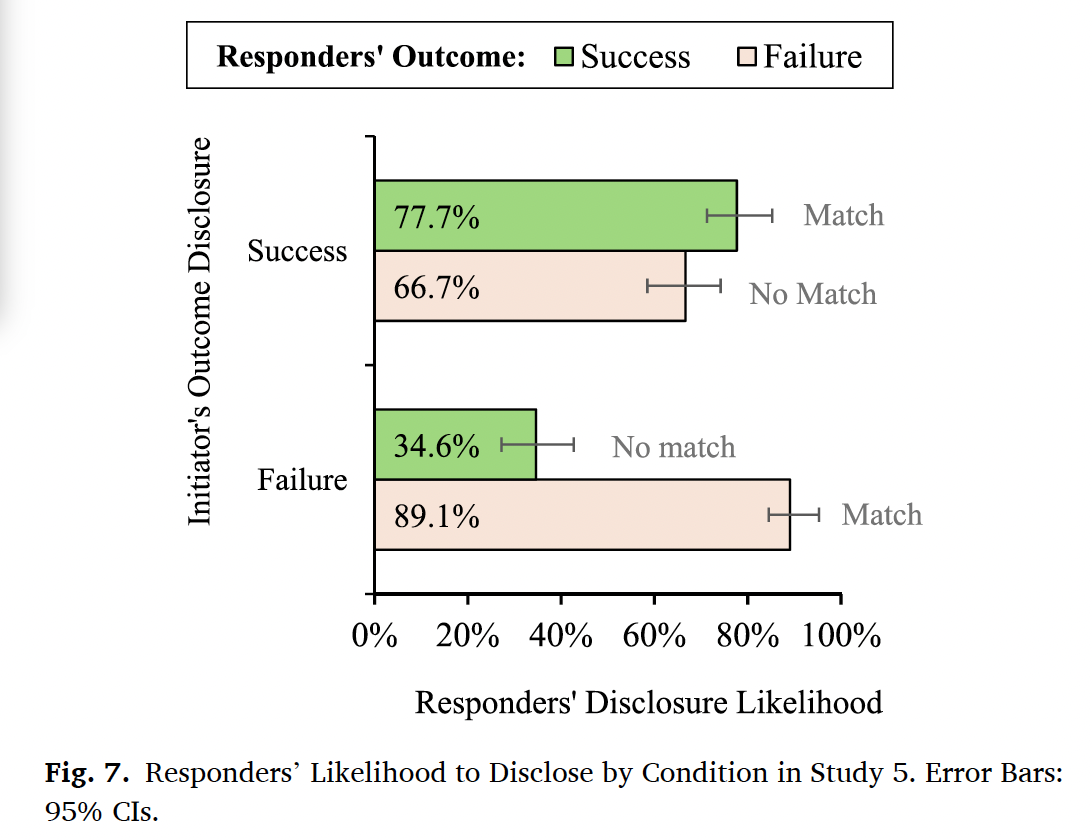
Across the board, people tended to follow a basic rule of reciprocity, matching what others shared first — disclosing success in response to success; and disappointment in response to disappointment.
Interestingly, this reciprocity was not perfectly symmetrical. Study participants were more willing to match stories of failure than stories of success.
Whereas sharing a matching setback is expected to have an emotional impact, such as a feeling of solidarity or comfort, participants expected little benefit from matching someone’s success disclosure.
And what about sharing a story of failure in response to someone else’s win? This was seen as dampening a celebration or shifting attention away from it. Most people instinctively hold those disclosures back to protect the initiator’s feelings. That said, the researchers found that people are far more willing to admit a failure to a successful colleague than to announce a success to one who had failed.
That restraint is highly prosocial.
When someone reveals a setback, we often share our own to signal solidarity and make that person feel less alone. (With a crucial caveat: Responsive disclosures need to be relevant to the story the initiator shares. Sharing an unrelated health issue in response to someone’s financial struggle is unlikely to inspire prosocial feeling.)
But responsive disclosures are not just a choice of whether to share information. How we choose to frame and articulate those disclosures are also shaped by how we anticipate it will be received.
To see this in action, one of the studies asked participants to imagine running into an acquaintance at the airport. The participants imagined having received a prestigious job offer, but their acquaintance shares they’d just been rejected for a job.
Many participants softened the blow of disclosing their success by writing longer responses, downplaying the offer or attributing it to luck. More than a quarter even misrepresented or concealed their success to spare the other person’s feelings.
Whether through apologies, delayed reactions or outright deception, these conversational gymnastics show that we are acutely aware of the emotional weight our words and stories carry. The research proves that in everyday interactions, we are constantly and intuitively trying to manage the feelings of the person standing in front of us.
Prinsloo and her co-authors note that good intentions don’t necessarily mean these strategies achieve their aims. Concealing a success could potentially make the other person feels patronized, and sharing a matching failure could be heard as competitive instead of comforting (perhaps making the initiator feel “this is about me, not you”).
Cultural norms may also shape when these patterns appear. But generally speaking, the findings reveal that our responsive disclosures are motivated by empathy for others. It’s a key conversational tool we use every day to preserve harmony and support our peers.
“The next step is understanding when these conversational choices are actually seen as supportive, and when they instead create awkwardness or friction,” Prinsloo says. “Future research can clarify not just why people choose to share or hide their outcomes, but whether those strategies achieve their goals.”
Written by Scott Pett
Prinsloo, et al (2026). “Responses to Outcome Disclosure: People Asymmetrically Disclose or Hide Their Outcomes to Protect Others’ Emotions,” Organizational Behavior and Human Decision Processes.


U.S. consumers and businesses are now facing a future of more expensive borrowing.

Rice Business faculty are exploring big questions about AI and how it’s reshaping business, technology and the classroom.