Up Next
Professor Jonathan Miles discusses why so many talented people struggle to advocate for themselves, what his comic book store taught him about entrepreneurship, and why influence is often misunderstood.
When Yael Hochberg, the Ralph S. O’Connor Professor in Entrepreneurship — Finance, made the decision to come to Rice, she had a vision for building an entrepreneurship program like no other. It would be one for the modern era that would set the pace for entrepreneurship education going forward.
Now, more than a decade later, Rice consistently ranks number one in the country for entrepreneurship and is leading the way in world-changing innovation through hubs like the Liu Idea Lab for Innovation and Entrepreneurship (Lilie), which offers experiential learning opportunities and co-curricular activities.
In this episode, Professor Hochberg, head of the Rice Entrepreneurship Initiative and Lilie, joins co-host Brian Jackson ’21 to discuss how she brought her vision for a modern entrepreneurship program to life at Rice, the incredible innovation that has come from Lilie over the last 10 years and what the future holds for entrepreneurship education in the age of AI.
Subscribe to Owl Have You Know on Apple Podcasts, Spotify, Youtube or wherever you find your favorite podcasts.
[00:00]Brian Jackson: Welcome to Owl Have You Know, a podcast from Rice Business. This episode is part of our Up Next series, where faculty researchers and alumni weigh in on the trends currently shaping the world of business.
Today's episode features Professor Yael Hochberg, a professor of entrepreneurship and finance at Rice Business, who leads the Rice Entrepreneurship Initiative and Lilie, the Liu Idea Lab for Innovation and Entrepreneurship. Professor Hochberg is one of the leading voices in entrepreneurship, with research focused on venture capital, startup networks and the financing of innovation. Before academia, she also spent some time in the tech industry, giving her both the research and real world perspective on building companies. At Rice Business, she's also shaped one of the top entrepreneurship ecosystems in the country through Lilie, supporting founders from idea to venture and connecting them with capital, mentorship, and a broader network.
In this conversation, we talk about her path into entrepreneurship, what makes Rice Business's approach different, and what she's learned after years of working with founders about what actually turns an idea into a company.
Well, thank you, Professor, for joining me today on Owl Have You Know.
[01:15]Yael Hochberg: Great to be here, Brian.
[01:17]Brian Jackson: Well, I want to start off. You're the head of the Rice Entrepreneurship Initiative, the Lilie Lab, and you are the Ralph S. O'Connor Professor in Entrepreneurship – Finance. What was your hook into entrepreneurship? Was it an experience, a person, a company?
[01:33]Yael Hochberg: That's a really great question. I would say I rather accidentally fell into this. I was a math geek in high school and in college, undergraduate engineer, went off to grad school to do more complex math, and about my second or third year in graduate school, I met a number of undergraduates at Stanford who were trying to build something. This was 1999, so Web 1.0, and they wanted to sell consumer electronics online. You know, at the time, revolutionary, now obvious. But we took that, and together with an executive who had been at Best Buy, who had just left, actually wound up building something a little bit different than that. We wound up building a software startup that did middleware for original equipment manufacturers in the electronics industry.
So, we built a company that basically replaced these guys called manufacturers' reps, which are, kind of, think about middle-aged men in ill-fitting suits, driving Buicks where, you know, they arrive at the regional headquarters of a Best Buy or a Good Guys or a Future Shop, open up a trunk and pull out a bunch of catalogs for Westinghouse and Sony and Samsung and LG and a bunch of other manufacturers and say, "Here's a form. What would you like to order this quarter to stock in your stores?"
And, you know, the regional manager would fill out a bunch of these forms and then go over to the advanced technology of the 20th century, the fax machine, and fax those to the manufacturer's rep, who would then walk over to his fax machine and fax those on to the manufacturers. And then someone would drop ship a bunch of electronics to, you know, a regional warehouse or to the stores for you and me to go buy a TV or, you know, a computer, a monitor, a video game console, whatever it might be.
And we replaced that with software that, kind of, took all of that out of the loop and was meant to connect the original equipment manufacturers with the managers of these, you know, kind of, big-box stores to, kind of, help them order their inventory for, you know, the quarter or the year, whatever it might be.
And this was 1999, 2000, you know, B2B, it's going really, really hot. We raised money, we were building the software, and I think if you fast forward to today and I say to you, how many of the following names still exist, Circuit City, Good Guys, Future Shop, et cetera, they don't exist. These stores don't exist. The only one that's left is Best Buy. We were doing something very interesting that Best Buy then did for itself, but we also hit the B2B Nasdaq crash, and Web 1.0 crashed out from underneath us and, kind of, took everything along with it, in particular, took our investors along with it, which was sad at the time.
I was at Stanford Business School doing my Ph.D. And by the time we were done with that and I had put the company to bed, I was like, "Okay, I'm going back, and I'm going to finish off the Ph.D., but now I actually know what I want to do research on." And, you know, I found a couple of faculty members at Stanford who were doing work in the world of venture capital and entrepreneurship and said, what would it take for me to not price options or the yield curve term structure of interest rates, do fancy math, and instead switch to doing very different kind of work, which is, you know, sort of, the world of corporate finance as it applies to entrepreneurship? And that's, kind of, where I fell into things.
[05:22]Brian Jackson: No, but you saw a process, right? I mean, one, to take the form, to then fax it. How incredibly inefficient. You improved it. Like, is that the hook of entrepreneurship – is solving something that just seems so antiquated for a process?
[05:37]Yael Hochberg: I think this is, you know, part of this is also personality. People always ask me, you know, "What do you mean you can teach entrepreneurship? Why do you guys have even bother with entrepreneurship programs? People are either born as entrepreneurs or they're not. They either have that entrepreneurial drive or they don't."
I think there's something to that, and that it is true that I, you know, can't take someone without the drive and turn them into an entrepreneur. But I can take someone who has that latent drive and who is interested, and I can give them tools and frameworks that will help them be successful if they pursue entrepreneurship. I happen to be one of these people who has that drive. I like to build. I don't like sitting still. When I see problems, I don't like to simply say, "Hmm, that's really annoying." I try to solve them.
So, you know, in this particular case, a couple of undergrads caught me at a point when I was frustrated with buying, you know, I forget whether it was a stereo or a video game console or whatever it was for my dorm at Stanford, and I thought it was an interesting opportunity. So, you know, that's, I would say, the hook is seeing places where there are inefficiencies or opportunities to improve and wanting to find a way to improve them.
[06:47]Brian Jackson: Yeah, when I think of people who have that drive, I mean, I, of course, think of Rice and the students and alumni there. So, when you first arrived at Rice, what felt different about the culture here?
[07:01]Yael Hochberg: So, I chose to come to Rice specifically with the idea of building an entrepreneurship program in mind, and to me what was appealing about Rice was the fact that it was, you know, a high-quality, well-respected institution, you know, a top-tier school with a big focus on engineering and technology in a city that had a number of major industries that were ripe for change. So, we're talking transportation, we're talking healthcare, we're talking energy, all industries that, at the time that I arrived, had not yet undergone the changes that we're seeing them undergo today.
And then on top of that, you've got NASA, the commercial space arena, which was really, really just starting to develop back then. You know, it's a massive city. It's got two major airports, a great economy, ton of smart people. It was a platform. The university is a platform, the city's a platform, and yet there really wasn't anything here.
We had a couple of faculty members who had really made it their life's work to create an entrepreneurship program for the MBA students, who had built an entrepreneurship program through the '80s and '90s, and they built a phenomenal program that was built around what Houston was at that point in time to a great extent. It really wasn't about, per se, launching deep-technology businesses or things of that sort, and, you know, they were looking for someone to modernize and, you know, freshen that up, but they were ready to retire, and they wanted someone who would take the program and build it for the modern era. You know, for the undergraduates, there was nothing. There was, I think, a one-credit class in entrepreneurial leadership, but from the Center for Civic Leadership.
So, there really just wasn't a lot going on. And that was an opportunity to really think about what should an entrepreneurship program for the 21st century actually look like. What should an entrepreneurship program in the 2020s and the 2030s look like? And a place to do so where there's a ton of industry looking for innovation and hungry for change and seeing the change that's coming for them and eager to participate in that.
And that, to me, was just a tremendous platform. You've got smart students, amazing faculty, amazing technologies being developed in the labs, and a city with a fantastic economy, a sense of civic pride, a desire to build and transform, and I thought that was a really appealing place to come and be able to re-envision what entrepreneurship programs should look like and build that. And I was lucky enough, you know, there was interest at Rice in seeing someone do that, and the university and the city have been a really interesting place to try and envision that and build.
[10:06]Brian Jackson: I wholeheartedly agree about Houston and Rice being just such an incredible platform. Also, I mean, a huge kudos to you, and congrats on Lilie. It celebrated its 10th anniversary last November. For someone who's never stepped inside or heard of Lilie, how would you describe it and what it is, and key benefits for students and alums?
[10:27]Yael Hochberg: Sure. Wow, that's a big task right there. Okay, so I think it's worth stepping back and starting from the beginning. So, Lilie, the Liu Idea Lab for Innovation & Entrepreneurship, at some level, it's, sort of, the manifestation of the pipe dream of myself and Frank Liu, who, through the generosity of the Liu Family Foundation, is how we got to launch Lilie.
I was at Rice during my first year here, talking about my vision for what I wanted to build in entrepreneurship here at Rice. Frank was in the back of the audience. This was an event for parents, I believe, and heard me talking and was quite interested. He had two kids who were entrepreneurs. He was very enthusiastic about entrepreneurship. He was an entrepreneur. He met his business partner in Lovett College as an undergraduate, felt Rice had really given him the ability to launch his business, wanted to give back, and have more students be able to create their dreams, and through that support the economy here in Houston.
So, Frank and Cindy Liu decided that they would fund my… I'll call it my pre-seed round of investment in my little startup dream, and enabled us to launch Lilie back in late 2015, early 2016. So, all of this, you know, wouldn't have been possible without their contribution, and Frank has been an amazing, amazing partner to really shepherd this along. He gives of his time, he gives of his knowledge, he is constantly interacting with the students, and it's just fantastic to see.
For a student who's walking into Lilie, I would say, “Imagine the antithesis of every neo-Gothic, Ivy League university space you can think of.” You walk into a modern building, floor-to-ceiling windows flooded with light, bright colors everywhere. Our color scheme is lime green, bright pink, royal blue, and there was some yellow in there at some point that got retired. But it's a riot of color. It's a space that feels like a startup space.
So, you're walking into a, you know, space that could be the offices of any major tech company in Silicon Valley that you can think of, complete with all the comfy spaces, the little kitchen with the coffee machines, we've got four different kinds of coffee, and lots of people wandering around doing interesting things. There's whiteboards everywhere, there's Post-it notes, there's markers and highlighters and Legos, and you name it. It just looks like a creative space. And it was really meant to give a different kind of feel, a different kind of space for the students to walk into and step back from just the notion of academics as usual, and put them in a headspace to think about creativity and making change, you know, building things, designing things.
So, for students who are walking in, the first thing that will happen is someone will greet them at the door. There are a set of staff members, all the Lilie staff live over at the Lilie space, and someone will ask them what they're looking for and why they're there, what they're interested in, how can they help. It's an opportunity for the students to really get connected to resources. Lilie offers classes, but not just classes. Lilie also offers a ton of co-curricular activities. So, it's really, kind of, the center for entrepreneurship on campus.
And it's not just students, it's graduate students, it's postdocs, it's faculty members, it's research scientists, it's anybody on campus who's thinking about building something. And we really get a ton of diversity in who's walking through those doors, from music students to architecture students to Ph.D. research scientists, faculty members in physics, MBA students. It's the whole gamut.
And my goal is to create a place where they can come and get access to, you know, a lot of different resources. So, you know, in addition to the classes, one of the things that we do is we offer a ton of what we call co-curricular programming. So, this is programming that's very tightly linked to the curriculum we teach in the classes, which is to say that a student who is in a class will hear the exact same language, terms, frameworks that they'll hear in the co-curricular programming.
So, it's not disconnected. It's a strong continuation from the classroom to outside the classroom. We call this our double helix between the co-curricular and the curricular. But these are things like in-academic-year venture acceleration programs, like our Launchpad program, it's our annual business plan competition, the Napier Rice Launch Challenge, it's things like venture development workshops, it's things like First Pitch, it's mixers where they can meet other students, it's programs for Ph.D. students specifically who are trying to launch companies, like our Innovation Fellows program, or for postdocs, like our Commercialization Fellows program.
There's just a ton of stuff that we're doing... A summer venture studio accelerator where students who are working on businesses can come in and have, you know, 10 weeks of closely mentored time to really work on their businesses and get them launched. It's a lot of things that happen outside the classroom, and really, it's meant to meet each and every stakeholder where they're at.
So, for the student who isn't ready for a class and just wants to hear an inspirational lecture, and show up at a Lilie lecture and hear from a famous founder, or for someone who wants to learn about something specific, who comes to a specific training workshop or to a lunch and learn, it might be someone who's got a business idea and is looking for that mentorship who comes into a weeks- or months-long program, such as the Launchpad program. Students with businesses who are actually operating them, it varies. We try to have something there that meets the needs of everybody.
And it's not just entrepreneurship, it's also innovation. It's also the students who are interested in thinking about, "How do I make change in other spheres? How do I make change in government, in large corporations? How do I think about innovation more generally?" It's the students who are interested in design and design of new products, new approaches. So, we try to be inclusive to everybody who's thinking about, “How do I make change in the world?”
[17:14]Brian Jackson: Do you have, like, an example that you can point to of something that, you know, a student-led initiative that has done that, where it's change that we are seeing?
[17:23]Yael Hochberg: Oh yeah, I mean, I'll give you two examples that are now amongst the largest tenants in our innovation district over in the Ion District. So, the first of those is Helix Earth Technologies. Helix Earth Technologies is a company that was born at Lilie from a mechanical engineering Ph.D. student, Rawand Rasheed, who came into Lilie, participated as an Innovation Fellow, participated in a ton of our programs. He came into his Ph.D. program with a technology that he had worked on at NASA for doing filtration of air and water on the space station, and he turned that into his dissertation work, developed that technology, and has since launched a company together with one of our alumni, Brad Husick. And that company is now one of the largest tenants over in the Ion District. They're about to raise their second round of financing.
And the company's just grown tremendously. They reduce latent load in commercial HVAC applications, retrofitting existing systems so as to make HVAC more efficient. The technology has a ton of other applications as well. It's a platform technology. Fantastic thing that I think we'll see applied in quite a few industries in the future.
Another example, Coflux Purification, another great story. This one's a story that comes out of a, kind of, combination of the business school and the engineering school. We had a part-time MBA student who was, kind of, matched up with a postdoc and Ph.D. student out of the engineering school. They have built a company that removes PFAS from water, so these are the "forever chemicals."
They do it with a drop-in system that can go into existing municipal water plants and existing filtration systems. They take all of these harmful forever chemicals out of the water. They have also successfully raised funding over in the Ion District, hiring like crazy, fantastic success story of bringing together the business talent and the engineering talent, which was really what, you know, had been the big attraction for me in coming to Rice and thinking about it as a platform.
Then I'll give you a third one. So, an undergraduate student named Tyler, who was a long-distance runner on our track team and, for the life of him, could not find a running shoe that met all of his requirements. So, he decided, "Maybe I should build one," showed up in Lilie and said, "Am I crazy? I want to build a shoe company." We told him, "You're not crazy." And he has built a shoe company, and every time I say how much money he's had in the last quarter, I'm wrong because it's always more. I think it was something like two and a half million was the last run rate that I heard, and everyone I know seems to get his targeted ads on Instagram. So, the shoe has taken off, literally. The company's name is Veloci, and another great example of a company born out of Lilie.
We've got autonomous drones for organ transplant deliveries, that's a team out of engineering, an undergraduate team. We've got a lovely team right now, a venture that's both students and a faculty member at the business school who are creating an AI company in the financial space that's looking extremely promising, and I think is going to be a big success out of the business school. It's just there are so many stories, too many to recount here.
[20:45]Brian Jackson: Well, these are fantastic, and I think such a great hint at what's happening there at Lilie. The one part I always like to go back to is the strong alumni network that Rice has, and, of course, the number of founders we have out of Rice. So, how do alumni stay involved with Lilie, and what difference does that make for students who are just trying to get started?
[21:07]Yael Hochberg: So, one of the things that Lilie spent time building it was one of the opportunities we saw right at the beginning, was thinking about how we could tie back the alumni and keep them more connected to what we were doing at Rice Business.
So, we took an organization, a small organization that had been built through the efforts of one of our faculty members, Al Danto, the JGSEO (the Jones Graduate School Entrepreneurs Organization), and expanded that into a Rice-wide network, the Rice Alumni Entrepreneurs and Innovators (RAEI). And that organization is an opportunity for alumni to stay connected to each other, to stay connected to us. We run roundtables for entrepreneurs here in Houston and a few other cities. It's been growing over the last few years, and it's also an area that I think we'll see a lot of expansion on in the coming years. But it's an opportunity for our alumni who think of themselves as entrepreneurs and innovators, who are interested in the space, to stay connected to each other, to stay connected to us here at the business school and here at the university.
And, you know, I think one of the things that's really amazing about Rice alumni is just the willingness to give back. We are constantly, constantly, you know, running into... First of all, constantly running into entrepreneurs we didn't even know existed, right? And invariably, when you find someone, it doesn't matter whether they are a graduate of the Rice Business MBA program or whether they are a graduate out of undergrad or grad over in some other part of the university, everyone is so excited about the idea of giving back to the students, to, you know, volunteering their time, helping, and giving from their knowledge and experience. And it's just been fantastic to see that.
It's a true testament to just the amount of gratitude and affection that our alumni have for the school and how they feel it contributed to them. I think, you know, we have a very, very tightly knit network of alumni. We're a small school, you know, we're not a massive alumni network, but the alumni network that we have is very committed, and I think that's been a great thing for our students and a lot of fun for us. And it's not even just the alumni, it is also amazing to see how the community itself has been willing to give back and how many people with more peripheral connections to Rice through Houston have just been willing to step up and really contribute to helping our student entrepreneurs and our faculty entrepreneurs build the companies that they want to build.
[23:52]Brian Jackson: So, as you're supporting founders at Rice, how does your research help shape that? You're focused on venture capital, accelerators and networks. How do those all apply here?
[24:04]Yael Hochberg: Great question and a great connection to make. You know, I have spent my academic career studying the world of entrepreneurship and entrepreneurial finance and entrepreneurial ecosystems, innovation ecosystems. All of that has, kind of, shaped my approach to the programming and how we think about the education program and the ecosystem that we're building here.
So, just to give you an example, for many, many years, the way people would teach entrepreneurship at a business school was we would go out and find a former entrepreneur or a venture capitalist and ask them if they would come in and teach an entrepreneurship class and, kind of, leave them to it and hope they understood pedagogy and had something real to teach. I think the reason that business schools did this traditionally was because it wasn't an academic discipline. It wasn't an academic area of study.
And I think many of those people that we would bring in, the practitioners, turned out to be amazing teachers who had thought through frameworks, and Al Napier and Ed Williams, who had created the entrepreneurship program here, are great examples of that. They had written textbooks, they had really thought through the frameworks that they were teaching. But at the same time, in many other cases, it was really a lot of ad hoc, this was my experience, people telling stories. And the stories are inspirational and helpful, but they're not the same as the way that we might teach finance or marketing or strategy in a business school, which is based on theoretical models, empirical evidence of what works and what doesn't, and, you know, what are the right approaches in different situations.
And over the last 25 years or so, there's been a sea change in how we think about entrepreneurship education, as entrepreneurship has become a real area of academic inquiry, and researchers from across many, many disciplines have stopped to actually think about entrepreneurship in the same way that we think about, you know, large corporations and how do we apply economics and strategy and management and marketing and all the tool sets that we have to study these things in the disciplines to this arena of entrepreneurship, which is different than what, you know, we might be teaching about when we're thinking about large corporations, because it's characterized by a massive amount of uncertainty. The markets are unknown, the technologies are unknown, the situations are unknown. It's hard to plan. You can't forecast because there's nothing to forecast off of. So, how do you make decisions in these situations?
And luckily, many people, including myself, have spent a lot of time thinking about what that should look like and bringing in frameworks from research and, you know, really thinking about how do we approach teaching entrepreneurship, not as there's a class in entrepreneurship, but recognizing that what there is is entrepreneurial finance and entrepreneurial strategy and entrepreneurial leadership and a whole variety of other things that feed into the entrepreneurial process that are part of all of these wonderful disciplines of management that we've been, you know, developing for so many years and now have, you know, faculty members who are really thinking about from the perspective of entrepreneurship and innovation.
So, our classes are really built around this idea of rigor and this idea of real frameworks and tools rather than stories. And to be clear, we absolutely have the “stories” class. We absolutely have the classes where people come in and share their experiences. Those things are invaluable. But alongside it, we have classes that really dig into what is the correct approach for thinking about, "How do I choose a strategy as a startup? How do I decide how I'm going to commercialize an idea?" We have frameworks for thinking about, "How do I value my company? How do I build a financial model in a world where I can't simply project off of last year's or the last five years of data," right?
And really thinking about that in a deep way to construct an entrepreneurship program that's built off of the notion of academic rigor, and academic research, and academic frameworks. And I think that's a distinguishing feature for us. There are a number of universities taking this approach, but not all, and I think that's an important distinguishing feature for our students in terms of the education that they're receiving here at Rice Business and what differentiates Lilie and the programs we offer here at Rice Business from some of the other schools that, you know, we might consider as competitors.
[28:45]Brian Jackson: So, I'm sure as stories are being told and shared, conventional startup advice comes in. Is there, you know, one piece that you disagree with? Like one thing that seems to always come up where you're like, "No, no, no, no, that's not right?"
[29:00]Yael Hochberg: I think it's less that. I would characterize it somewhat differently. We have frameworks, and we have, you know, approaches. It's like, "Teach the equation." In physics, we have our equations, but you also have to know when the right equation applies.
So, we'll see situations where people will be coming and be like, "Well, I'm going to take Lean Startup," and, you know, this is a framework. We teach it in classes. It is absolutely something that has been studied academically. It's understood. It's about hypothesis-based testing of ideas and iteration, and it's something that has been adopted widely in the startup world. But it's been adopted widely in the startup world in an arena where it's appropriate, software primarily, and things that can be iterated on rapidly. And there are other areas of entrepreneurship where it's less applicable.
And so, it's not that people come in and they're like, "Oh, there's this thing," and I'm like, "Oh no, that's constantly wrong." It's about teaching the students to understand when different frameworks apply to different things. Deep tech commercialization, taking something that's, kind of, a brand-new technology that still has to be de-risked and evolved before it's ready to be tested with an MVP, very different than software that we can, nowadays, probably in three days, get that app out into the, you know, market and have you testing the MVP. Those are two different things.
So, it's really about helping students understand what frameworks apply when. When do you use different tools that we have available to us, and how do you think about testing in different situations? You're not going to, you know, roll onto an oil platform out in the Gulf and test, you know, like, "Hey, here's my MVP, let's go," when people's lives are at risk, right?
[30:41]Brian Jackson: Yeah.
[30:42]Yael Hochberg: And you have to understand in what situation different things apply. So, you know, that's, I think, part of what's important about actually going through an education program. It's not about just going, "Oh, let me search for big, you know, major frameworks online and then not know what applies to what,” but the opportunity to interact with faculty and staff, you know, all of our staff have some sort of entrepreneurial background, most of our faculty have some form of entrepreneurial background as well, and have those people help you understand how the different things that we're teaching in the classes and in the programming fit to what you're doing and what are the right steps that you should be taking for what it is that you're creating.
[31:21]Brian Jackson: And when you were saying, like, apply tools and frameworks, the first thing that comes to my mind is, "Okay, AI, we can't go five minutes without talking about it," but, you know, in applying it to entrepreneurship, is it making it easier, or is it just changing what's hard?
[31:36]Yael Hochberg: Probably both, actually. No, AI is an interesting challenge for all of us right now in management education. The tools that are available today, in particular for us as educators in entrepreneurship, the tools that are available today really do change how you think about things, because the tools offer you an opportunity to build things faster than you could ever imagine before, to test things faster than you could ever imagine before.
We have classes where, nearly all of our classes are experiential. The students are actually building something, they're doing something. They're walking through the process, and they're getting in the reps, right? And it may be on something stupid like Uber for cats, I don't care. I want them to learn the process and actually go out and experience it, and when the right idea comes along, they'll already know how to actually do it.
But, you know, the classes are experiential. It used to be the case that what we could hope the student would get to was maybe a wireframe of an MVP at the end of a class. Now, our students, halfway through the semester, can be out there with an actual application, with an actual website, with an actual something, in many cases, particularly when we're talking about software-based businesses, which is, quite honestly, a lot of what we see built, you know, and really, you know, let the market tell them what features work, what it wants, where the value proposition is, what's going to be required for product-market fit.
And these are things that, you know, now it's, I can literally talk to a chatbot and off the agents and sub-agents go, and the next thing you know, I've got a working website that can take money and, you know, take payment, and it's going, right? And that's an amazing opportunity for people to really be able to go out and test ideas faster.
It also provides, and I think this is true for any student, the opportunity to say, "I'm going to be lazy," and it's our job to, sort of, responsibly show how these tools can be used to really accelerate businesses, and also where they fail, right, and where they can't meet the needs. And all of this is rapidly changing, right? This is going to be the challenge for us as educators for the rest of the decade. How do we integrate these tools? How do we teach our students to use them? How do we make sure that they are equipped as they go out into the world to really be able to use AI in an effective way in the businesses that they go into? Because that's what employers are going to demand, and it's what the market's going to demand, whether you're an entrepreneur or not.
Everything is changing so rapidly that we, as, you know, faculty members, have to really keep up as well, which is, you know, not what all of us are necessarily used to doing, right? I mean, the principles of net present value have not changed, right, over time, but the things that you can now calculate and teach a student to do have accelerated rapidly and are much more expansive. So, you know, we have to figure out the right balance. How do we teach using these tools? How do we make sure they learn the principles and the frameworks and actually internalize what they mean and what they do, and then, at the same time, make sure they understand what the tools are that can actually allow them to implement really, really quickly relative to what we used to do before?
So, it's going to be an interesting, interesting ride for the next, I don't know, next many years, I'm guessing, but certainly for the next few years, as we really figure out where the tools are going, what they're going to be capable of doing, what is our role as, you know, managers going to be, what are our students' roles going to be out there in the job market, what's the entrepreneur role going to be in all of this. I'm doing some research now with a colleague at UCLA and a colleague at Yale, understanding how these tools are changing founding teams and skill sets and other things of that sort. We, you know, truly believe that this is going to have a real effect on entrepreneurs just as much as having an effect in, you know, sort of mainline big business.
[35:49]Brian Jackson: Well, and then speaking to the future, like, what is next then for Lilie? And how do you hope to see Rice's entrepreneurship ecosystem develop in this uncertain future?
[36:00]Yael Hochberg: Yeah, you know, this is one of these things that I'm spending a lot of time thinking about now. I think if you had asked me that a year ago, I would probably have had a really well-formed answer for you about where I thought we were going, and today it's something where we're actively stepping back to take a good look and think about where do we go, given how AI is changing the world. And we want to do that thoughtfully, not slowly, but thoughtfully.
There are a few things that I can say, you know, without hesitation. So, one of those is Rice, the university, is a tremendous platform that the business school is, you know, now slowly but surely connecting with much more deeply than it was in the past. We're now looking toward that as a real avenue for growth. And I don't mean growth of our programs, although certainly that way, but growth of what we can give to our students in all of these places and what we can do for our faculty, and to enable all of the amazing things that are discovered every single day at this university to actually be seen out there in the world, in the market.
You have amazing technical minds over in the engineering school who come up with amazing new technologies in science. How does that turn into a solution to a real market problem? We have amazing business school students who are super entrepreneurial and would love to be the business side of that, and how do we connect those and how do we foster those interactions in a way that allows us to take the best of both, put them together to make more than the sum of the parts?
I think looking in the direction of how do we do more to, sort of, cross-pollinate with engineering and the sciences, to connect our students more to what's going on there, to think about how the business school can be part of turning a lot of these discoveries into real products and launching, you know, amazing companies out of that is a direction that I am 100% certain Lilie is going to be pursuing going forward.
But we're also thinking about what else is next. You know, we got our seed round, I said we had our, you know, Frank Liu gave me my pre-seed, or maybe it was my seed round. What are we going to do with a Series A? Where are we going to get a Series A? Where is that investment going to come from, and how are we going to choose to grow? I think there is still a lot more that we can be doing to support our students and to really help the ventures that are incubating here now grow.
When I came in, if I asked the average MBA student, "Why did you come here?" if I took a sampling of, say, 10 students out of an incoming class of 120, I don't know if anyone would have said to me, "Entrepreneurship." I think now three or four of them would say, "We came here because of entrepreneurship. We came here because of the high ranking. We came here because we think this is a place to learn about entrepreneurship and innovation."
That means there's a lot more students for us to serve. How do we do a better job of supporting them and their businesses? How do we expand the services that we offer, the curriculum that we offer, the co-curricular activities that we offer to make sure that every student here who wants to try and build something can do so in this safe space that is the business school, while not losing sight of the fact that ultimately their venture hatches into the real, harsh world of the market?
And how can we equip them to have a much better chance at success? And we would love to be able to help every single student on campus, be they our MBA students, our Virani undergraduates, students across campus from any school that it may be, see their dreams realized. And I think we have a real opportunity for that, and that will probably be our next chapter. So, we'll see where that takes us. Come back in 10 years for the 20th anniversary of Lilie, and I'll tell you how that all worked out.
[39:58]Brian Jackson: We'll have to do a follow-up episode and get an update. When I think about the entrepreneurial spirit that's present at Rice, I think a big driver pulling that in is the recognition we consistently get, be it Princeton Review ranking us as, you know, the nation's top graduate school for entrepreneurship seven years in a row. When you think about that success, what do you think is the biggest driver behind it? What's making that possible?
[40:24]Yael Hochberg: I think it's a combination of many things. It's our students, our amazing students, who come in with the drive to create things. It's our alumni who are willing to stand behind us and support us. It's people like Frank Liu who are willing to seed the resources that were necessary here on campus to truly support entrepreneurial ventures. It's the amazing staff and faculty at Lilie who give 90- to 100-hour weeks, 365 days a year, to make sure that our students have the support that they need, that our faculty have the support that they need to really build amazing ventures.
It's, you know, the support of the school and Dean Rodriguez and his predecessor. It's the support at the provost and at the president level. It's a lot of things, but I do think that the fact that we sat back, and really thought about what entrepreneurship education should be like, what does it mean to actually equip someone with the tools and the ability to be successful as an entrepreneur?
And it's not just, "Oh, if only we had some more venture capital funding," "if only there was a nice space for them to sit in." It is the community, it is the support, it's recognizing, you know, all the different areas in which an entrepreneur has to function. And they are everything. They're every element of the organization. They are not corporate finance or marketing or this, it's all of the above. And I think really sitting back and saying we're going to build a first-class entrepreneurship program that is based in real frameworks and real thoughtfulness about what's required to be successful as an entrepreneur.
[42:12]Brian Jackson: Well, I want to wrap up with one last question, Yael. What has been the most rewarding part of doing this work at Rice?
[42:20]Yael Hochberg: So, I think by far, and this is true, you know, it's been true throughout my academic career, whether it's my Rice students or students from institutions I've been at before, it's when you meet a student a few years past or many years past, and you hear that you had a real impact on their lives.
For me, the stories are, you know, the student who sat in my office and said to me, "I don't know. I have this big, massive offer from Exxon, or I have this offer from this little venture capital firm. What should I do?" And saying, "You wouldn't be sitting here in my office asking me this question if it wasn't something you really wanted to do." And then watching that person blossom, the individual in question now teaches for us here at Rice, teaches a venture capital class, is an extremely successful venture capitalist.
It's, you know, hearing from people that, you know, they still open up my notes and look back at things that they learned in my class. You influenced my career in a certain direction. You helped me achieve my dreams, right? And I think that's the most important thing. It's seeing my Ph.D. students achieve success. It's just knowing that there's impact. I think that's one of the great things about being an educator, is just the impact that we have on the world. Any of us, you know, I'm a finance professor, any of us in finance, we could be working at a hedge fund or an investment bank making 10x what we make at a university. I don't think it would be anywhere near as rewarding for us as individuals as it is to know how many students' lives we're touching and, you know, how many lives they will touch with their successes.
[44:00]Brian Jackson: Well, Professor, I'm very thankful as an alum of Rice that you've taken the opportunity to be impactful to us. So, thank you, and I want to thank you also for joining the podcast today.
[44:11]Yael Hochberg: Oh, no problem. This was a lot of fun, and thanks for chatting.
[44:20]Brian Jackson: Thanks for listening. This has been Owl Have You Know, a production of Rice Business. You can find more information about our guests, hosts, and announcements on our website, business.rice.edu. Please subscribe and leave a rating wherever you find your favorite podcast. We'd love to hear what you think. The hosts of Owl Have You Know are myself, Brian Jackson, and Maya Pomroy.
Professor Jonathan Miles discusses why so many talented people struggle to advocate for themselves, what his comic book store taught him about entrepreneurship, and why influence is often misunderstood.
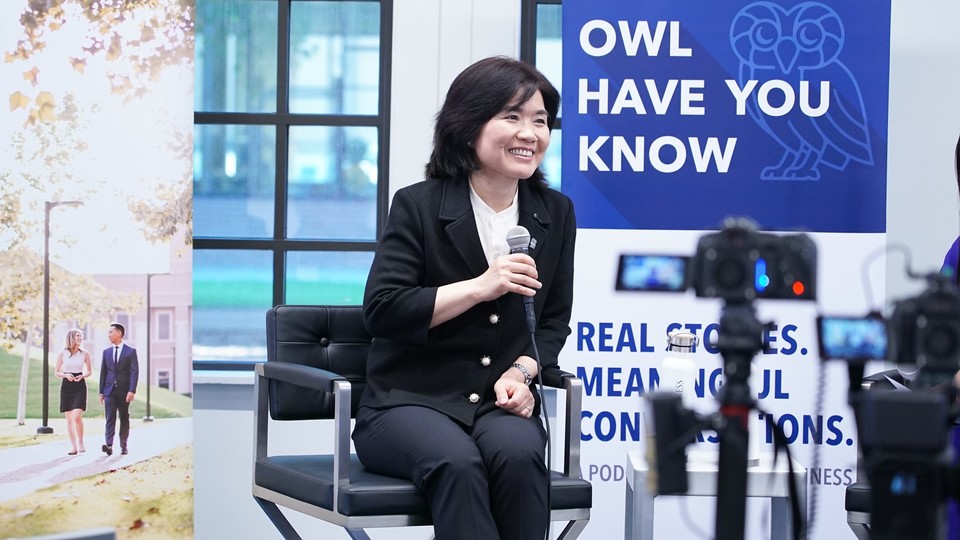
Professor Zhang shares what her research reveals about the leap from functional roles to the C-suite, why taking risks is non-negotiable for career advancement, and how Rice Business Executive Education’s Executive Leadership for Women program is giving women the tools and community to rise.

Associate Dean Bob Dittmar shares what sets the Virani Undergraduate School of Business apart and delves into his fascinating research on how to assess risk more clearly, especially when the signals aren’t obvious.