News & Events
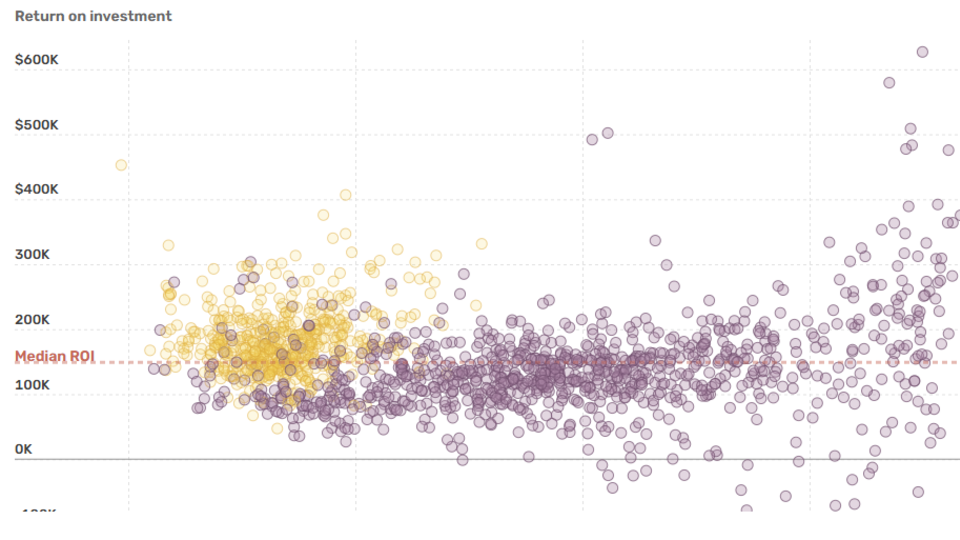
Rice University ranks first in Texas for 10-year return on investment, with alumni seeing roughly $334,000 in gains. Its strong earnings outcomes keep Rice at the top of both short and long-term ROI comparisons statewide.
-
In The Media
Rice Business professor Mijeong Kwon finds that viewing passion for work as a moral virtue can harm employees and teams, leading to guilt, burnout and biased treatment of colleagues who are seen as less passionate.
26 Nov
-
In The Media
Rice Business professor Mijeong Kwon argues that moralizing a love of work can undermine workplace well-being. Her research shows that treating intrinsic motivation as a virtue fuels guilt, burnout and biased judgments that disrupt team dynamics.
25 Nov
Filter
So how can you decide the value (financial and otherwise) for yourself? Utpal Dholakia, a professor of marketing at Rice University, has a simple suggestion. Ask yourself: If I didn't have this service today, would I buy it again? If no, toss it. If yes, keep it and enjoy.

There's always a lot of news about tech startup policy in Houston. Most recently, the Houston Technology Center (HTC) was reborn as a pure policy organization called Houston Exponential, with the backing of the Greater Housotn Partnership and local philanthropists. Rice University announced an innovation corridor from below the Texas Medical Center to above downtown, anchored by the Sears' buiding in Midtown. Station Houston, the city’s local entrepreneurship hub, became a nonprofit and did a real-estate deal with Rice.

Houston entrepreneur Mark Schmulen went to Silicon Valley for a three-month business startup program in 2009 and ended up staying, selling his social media marketing company to the digital marketing firm Constant Contact — an unlikely outcome had he stayed in Houston.
Fresh from attracting a $200 million investment, the Houston software company Onit proceeded to get it backward last month. Instead of pulling up stakes and heading west, or selling out to a California tech company, the startup stayed put and bought a Silicon Valley rival.
So how can you decide the value of convenience (financial and otherwise) for yourself? Utpal Dholakia, a professor of marketing at Rice University, has a simple suggestion. Ask yourself: If I didn't have this service today, would I buy it again? If no, toss it. If yes, keep it and enjoy.

Retailers using an omnichannel strategy believe this to be the magic bullet. Rice University’s Jesse H. Jones Graduate School of Business collaborated with a large U.S retail company with hundreds of stores, and studied 46,000 shoppers behavior over 14 months. Shoppers were asked about the channels they had used. The results? Only 7 percent were online shoppers, 20 percent were store only and 73 percent shopped omnichannel.

In one of the most stunning twists of the final season of Game of Thrones, teenage ninja zombie-killer Arya Stark achieved what no other warrior could: She took out the Night King. And as she ascended to her rightful place at the top of the Westeros hero hierarchy, the obvious question soon emerged.
Rice's Liu Idea Lab for Innovation and Entrepreneurship got a jump on molding its young minds. Lilie hosted 44 incoming freshmen as a part of its inaugural Lilie Change Maker Summit. For four days, the to-be students had the opportunity to get get a taste of the program and entrepreneurialism through workshops, guest speakers, and more. "We truly believe this will be a game changer in the Rice entrepreneurial ecosystem," says Caitlin Bolanos, associate director at Lilie, in an email to InnovationMap.

Rice University’s Jones Graduate School of Business has launched a leadership accelerator, a four-day program that teaches executives to become better leaders. “The value of leadership education is to prepare people for a set of responsibilities that they’re generally not prepared for, honestly,” said the course’s instructor, management professor and senior associate dean of executive education at Rice Business Brent Smith.

In the program, UFM students enroll in a 34-hour curriculum that includes 16 credit hours of foundation courses taught in Guatemala and 18 credit hours of coursework delivered by Tulane faculty in Guatemala and Panamá City. As part of the program curriculum, UFM students also participate in an on-campus business module in New Orleans. It is a program thoroughly corrupted by cheating, claims Fergus Hodgson, a New Zealand native who enrolled in the Tulane MFIN in 2017. Hodgson, who has since been admitted to the MBA program at Rice University’s Jones Graduate School of Business, tells Poets&Quants that he entered the Tulane-UFM doble titulación as a way to get a degree from a “credible” U.S. school for about half the price while studying in a country he knew well, where he could improve his self-taught Spanish and be among friends.