Investment banking can look intimidating from the outside. Recruitment is highly competitive and moves quickly, and candidates are expected to — build fluency in financial modeling, understand markets, prepare for interviews and decode a seemingly endless number of acronyms. But for many MBA students, that intensity is also part of what makes the field appealing: the work is demanding, analytical, and close to consequential business decisions.
For many aspiring bankers, an MBA can be the bridge between where you are today and where you want to go next.
But there is good news: You do not need to arrive at business school knowing everything about investment banking. You need curiosity, analytical discipline, a willingness to learn and a community that will help you put the pieces together.
Wall Street may be synonymous with investment banking, but it is hardly the only place where deals happen.
Houston, the energy capital of the world, offers a particularly relevant environment for aspiring investment bankers. The city is a global center for energy, infrastructure and industrial businesses, creating opportunities to understand complex transactions close to the companies and executives involved. For students with prior experience in energy, that industry knowledge is a real advantage. Familiarity with the energy sector helps candidates ramp up more quickly, speak more credibly in interviews, and better understand how banking teams evaluate companies and transactions.
The city is home to major corporations, financial institutions, entrepreneurs and investors, and that creates an especially interesting environment for students interested in investment banking. Alumni who stay in town see a better cost of living (by more than 20%) than residents in most other big cities, making Houston highly affordable.
Investment banks evaluate more than whether you have worked in banking before. They are looking for candidates who can demonstrate quantitative ability, strong communication, a clear reason for pursuing IB and evidence that they can perform in a demanding environment.
That is one reason a strong GMAT score can matter for students considering investment banking. Even in a test-optional admissions environment, some highly selective employers continue to ask about standardized test scores during recruiting, and a competitive score can provide another signal of analytical strength.
If investment banking is one of your goals, read more about why taking the GMAT may strengthen both your MBA application and your recruiting profile.
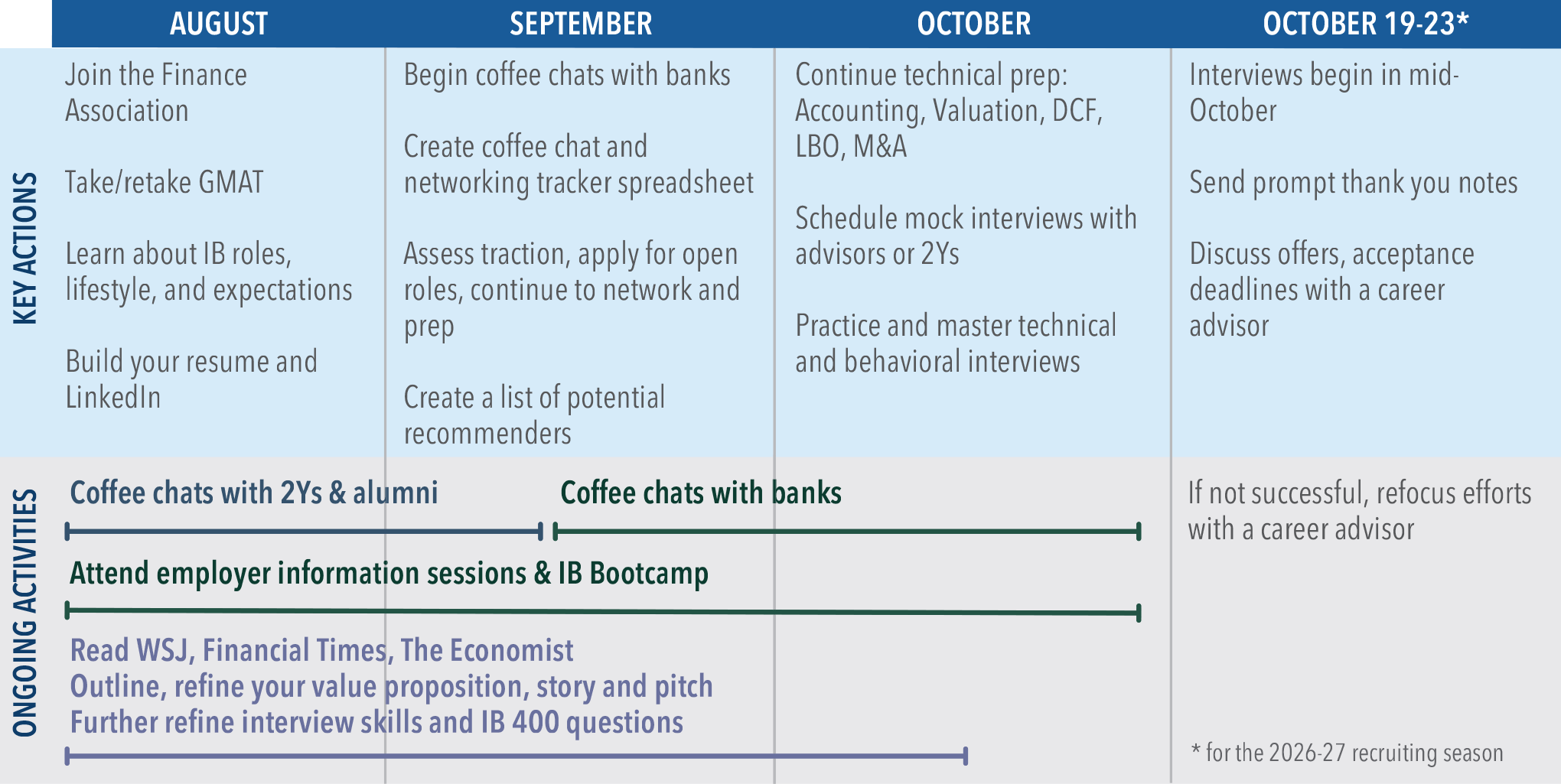
Be prepared to engage once the MBA program begins, because investment banking recruiting starts early and moves quickly during the fall semester.
3. Build a strong foundation in finance
A successful investment banking career starts with understanding the fundamentals: financial statements, valuation, corporate finance, capital markets, mergers and acquisitions, and financial modeling.
You don’t need to be a finance major to get started. In fact, one of the advantages of an MBA is the opportunity to build technical skills alongside classmates and professors who can help you connect the numbers to real business decisions. Candidates who come from industries such as energy often bring sector knowledge that becomes highly relevant when recruiting for employers aligned with their prior experience.
My experience at Rice was great, and now I’m an investment banker. The finance curriculum at Rice is just top tier.
Rice Business’ finance program is ranked No. 7 among MBA programs by The Princeton Review, and we’ve been in the Top10 for almost a decade. Our students learn from faculty whose research regularly appears in leading academic journals and spans corporate finance, investments, financial markets and mathematical finance.
Investment banking recruiting is highly relationship-driven.
During your MBA, connect with alumni, attend finance events, participate in student organizations and learn how different banks — and different coverage groups — actually operate. At Rice Business, the Finance Association, Career Development Office and alumni network give MBA students multiple avenues to build those relationships.
Whether it’s by attending events and conferences on campus or reaching out to our highly engaged alumni on your own, there are many avenues for Rice MBA students to expand their network of finance professionals, both in Houston and across the country.
One of the most valuable aspects of an MBA is the community you gain. From career advisors, to alumni in top roles, to business leaders that recruit at Rice Business, there are many resources for students to take advantage of during their two-year program.
Make the most of your time by utilizing every resource available, such as:
Career Development Office one-on-one coaching with a career advisor
Finance Association recruiting prep, coaching, networking, workshops and peer support
Week on Wall Street Trek
Employer and alumni networking events
Technical and behavioral Interview preparation
The Finance Association is a particularly important resource for students pursuing investment banking. The student club hosts the Financial Services & IB 101 Bootcamp, with hands-on workshops, guest speakers, technical prep, peer feedback and real-world insights into deals.
As a Rice MBA, I joined the Rice Business Finance Association, and that was critical for me to get a job in investment banking. The club president actually convinced me to join after hearing about my interests and qualifications, and I eventually pursued a role through investment banking recruitment.
A strong MBA community should give you people to call when you have a recruiting question: a professor who will challenge your thinking, an alum who remembers exactly what recruiting felt like and classmates who want to see you succeed. At Rice Business, 72% of students in the Class of 2025 accepted jobs through the Rice Business community, and finance remains one of the school’s strongest career pathways.
5. Turn your MBA into an investment banking launchpad
For students pursuing investment banking, recruiting begins early in the MBA experience. For many MBA candidates, the summer associate internship is the primary pathway into a post-MBA career in investment banking. A successful internship can lead to a full-time associate offer, while the MBA experience continues to build the technical, leadership and sector expertise that supports longer-term success.
Manage analysts, review models, run workstreams, more client interaction
3-6 years
Vice President (VP)
Manage deals, teams and client relationships; increasingly involved in winning business
6-10 years
Director/Executive Director
Senior client relationships, business development, deal leadership
10-15 years
Managine Director (MD)
Win clients, originate deals, lead relationships and generate revenue
12-15+ years
Standard role progression of a career in investment banking.
Reach your long-term goals
At its best, investment banking is not just about spreadsheets, valuation multiples or long hours. It is about helping companies make consequential decisions: raising capital, acquiring another business, navigating a strategic transition or figuring out what comes next.
The right MBA program can help you build the financial skills, recruiting readiness, relationships and confidence to turn that curiosity into an investment banking career. You do not need to arrive as an investment banking expert, but you should be ready to learn quickly, use the resources around you and engage early once recruiting begins. You may discover along the way that you’re more ready than you thought.
Curious how Full-Time MBA recruitment works? Explore how top programs like Rice deliver high-ROI outcomes through career bootcamps, coffee chats and industry network access.
Are MBAs good for changing careers? Learn what to look for in an MBA program, including comparing program ROI for career changers pivoting to new industries.