
7 Questions Our Faculty Are Asking About AI
Rice Business faculty are exploring big questions about AI and how it’s reshaping business, technology and the classroom.
This story is part of our special anniversary issue of Rice Business Wisdom on artificial intelligence.
As AI becomes increasingly integrated into markets, classrooms and workplaces, Rice Business faculty have many questions. Here are just seven of them.

Does Using AI Change How Colleagues See You?
That’s the question driving Mijeong Kwon’s newest research. When a coworker uses AI for a piece of work, does your opinion of them quietly shift? Do you assume less effort went in, or that they care less about the job than you thought? AI runs through Kwon’s own methods: She uses it to code open-ended participant responses, and she builds it into experiments themselves, designing AI interviewers and confederates that participants interact with directly. In her classroom, students use AI openly and examine what changes when they do. The stakes reach anyone who has finished a draft with ChatGPT and paused before hitting “send.” There’s a real question of whether the tools you use shape what others assume about your effort.
Mijeong Kwon, Ph.D.
Assistant Professor of Management – Organizational Behavior

Why Do AI-Fluent Outsiders Keep Beating Legacy Brands?
Over the past few years, a new entertainment category emerged in China: dramas told in one-minute vertical episodes. By 2024, 36,400 titles were outgrossing the country’s traditional box office. The pioneers were internet-native startups from online literature and mobile gaming, companies built on AI-driven data fluency and operational speed. Their first viewers were newly online audiences in smaller cities, long overlooked by prestige studios. In Harvard Business Review, Haiyang Li and his co-authors find a pattern business leaders will recognize: When underserved audiences meet new devices and channels, whole categories appear, and the companies that capture them are usually the ones that know what to do with data.
Haiyang Li, Ph.D.
H. Joe Nelson III Professor of Management – Strategic Management

Is the Finance Classroom Keeping Up With AI?
In Kerry Back’s MBA course, students run financial analysis by chatting with an AI model. They tell it to pull data, sort stocks or run regressions, and the model writes and executes the code — no programming background required. Now Back has made that workflow available to anyone. His new app, Academic Studio, bundles Anthropic’s Claude Code into a simplified, one-click-install workspace where students can analyze data, build slides and create documents, with no intimidating setup. It mirrors what’s happening inside firms, where routine analyses are being automated. “In some ways, the classroom is actually ahead of the curve.”
Kerry Back, Ph.D.
J. Howard Creekmore Professor of Finance and Professor of Economics

Is AI the New “Fad That Forgets People”?
In the 1980s and 1990s, companies poured billions into business process re- engineering and rarely achieved the promised efficiency gains. One of the movement’s own champions later explained why: It was “the fad that forgot people.” Headcount reductions, a natural outcome of re-engineering efforts, damaged the morale and engagement of remaining employees, offsetting the efficiency gains from redesigned work. Brent Smith, who advises companies like Phillips 66, MD Anderson Cancer Center and Hess Corporation (now Chevron) on change management, sees echoes of that pattern in AI. Many organizations are training employees on tools and hoping productivity follows — while downsizing based on hypothetical gains erodes engagement. For Smith, AI adoption is less a technology rollout challenge than a change management challenge.
Brent Smith, Ph.D.
Senior Associate Dean for Executive Education and Associate Professor of Management and Psychology

If AI Builds the App, Who’s the Designer?
AI can now build entire apps from a single prompt. But knowing whether the result works for users still depends on human judgment. That’s the challenge at the center of Emily Prinsloo’s New Product Development and Management course, where students use tools like Cursor and Vercel to create real apps for a client partner, then learn how to evaluate what the AI produces. During the spring 2026 course, visiting designer Pat Capulong gave Prinsloo’s students a simple test for visual hierarchy: squint at the screen. If nothing grabs your attention, or if everything does, the design isn’t working. Every screen needs a clear visual hierarchy. “AI will help you build faster,” Prinsloo says, “but you still have to be the designer.”
Emily Prinsloo, Ph.D.
Assistant Professor of Marketing
Can Strategy Survive Gen AI?
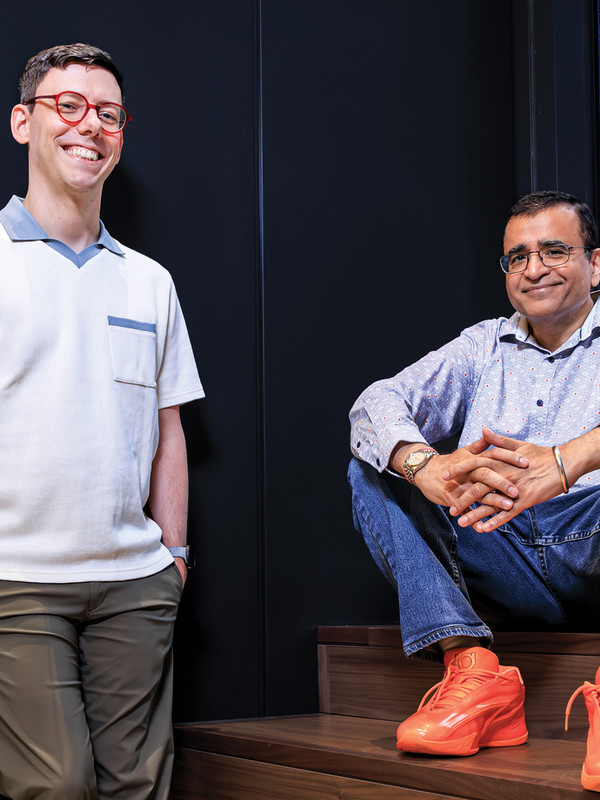
When Vikas Mittal, Alessandro Piazza and their co-authors interviewed 20 CEOs and strategy officers across 11 companies, every single one was already using AI for core strategy tasks — and 90% believed major parts of the chief strategy officer’s (CSO) role would soon be replaced by it. The deeper problem: In an analysis of 717 published correlations, legacy strategy planning showed zero or negative correlation with financial outcomes 79% of the time.
Gen AI excels at gathering and summarizing, but it can’t tell a CEO which one initiative of the dozens being implemented actually lifts customer value. Mittal and Piazza argue that strategists should let AI absorb that synthesis work and rebuild their role around statistical models linking strategy to customer outcomes. At one manufacturer, just 12 of 87 value drivers produced over 90% of the lift in customer value; focusing on three of them pushed sales 22% above industry peers. In other words, strategy excels — when it becomes a science.
Alessandro Piazza, Ph.D.
Associate Professor of Strategic Management
Vikas Mittal, Ph.D.
J. Hugh Liedtke Professor of Marketing
Can AI Lower the Price of Privacy?
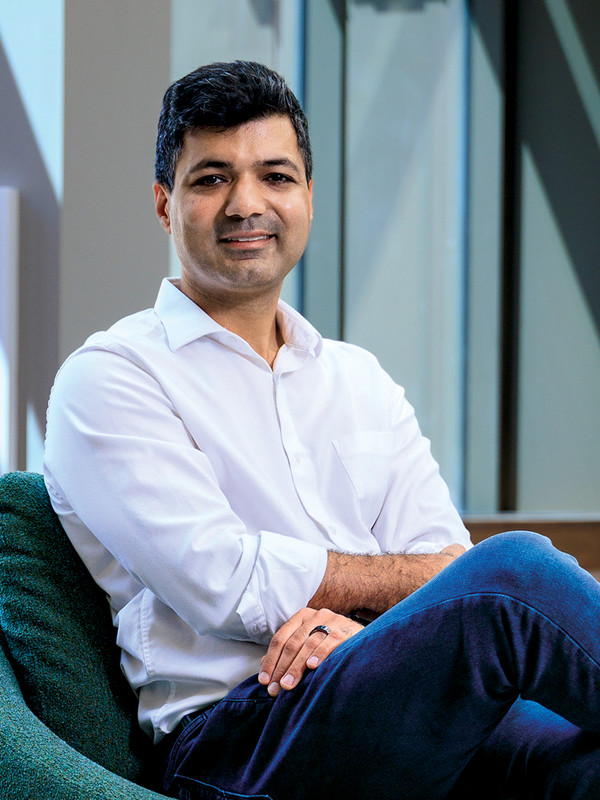
Privacy and antidiscrimination requirements can force firms to balance two goals: protecting sensitive customer attributes (e.g., race) and preserving the accuracy of predictive pricing, targeting and recommendation systems. Piyush Anand’s research suggests that AI can narrow this trade-off in two ways. First, firms can share a trained generative model rather than raw customer records, allowing others to analyze patterns without direct access to the underlying data. Second, when protected attributes such as race are involved, simply deleting those fields is not enough. Pattern-seeking AI systems can still infer those attributes via information like ZIP code, income and purchasing behavior. Adversarial AI trains one model to predict customer behavior and a second to guess protected-group identity from the first model’s output, penalizing the first whenever the second succeeds. What survives is predictive signal that carries less identifying information.
Piyush Anand, Ph.D.
Assistant Professor of Marketing