Image
Many companies treat safety training as a compliance requirement. But new research shows that making safety a strategic priority can actually create value for employees, customers and shareholders.
Based on research by Vikas Mittal (Rice Business), Alessandro Piazza (Rice Business), Yixing Chen (Notre Dame), Shrihari Sridhar (Texas A& M), Kyuhong Han (Korea University), Sonam Singh (University of South Florida) and Taehoon Im (Cal State – Northridge)
Key takeaways:
Far too often, employees might find themselves slogging through trainings, annoyed the course content relates little to the tasks they do at work. Executives spend on safety training hoping it will ultimately mitigate safety hazards and win regulatory favors. But the reality is that, safety done right accomplishes much more, according to recent papers co-authored by Rice Business Professors Vikas Mittal and Alessandro Piazza in the Journal of Marketing Research and Harvard Business Review.
Companies that invest in safety training as a strategic priority can see real improvements in mitigating safety hazards and preventing workplace injuries, impacting customers’ buying decisions, increasing shareholder returns and improving customer satisfaction. “When companies invest in safety strategically, they often see a lift in sales, in profits and in stock price,” Mittal says. “Safety is a strategic asset that drives financial performance.”
Mittal, Piazza and their research colleagues began by looking at the value of safety training for business-to-business firms in a series of three studies.
The first two tested whether safety training actually reduces risk. In one, they analyzed monthly data from an oil field services company on the following: number of safety trainings, number of accidents and number of safety hazards. They found that for an average work site, as monthly safety training hours per capita increased by 10%, each site had 17.8 to 26.4 fewer safety hazards per person.
The second studied a change in law in New York City. Approved by Mayor Bill de Blasio in October 2017, Local Law 196 requires construction workers across the city’s five boroughs to complete 40 hours of Site Safety Training and earn an SST card. Their supervisors had to complete 62 hours.
After the law was enacted, injury rates decreased by 15.56% to 18.84% at construction establishments across New York City, relative to counterparts, a 42% return on safety-training investments. Together, the studies suggest that meaningful investments in safety training can effectively help firms mitigate risk, Mittal says.
The third study asked whether or not safety training can win customers.
Mittal, Piazza and colleagues recruited 312 managers or higher-up roles in B2B companies in the U.S. Participants were asked to imagine they were the director of procurement services of a global energy company leading a team of specialists tasked with shortlisting the most qualified hypothetical vendors for a system that improves the flow of fluid from wells.
They evaluated the qualified vendors using four criteria: product quality, after-sales support, safety, and price. A vendor’s emphasis on safety training measurably increased the odds that buyers would seriously consider their proposal. Safety training carried nearly as much weight in purchase decisions as price and after-sales support, accounting for roughly a fifth of what drove buyers’ choices, right alongside quality (the top factor), price, and service.
The takeaway? Safety training isn’t just about avoiding accidents, it’s something that customers notice and value when they’re picking a vendor, and it wins business in its own right. “Typically, companies will keep adding safety trainings because they don’t know which add to safety or not,” Piazza says. “That’s why the majority of trainings are ineffective. But you can statistically identify trainings that lead to better safety. It’s something that customers actually notice and reward. Get it right, and it becomes a reason they choose you.”
In Harvard Business Review, Mittal and Piazza co-authored a practical playbook for leveraging safety as a strategic priority. Companies that get this right follow five key steps:
Two examples show what this looks like in practice. Consider the Harris County Sheriff’s Office, which runs one of the largest jail systems in Texas. By recognizing inmates as their customers, and treating their safety as a central strategic priority, leadership redesigned how it ran its operation. Treating it as their central priority, guards began checking every cell every 30 minutes to catch early warning signs of distress or aggression, using technology to make sure inmates with serious conditions like diabetes got their medication on time, and scanning incoming mail digitally to stop drugs from being smuggled in on paper.
On-time cell checks now top 99%, inmate deaths are down 30% and staff use-of-force incidents have dropped 23%. A safer, calmer jail also meant less staff turnover, down 24% over three years.
You can statistically identify trainings that lead to better safety. It’s something that customers actually notice and reward. Get it right, and it becomes a reason they choose you.
Meanwhile, a nursing home chain in Pennsylvania got specific about what safety meant for them: fewer falls and fewer bedsores among residents. When the chain moved training online, focused it specifically on spotting early-stage bedsores, and paid employees $70 to complete it, with a bonus of up to $200 for whichever shift caught the most cases, training completion jumped to 96%, and the bedsore rate among residents dropped from 23% to 9%, a 60% improvement.
Both cases point to the same lesson: paying lip service to safety through generic training or safety minutes doesn’t work. It only pays off when it statistically identifies and targets one specific, measurable behavior, is easy for employees to actually complete, and comes with a clear reward, not when it’s just a box to check.
“This doesn’t mean more investment,” Mittal says. “It means stopping useless, feel-good activities that produce no real results. It really should be the CEO who helps turn safety into a strategy driver rather than a feel-good activity. Doing so can meaningfully add to your bottom line.”
For CEOs, the research makes the case that safety training is worth talking about publicly, not just as a regulatory requirement, but as something that genuinely matters to customers. Sempra Energy’s CEO Jeffrey Martin, for example, described safety in a letter to shareholders as a foundational value at the company, one that shapes how it serves customers and communities.
Written by Deborah Lynn Blumberg
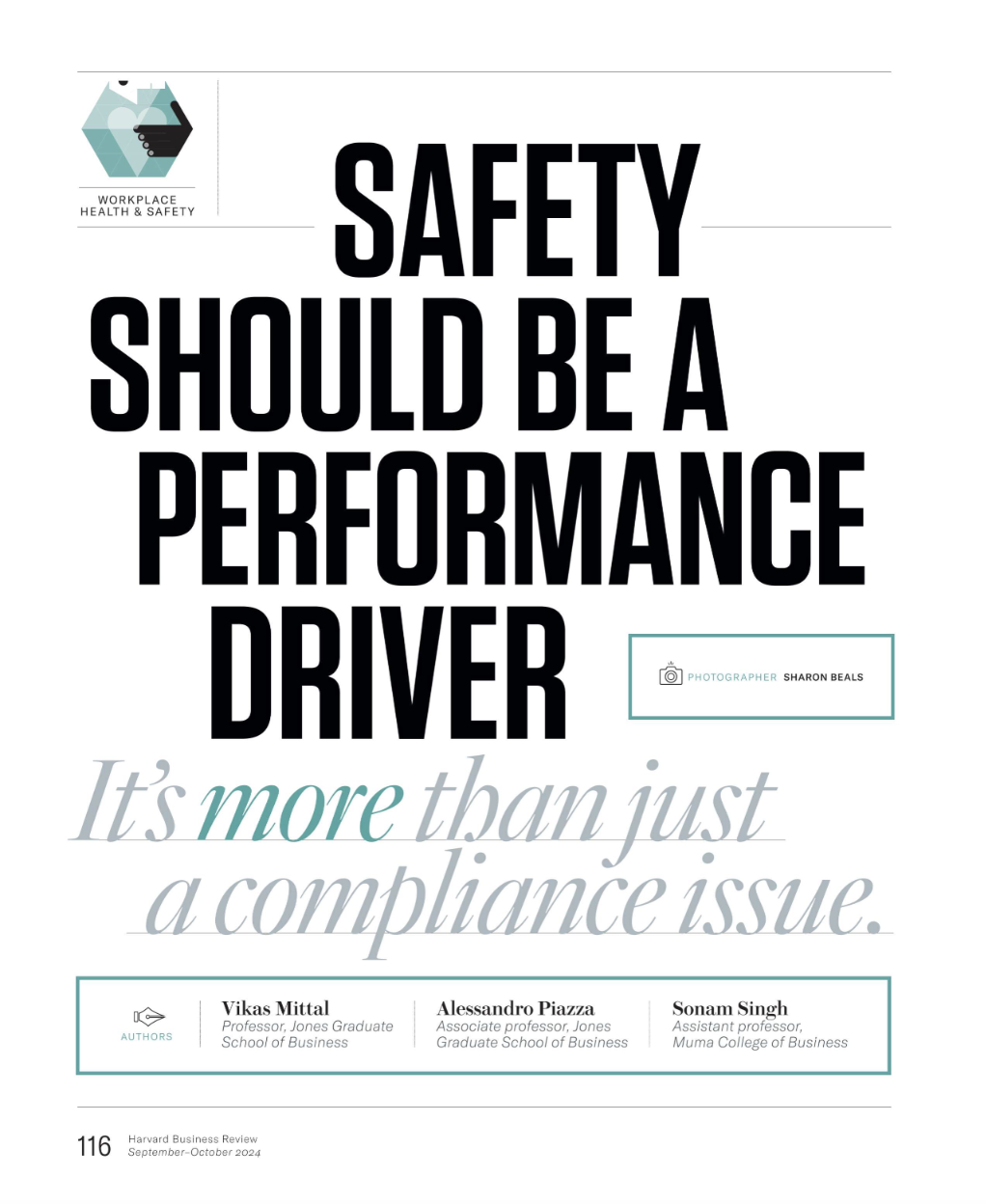
“Safety Should be a Performance Driver,” Harvard Business Review (September-October 2024).
“The Value of Safety Training for Business-to-Business Firms,” Journal of Marketing Research (2024).





U.S. consumers and businesses are now facing a future of more expensive borrowing.