Image
As corporate value has become more intangible, leaders have less control over how their organizations are perceived. Anastasiya Zavyalova explains what that means for reputation strategy.
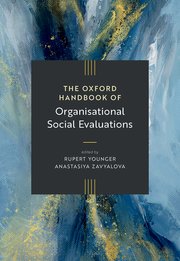
The new Oxford Handbook of Organisational Social Evaluations, co-edited by Anastasiya Zavyalova, brings together two decades of fast-growing research, along with practitioner insight, into one place for leaders trying to understand and manage how their organizations are perceived.
In this Q&A, Professor Zavyalova discusses why reputation has become a core strategic concern and how social media, polarization and AI are changing the way people judge companies.
Those days are over. With the rise of social media, AI and online polarization, the traditional levers of reputation management have fragmented. Organizations are expected to manage relationships with shareholders, customers, employees, suppliers, the media, regulators and the public more quickly and directly than ever. At the same time, intangible assets like patents, trademarks, copyrights, branding, software, proprietary data, customer relationships, trade secrets and goodwill have risen in value, now accounting for over 90% of the market value of S&P 500 companies, up from 17% in 1975.
Rice Business professor Anastasiya Zavyalova studies how these forces are shaping “organizational social evaluations” — the collective judgments that audiences form about a company — into a core strategic concern. She recently co-edited the new Oxford Handbook of Organisational Social Evaluations, a 700-plus-page volume that brings together cross-disciplinary research and practitioner experience and provides critical insight for business managers and executives.
The project came out of conversations at the University of Oxford’s Centre for Corporate Reputation, where I’m an International Fellow. It brings together scholars from different disciplines, but the Center also invites practitioners. We meet once a year for a reputation symposium.
At one of those meetings, we were talking about research on what we now call social evaluations of organizations. Really, what that means is: How do people form judgments about companies and organizations? How do companies build relationships with stakeholders? How do they manage the way stakeholders think about them, especially in the age of social media and AI?
In the 1970s, top companies’ market value came from tangible assets: factories, equipment, machinery — everything you physically owned. But in the past 25 years or so, company valuation has become increasingly intangible, including just the public’s belief in the company’s future earnings. What do investors think? What do shareholders believe they will get out of this company? Can you deliver on the promise? A big part of that is reputation, or what people believe about your organization and your leadership.
You can see it in acquisitions, because that is one of the rare moments when someone actually puts a dollar amount on what they believe a company is worth. When Facebook bought WhatsApp for $19 billion, for example, most of the purchase price was goodwill. It wasn’t the servers or the physical things they owned. It was, essentially, belief that the company would provide value in the future. From a practitioner perspective, that is why this area is important. Do stakeholders trust your company to deliver value?
We realized that this research has just skyrocketed. The research has proliferated over the last two decades, but there was not one go-to source. The ambition of the book was to put scholarly and practitioner minds together in one place.
Years ago, companies had more breathing room. In the 1980s, when an oil spill happened, company leadership had time to figure out a communications strategy and what they were going to say. Now, if a major oil spill happens, the news can spread all over the world in a matter of seconds. As a leader, you have to be ready to deliver your message.
Companies that want to be prepared have strategies in place for different scenarios. Some have what they call war rooms. They practice: If this happens, what is the message? For a large company, inevitably something will happen, so you need to be ready.
But this is where the fundamentals still matter. If you actually do what you do well, you can withstand a crisis that is brewing on social media. Your underlying business should be strong. And you have to be consistent, both across stakeholders and over time. You cannot communicate one thing to employees and something else to the public because the internal message can also become public. If you are consistent, you can build a strong reputation, and that becomes a safety net when a crisis hits.
I think social media and now AI have contributed to two countervailing forces. On one hand, news cycles have sped up so much that when something new happens, we often forget what happened only a week or so ago. Very few stories keep going in the media for long.
On the other hand, digital technology has preserved an archive of everything companies have said or done. When a company does something today, it’s easy to go back and hold it accountable for actions in the past. Even if you erase something from your website, someone may have taken a screenshot. The digital history of each company is now preserved forever.
That makes social evaluations more challenging to manage, because you can be held accountable for past deeds even as information about a new crisis is spreading almost instantly.
Some companies do that, but I think that strategy will backfire, and quite quickly, especially in the era of social media. It’s more and more costly to be inauthentic. Employees will sense it right away. They are often the first stakeholders who know that what you are saying diverges completely from what you are actually doing.
Eventually, that gap can backfire publicly. Employees can leak information confidentially or anonymously. Then investors may start asking: Is turnover going to increase? Are the most valuable employees going to competitors? It all trickles down. Enron was a great example of this.
If you are consistent, you can build a strong reputation, and that becomes a safety net when a crisis hits.
In some of the research, we refer to this as the reputation-identity gap. Identity is who you truly are. Reputation is what others believe you are. The larger the gap, the more troubling it is, the more like a house of cards your company becomes. If the goal is sustainable competitive advantage, you want your words to match your actions.
One way to close that gap is to make fewer rosy public declarations. Another, and I think the one many leaders aspire to, is to make the internal workings of the company as good as what they publicly declare them to be. That is more sustainable.
You can see evidence of how much more polarized the United States has become in polling on where Democrats and Republicans stand on different issues. If you look back to the 1990s, the means of those distributions were much closer together. Now they are much farther apart. On many issues, the two sides have become much more divided.
I think there are two views on this question, and there is no right or wrong answer. Ultimately, each CEO or manager decides what feels right.
One view is: These are my values. I am going to stand by them. If I lose customers or investors, so be it. Patagonia is a good example. Chick-fil-A is another. You know an issue will be polarizing, but you are willing to have a smaller group of loyal followers.
The other view is: I am not going to take stances. I am going to make a product and run a good company. In recent years, I have had students say, why would I care what the company thinks about every social issue? I want a paycheck, a good salary, a stable work environment and decent co-workers.
I think some leaders are being prudent and deciding not to take stances regardless of their personal beliefs. But it is a conundrum. On one hand, you want to please more polarized stakeholders. On the other hand, you want as many customers and investors as possible. That is the landscape companies are in.
I think everyone is still figuring this out. If we stay in the realm of social perceptions about companies, what AI has enabled is the production of content, lots of information about companies. What matters is that some of that information could be fake, and it can be produced very quickly.
People attend to emotional messages about companies and organizations they care about. So fake emotional content can spread very quickly online. You can be damaged for things you have not done. AI has also enabled deepfakes, where a company leader can appear to say something they never said. From a reputation management perspective, that fake information can have true, tangible consequences.
And it is not difficult to imagine how it spreads. You can tweak the emotionality, insert an issue you already know is polarizing and make it sound plausible. Just plausible enough.
Like any technology, there are pros and cons, and it can be used by bad actors. But in another forthcoming article, my co-authors and I argue that AI can be a very useful technology, but it has to co-evolve with human input. If we step in now and have a strong hand in how the technology is used, I think it could have more benefits than costs to society. But that is a big if.
Interview by Scott Pett
Rupert Younger and Anastasiya Zavyalova, The Oxford Handbook of Organisational Social Evaluations (2026).
“Keeping Up With the Times? Rethinking Social Evaluations Research Under Contemporary Technological and Sociopolitical Forces,” Journal of Management Studies (2026).