Our Business
Office Space
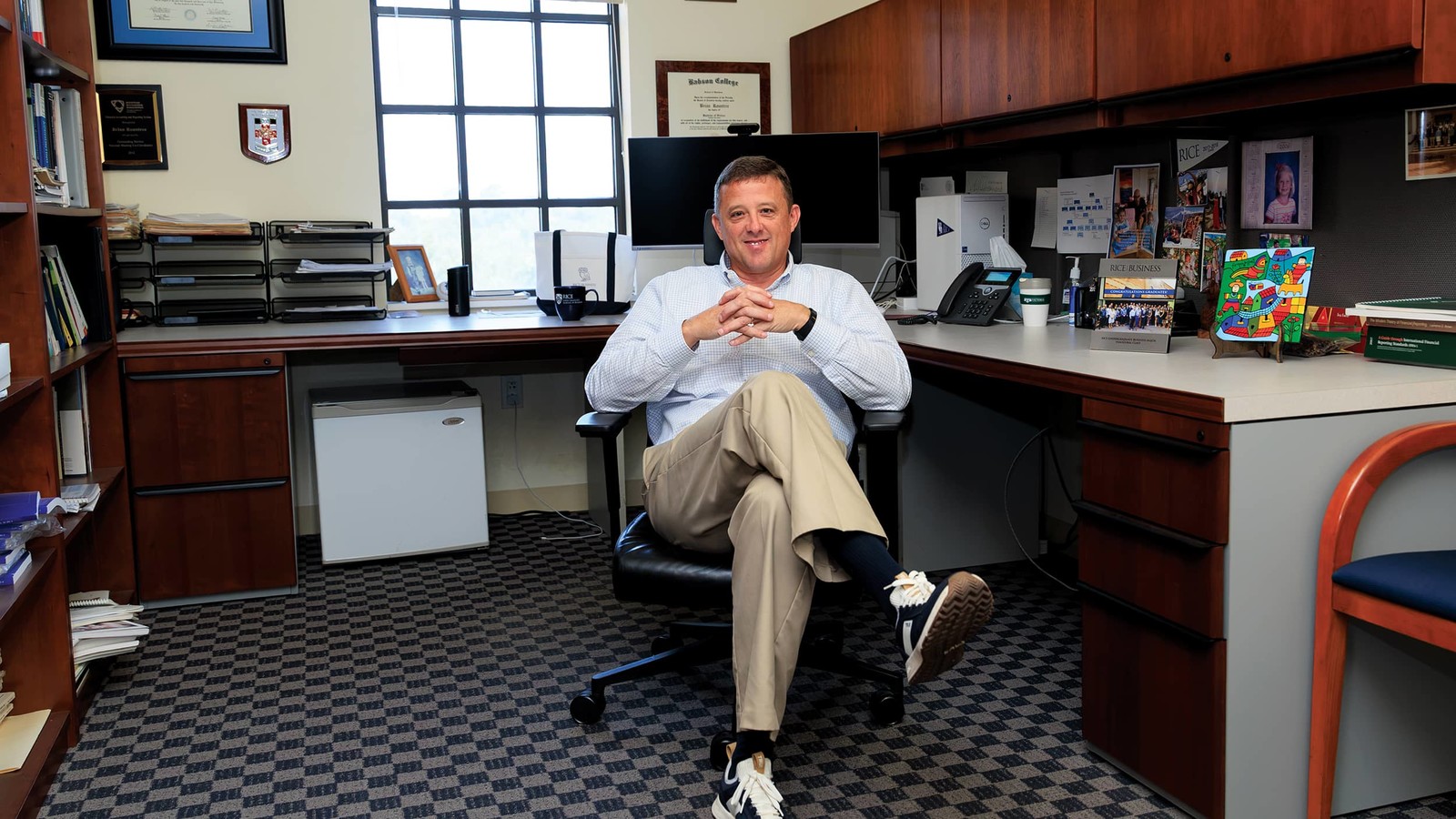
Brian Rountree still has the leather audit bag he carried at Price Waterhouse in the late 1990s, with the classic brass buckle and push lock. It sits high on an office shelf as a symbol of everything that came afterward: a Ph.D., 23 years of teaching and research excellence, including a recent promotion to full professor, and now a new role in the dean’s suite helping to shape the school’s future.
“I was at Price Waterhouse from 1996 to 1998,” he says. “It was a great learning experience. It just wasn’t something that I wanted to do forever. And so then as a result, I had to figure out — what is it that I wanted to do? I thought about maybe law school. And then my wife said, ‘You loved college. Have you ever thought about teaching?’”
Rountree was, indeed, an exceptional student, graduating from Babson College as Class of 1996 valedictorian and a star pitcher on the baseball team. (To this day, he has the third- lowest career ERA in Babson baseball history.) He took the idea of teaching seriously, going on to earn his Ph.D. in accounting at the University of North Carolina at Chapel Hill. When he went on the academic job market, Rice stood out among his opportunity set. “Rice has always had this idea of a growth mindset,” he says. “It’s constantly striving to be better.”
Another thing that drew him to Rice was its unusually deep accounting history. For a while, it was the only university with four active or former faculty recognized in the American Accounting Association’s Hall of Fame (Stephen Zeff, 2002; Edgar Edwards, 2003; Philip Bell, 2003; Robert Sterling, 2006). Some of that tradition literally ended up in Rountree’s office. When Bob Sterling, Rice Business’ first dean, went to teach at another university, he left his collection of The Accounting Review, one of the field’s premier journals, with issues dating to 1926. Rountree recalls librarian Peggy Shaw asking whether anyone wanted them. “I responded to her immediately, and now I’ve got his collection,” Rountree says, nodding toward the bound volumes that now occupy a couple of his shelves.
Rountree’s office reflects more than two decades spent watching Rice Business evolve. And now, from his new role as senior associate dean for degree programs, he will play a hand in shaping the school’s next stage of growth. He’s been tasked with tackling two of the biggest challenges facing all top business schools since the end of COVID-19: program flexibility and AI integration.
Rountree has only been in the job for a couple of months, so he admits there’s lots to learn. That may mean spending less time in the office that has accumulated 23 years of personal and school history, and more time in the dean’s suite helping decide what comes next. “The funny thing is,” he says, “the longer you stay somewhere, the less interested you become in keeping it exactly the way it was.”
You May Also Like
Rice Business Wisdom
Research from professors Vikas Mittal and Alessandro Piazza finds that generative AI now performs much of the traditional work of chief strategy officers (CSOs). Their argument: producing a strategy summary is only part of the job. Executives still need evidence of which initiatives improve customer value.